Whether you’re traveling in Japan, learning Japanese, or working with Japanese documents, the right translation app can save you a lot of time. But not every app can accurately understand context, work offline, or handle natural conversations smoothly.
Today, many Japanese translator apps use AI to support text, image, and voice translation. Some are ideal for travel, while others are better suited for document translation, kanji learning, or multilingual meetings.
In this article, we’ll introduce the top 5 Japanese translator apps worth trying in 2026, covering a range of needs—from travel and language learning to document translation and everyday communication.
📌 Key Takeaways:
Selecting the best Japanese translator app in 2026 depends on your primary use case. DeepL leads in accuracy and formatting preservation for business documents, work emails, and long-form text. Google Translate offers the most versatile, completely free solution with offline camera scanning and voice mode for travel. Naver Papago excels at handling natural short daily conversations and Asian honorific nuances. For Japanese language learners, Yomiwa is unmatched for camera-based Kanji lookup and stroke order, while Maestra AI provides specialized real-time subtitles and live translation for meetings and video content. For legal, technical, or high-stakes business documents, AI apps should be supplemented with human professional review.
1. Criteria for Choosing the Best Japanese Translator App
1.1. Japanese-to-English Translation Accuracy
A good app should be able to handle context, tone, honorifics, and natural sentence structure. This is especially important when translating emails, documents, study materials, or work-related content.
1.2. Offline Translation Support
When traveling in Japan, you may not always have a stable internet connection. Apps with offline support can be especially helpful for reading menus, checking signs, or translating quickly while you’re on the go.
1.3. Camera and Voice Translation Features
To choose the right Japanese translator app, consider four key factors: translation accuracy, offline support, camera and voice translation features, and your actual use case.
Camera translation lets you scan menus, signs, and product packaging. Voice translation, on the other hand, is useful when you need to communicate directly with native speakers.
📌 Below are the top 5 Japanese translator apps in 2026, selected for their accuracy, offline support, camera translation features, and real-world usability across travel, study, and work situations.
2. Top 5 Best Japanese Translator Apps in 2026
2.1. DeepL – Best for Natural Japanese Translation
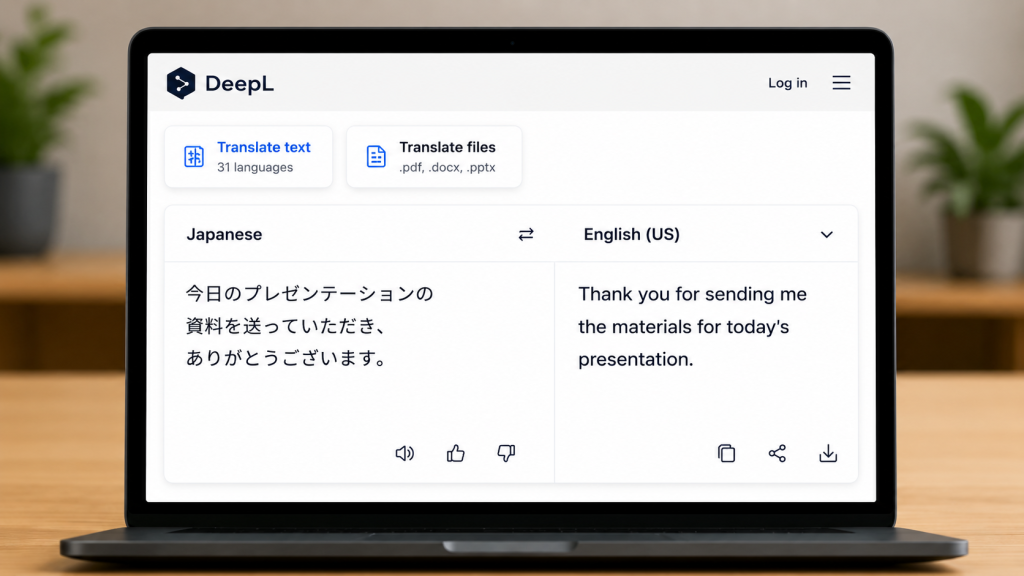
DeepL is widely considered one of the most natural AI translation tools for Japanese-to-English translation, especially when handling long-form text or professional content.
Compared to many general translation apps, DeepL often produces smoother, more natural translations with less of a “machine-translated” feel. It’s a strong choice for users who need to translate emails, documents, or Japanese business content.
What Stands Out
- High Japanese-to-English translation accuracy
- Supports PDF, DOCX, and PPT document translation
- Preserves the original file layout after translation
- Works especially well for business content and long-form text
Best Use Cases
- Translating work emails
- Translating Japanese documents
- Reading articles or contracts
- Handling business-related content
Strength
DeepL is an excellent choice if you need more natural, accurate Japanese translations for professional content or longer documents.
Limitation
DeepL is not especially strong for voice or camera translation, and it currently does not support offline use.
2.2. Google Translate – Most Popular Free Japanese Translator App
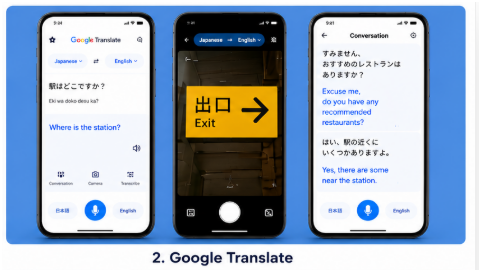
Google Translate remains one of the most widely used translation apps today, thanks to its free access, simple interface, and wide range of useful features for travel and everyday communication.
It’s a great option for anyone looking for an all-in-one app that can quickly translate text, images, and voice conversations.
What Stands Out
- Real-time camera translation support
- Includes voice translation and conversation mode
- Allows users to download language packs for basic offline translation
- Supports a wide range of languages
Best Use Cases
- Traveling in Japan
- Translating menus and signs
- Basic communication with Japanese speakers
- Quick everyday translations
Strength
Google Translate is a well-rounded choice for users who need a free, versatile, and easy-to-use Japanese translator app for a variety of situations.
Limitation
Some translations can still sound unnatural, especially when handling honorifics or more complex sentence structures.
2.3. Papago – Great for Short Japanese Conversations
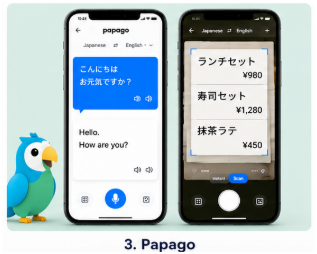
Papago is one of the strongest translation apps for Asian languages, especially Japanese and Korean. Compared to many general-purpose translators, Papago often handles short conversations and everyday expressions more naturally.
This app is especially useful for daily communication, asking for directions, ordering food, or translating short conversations while traveling in Japan.
What Stands Out
- Delivers more natural Japanese-to-English translations for everyday conversations
- Supports both voice and image translation
- Optimized specifically for Asian languages
- Simple, user-friendly interface
Best Use Cases
- Basic communication while traveling in Japan
- Translating short daily conversations
- Translating menus, signs, or images
- Practicing conversational Japanese
Strength
Papago is an excellent choice if you want more natural-sounding Japanese conversation translations than many general translation apps provide.
Limitation
Its language coverage is still more limited compared to larger platforms like Google Translate.
2.4. Yomiwa – Best for Learning Kanji and Japanese Translation
Yomiwa is a great app for Japanese learners, especially those who struggle with kanji.
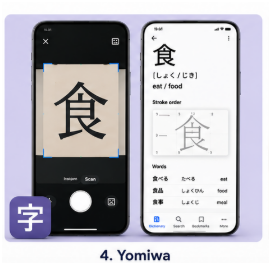
Unlike standard translation apps, Yomiwa focuses more on reading comprehension, vocabulary lookup, and kanji learning through features like camera scanning and handwriting recognition.
What Stands Out
- Scans kanji using the camera
- Supports handwriting recognition
- Includes a dictionary and stroke order guide
- Helps with Japanese vocabulary learning and reading comprehension
Best Use Cases
- Learning kanji
- Looking up Japanese vocabulary
- Reading manga or Japanese documents
- Practicing reading comprehension as a beginner
Strength
Yomiwa is a great choice if you want to combine Japanese translation with kanji learning as part of your study routine.
Limitation
Yomiwa is not optimized for fast conversation translation or real-time communication.
2.5. Maestra AI – Best for Live Captions and Video Translation
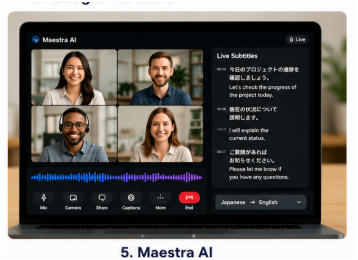
Maestra AI is not a typical travel translation app. Instead, it’s designed for professional live translation needs, such as meetings, webinars, and video content.
The app stands out for its AI subtitle generation, live captioning features, and real-time multilingual translation support.
What Stands Out
- Real-time live translation support
- Automatically generates AI subtitles
- Supports AI dubbing for videos
- Ideal for multilingual meetings and online events
Best Use Cases
- International meetings
- Webinars and livestreams
- Creating video subtitles
- Translating media content
Strength
Maestra AI is a powerful option for users who need real-time Japanese translation in professional environments or for multilingual video content.
Limitation
The app requires a stable internet connection and is not designed for typical offline travel use.
Quick Comparison of the Top 5 Japanese Translator Apps
✅ Supported
❌ Not Supported
⚠️ Limited support or depends on specific features/languages
3. How to Choose the Right Japanese Translator App for Your Needs
No Japanese translator app is perfect for every situation. Each app has its own strengths depending on what you need—whether you’re traveling, learning Japanese, translating documents, or joining online meetings.
Instead of looking for one “best” app, it’s better to choose the app that fits your specific use case.
3.1. If You’re Traveling in Japan
When traveling, the most important features are usually:
- Fast translation
- Offline support
- Camera translation
- Basic communication
In this case, Google Translate is one of the best choices because it:
- Allows offline language downloads
- Scans menus and signs with the camera
- Includes conversation mode
- Is fast and easy to use
Papago is also a good option if you want more natural translations for short conversations.
Best For
- Reading menus
- Asking for directions
- Shopping
- Basic travel communication in Japan
3.2. If You’re Learning Japanese
Japanese learners often need more than simple translations. They also need to:
- Understand kanji
- Check pronunciations
- View stroke order
- Learn vocabulary in context
In this case, Yomiwa is more useful than a standard translator app.
The app supports:
- Camera-based kanji scanning
- Handwriting recognition
- Built-in dictionary features
- Vocabulary and reading practice
For beginner and intermediate learners, Yomiwa can be much more helpful than relying only on Google Translate.
Best For
- Learning kanji
- Reading manga
- Studying Japanese materials
- Practicing reading comprehension
3.3. If You Need to Translate Documents or Business Content
When translating emails, documents, or business materials, the most important factors are:
- Translation accuracy
- Natural context
- Professional writing style
DeepL is highly recommended in this category because it:
- Provides more natural Japanese-to-English translations
- Handles long-form text well
- Preserves document formatting
Compared to many free translator apps, DeepL generally feels less “machine translated” when working with professional content.
Best For
- Business emails
- Contracts
- Work documents
- Professional articles
3.4. If You Need Natural Conversation Translation
Not every translator app handles conversational Japanese well. Some apps may be technically correct but still sound unnatural in everyday communication.
Papago is a good choice if you:
- Need short conversation translations
- Want more natural communication
- Frequently use voice translation
Because it is optimized for Asian languages, Papago often handles casual conversations more smoothly.
Best For
- Everyday communication
- Travel conversations
- Speaking practice
- Voice conversations
3.5. If You Work with Meetings, Webinars, or Video Content
If you need real-time Japanese translation for professional settings, regular translator apps may not be enough.
Maestra AI is more suitable for situations such as:
- Online meetings
- Webinars
- Livestreams
- Video subtitles
- AI dubbing
The app supports:
- Live captions
- AI subtitle generation
- Multilingual meetings
- Real-time audio translation
It is especially useful for content creators, businesses, and anyone working with multilingual video content.
Best For
- International meetings
- Livestreams
- Video localization
- Automatic subtitle generation
💡 Should You Use One App or Combine Multiple Apps?
In reality, many users combine multiple apps instead of relying on just one.
For example:
- Google Translate → travel and quick translations
- DeepL → document translation
- Yomiwa → kanji learning
- Papago → conversations
- Maestra AI → subtitles and meetings
Using the right app for the right purpose can significantly improve your Japanese translation experience.
4. Final Thoughts
Japanese translator apps in 2026 are smarter and more versatile than ever, thanks to advances in AI technology. However, each app is designed for different needs and use cases.
Instead of searching for one “best app for everything,” choose based on your specific purpose: Google Translate for travel, DeepL for documents, Papago for conversations, Yomiwa for kanji learning, and Maestra AI for live translation.
Choosing the right app can make learning, traveling, and working with Japanese faster, easier, and more efficient.
Japanese translator apps are extremely useful for studying and everyday communication. However, for business documents, contracts, or content that requires high accuracy and natural context, a professional Japanese translation service is still the more reliable choice.
Explore Green Sun’s Japanese Translation services and get support from an experienced team of professional translators today.