

Japanese Corporate Translation for IR, PR, and HR Communications
Japanese corporate translation for IR, PR, HR, and executive communications requires more than word-for-word accuracy. A sentence can be technically correct yet still sound too direct, too vague, or unnatural in Japanese, which can change how investors, the media, employees, and business partners interpret the message.
For companies communicating with the Japanese market, the main risks are usually not basic grammar. They are tone, hierarchy, terminology consistency, numerical accuracy, confidentiality, and whether the final document reads like professional Japanese corporate communication.
Quick answer: Use a controlled translation workflow for content that can affect trust or decision-making. Define the audience, approve key terminology, protect names and figures, use an appropriate Japanese tone, review with a qualified native linguist when needed, and run final QA on the actual file before publication.
Contents
1. What Is Japanese Corporate Translation?
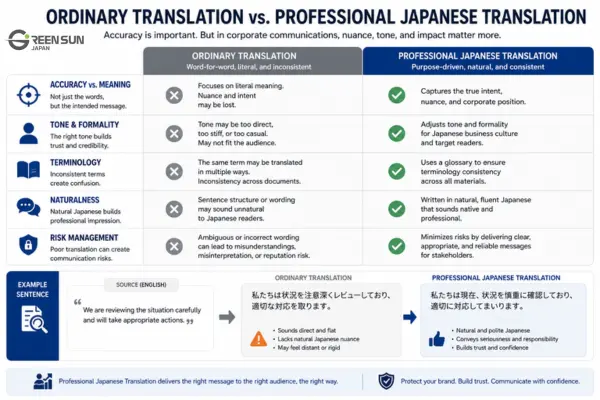
Japanese corporate translation is the translation and localization of business communications that represent a company to investors, employees, the media, customers, and business partners. The objective is not only to transfer meaning, but also to preserve the company’s position, tone of voice, terminology, and level of formality.
This is different from translating a document only for internal reference. Corporate communications may be published, quoted, reused across channels, or reviewed by multiple stakeholders. As a result, even small inconsistencies in titles, product names, financial terms, dates, or tone can create confusion.
| Area | Basic translation | Corporate communications translation |
|---|---|---|
| Main goal | Transfer meaning | Transfer meaning while protecting tone, credibility, and context |
| Terminology | Checked within one file | Standardized across reports, websites, HR documents, and PR materials |
| Tone | General readability | Adjusted to audience, hierarchy, purpose, and publication channel |
| Review | Proofreading | Linguistic review, terminology QA, figure checks, and format QA |
| Confidentiality | Depends on content | Often important because documents may contain unpublished or sensitive information |
· Discover Useful Japanese Translation Apps for 2026
· Questions to Consider When Choosing a Japanese Translator
· What Businesses Should Know About Website Localization for Japan
· Building Stronger Brands Through Japanese Naming and Tagline Localization
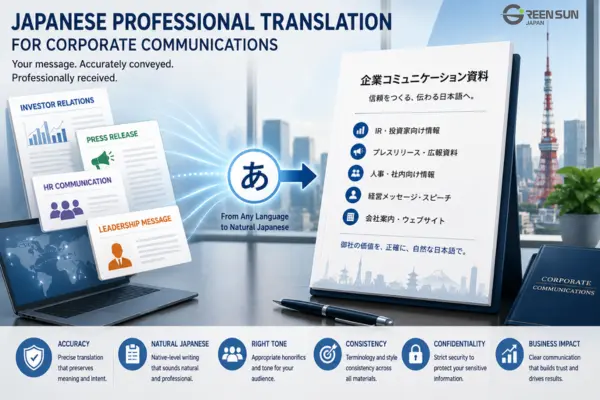
2. Which Corporate Documents Need Professional Japanese Translation?
Not every file requires the same level of review. The highest-priority documents are usually those that influence trust, public interpretation, employee understanding, or business decisions.
| Document category | Main risk | Recommended handling |
|---|---|---|
| IR and financial communications | Terminology, figures, dates, and consistency errors | Glossary control, bilingual figure checks, and final QA |
| PR and press releases | Unintended interpretation or unnatural public messaging | Translate to communication intent, then edit for natural Japanese |
| HR and internal communications | Employees misunderstand policies or organizational changes | Prioritize clarity, suitable formality, and consistent terminology |
| CEO and leadership messages | Loss of voice, authority, or intended emotion | Preserve message, position, and tone rather than translating literally |
| Company profiles and corporate websites | Inconsistent brand terminology and weak credibility | Align terminology with other public-facing materials |
| Proposals and partner communications | Wording sounds too direct, vague, or culturally awkward | Adapt business tone to the relationship and purpose |
For general language-pair support, see Green Sun’s Japanese translation services. This article focuses specifically on corporate communications where tone, governance, and publication risk need additional control.
3. Main Risks in IR, PR, and HR Translation
3.1 Tone and hierarchy
Japanese business writing changes according to the relationship between the writer and the reader. A phrase that works in an internal notice may be inappropriate in a shareholder message or press release. The translator therefore needs to understand who is speaking, who is reading, and what action or impression the message should create.
3.2 Terminology and numerical consistency
Department names, job titles, products, project names, slogans, financial terms, and recurring corporate phrases should be standardized. Figures, percentages, dates, currencies, and proper nouns should be checked separately from the language review because a fluent sentence can still contain a critical data error.
3.3 Confidential or unpublished information
IR, PR, HR, and leadership documents may contain information that has not yet been released publicly. Companies should confirm how files are transferred, who can access them, whether subcontractors are involved, and what confidentiality procedures are applied before sending sensitive content.
3.4 File and layout errors
Corporate content is often delivered in Word, Excel, PowerPoint, PDF, HTML, or other formatted files. After translation, text expansion, line breaks, table widths, charts, footnotes, hyperlinks, and character rendering should be checked in the final format, not only in a bilingual translation file.
4. How to Choose a Japanese Corporate Translation Company
Price and delivery time matter, but they are not enough for documents that may affect corporate credibility. When comparing providers, evaluate the process behind the quotation.
- Corporate-document experience: Can the provider handle IR, PR, HR, executive, or other published business materials?
- Terminology management: Can it create or follow a glossary and translation memory across recurring projects?
- Native-language review: Is there a suitable Japanese reviewer for content where naturalness, politeness, and tone are critical?
- Confidentiality controls: Are file handling, access permissions, and confidentiality requirements clearly defined?
- QA and file-format capability: Can the team check terminology, figures, missing text, formatting, and final files such as Word, Excel, PowerPoint, PDF, or HTML?
A good Japanese translation company should also ask questions before translation begins. If the provider does not ask about audience, publication channel, terminology, reference materials, or the desired tone, the final text may be linguistically correct but poorly aligned with the communication purpose.
5. Recommended Translation Workflow and QA
- Define the purpose and audience. Confirm whether the content is for investors, employees, the media, customers, or business partners.
- Collect references. Gather previous translations, approved company names, titles, glossaries, style guides, and related public materials.
- Set terminology rules. Decide which names or expressions must remain fixed and how recurring terms should be translated.
- Translate for meaning and communication intent. Avoid rewriting sentence by sentence without considering context.
- Edit and review. Check natural Japanese, tone, hierarchy, terminology, logic, and consistency.
- Run QA. Verify figures, dates, proper nouns, omissions, punctuation, links, and formatting.
- Check the final file. Review the actual Word, PowerPoint, PDF, website, or other delivered format before publication.
Final publication checklist
| Check | What to verify |
|---|---|
| Key message | The Japanese version reflects the intended meaning and business position |
| Tone | Formality and wording match the target reader and channel |
| Terminology | Company names, titles, products, and recurring terms follow approved usage |
| Figures | Numbers, percentages, dates, currencies, and units match the source |
| Natural Japanese | Sentences do not sound translated or unnecessarily rigid |
| Formatting | No broken tables, missing text, layout shifts, or character issues remain |
6. What to Include in a Quote Request
A clear quote request helps the translation provider estimate the correct workflow instead of pricing the project only by word count.
- Source and target languages
- Document type: IR, PR, HR, executive message, website, company profile, proposal, or other material
- Approximate volume and file formats
- Target audience and publication channel
- Required delivery date
- Reference translations, terminology lists, or style guides
- Need for Japanese native review, DTP, website implementation, or final-file QA
- Confidentiality or access requirements
Green Sun Japan supports Japanese business and corporate translation for documents, websites, and common business file formats. Send the source file or project scope for a review before quotation.
Request a free consultation and quotation for Japanese corporate translation.
7. FAQ
When should a company use professional Japanese corporate translation?
Use it when the content can affect corporate image, investor understanding, employee behavior, public interpretation, or an important business relationship. Typical examples include press releases, IR materials, HR policies, CEO messages, company profiles, proposals, and corporate websites.
Can machine translation be used for corporate communications?
Machine translation can support drafting or high-volume workflows, but publication-sensitive content should be reviewed by qualified linguists. The higher the risk of misunderstanding, reputational impact, or confidentiality, the stronger the human review should be.
Why is Japanese native review important?
A native reviewer can assess whether the final text sounds natural, whether the politeness level fits the audience, and whether the message reads like professional Japanese corporate writing rather than a literal translation.
How much does Japanese corporate translation cost?
Pricing depends on the language pair, volume, subject matter, deadline, file format, review level, DTP requirements, and whether terminology management or final-file QA is included. For important corporate documents, compare the complete workflow rather than the unit rate alone.
What should be checked before publishing the Japanese version?
Check the key message, tone, terminology, company names, titles, figures, dates, missing text, links, and final formatting. For public-facing or high-risk materials, review the final file after layout or website implementation.