Hindi document translation services help businesses translate contracts, HR records, onboarding materials, policies, compliance notices, and vendor documentation. Low-risk internal documents may be suitable for MTPE, while contracts and documents that affect rights, obligations, or compliance should be reviewed by qualified translators and reviewers with relevant subject-matter expertise.
Use this guide to brief a provider, compare review scopes, and choose a workflow for contracts, HR records, and compliance materials.
Key Takeaways
・Not every Hindi document requires the same translation workflow. The level of review should be determined based on the document’s intended use and the level of risk involved.
・MTPE may be suitable for low-risk internal documents, but contracts, policies, and compliance materials generally require a higher level of human review.
・HR records, contracts, and documents containing sensitive data require clear confidentiality procedures and appropriate controls over access to information.
・Certified Hindi translation services are necessary only when a government authority, organization, or receiving party specifically requires a certified translation.
・When selecting a provider of Hindi document translation services, businesses should evaluate subject-matter expertise, QA procedures, data security, terminology management, and how MT or AI tools are used in the translation process.
Contents
- 1. Which Documents Require Hindi Translation?
- 2. Which Hindi Documents Can Use MTPE, and Which Require Human Review?
- 3. What Should Be Reviewed in Hindi Contracts, HR Records, and Compliance Documents?
- 4. How to Choose Hindi Document Translation Services
- 5. Cost, Turnaround Time, Security, and Legal Accuracy
- 6. Conclusion
- 7. FAQ
1. Which Documents Require Hindi Translation?
Businesses need Hindi translation services when employees, customers, vendors, or partners rely on Hindi to understand company documents. Start by identifying who will use each file and what decisions they will make from it.
Documents that commonly require translation include contracts and agreements, HR records, HR forms, new-employee onboarding materials, employee handbooks, workplace policies, compliance notices, vendor agreements, and procurement documents.
However, businesses should not use the same Hindi document translation workflow for every type of document. A low-risk internal guidance document is significantly different from a contract that defines payment obligations or a workplace policy involving employees’ rights and responsibilities.
Assess errors in context. A mistranslated payment obligation or termination clause may have serious consequences, but an internal training file can also be high risk if it contains safety instructions or binding policy.
Before requesting quotes, record each file’s intended use, audience, confidentiality requirements, and the potential consequences of an error.
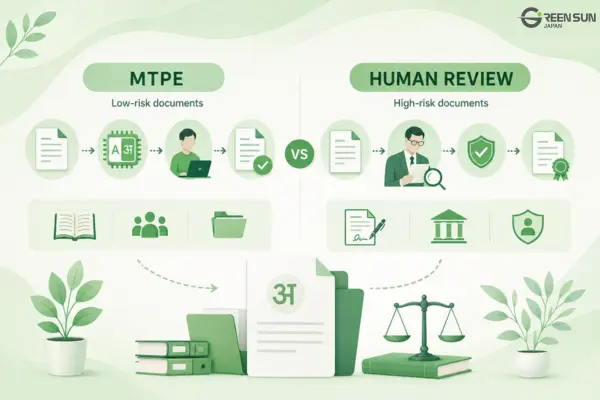
2. Which Hindi Documents Can Use MTPE, and Which Require Human Review?
In general, low-risk internal documents may be suitable for MTPE, while contracts, compliance documents, and other high-risk materials require stronger human review.
MTPE (Machine Translation Post-Editing) is a process that combines machine translation with human post-editing. In this workflow, a machine translation system first produces an initial translation of the document, after which a qualified professional reviews, checks, and edits the machine-translated output.
MTPE still requires a qualified person to compare the output with the source and correct meaning, terminology, omissions, and inconsistencies. Agree on the expected quality and review scope before choosing this workflow.
ISO 18587:2017 specifies requirements for the process of full human post-editing of machine translation output, as well as requirements concerning the competencies of professionals who perform post-editing work.
Source: ISO 18587:2017
| Document Type | Suitability for MTPE | Level of Review | Reason |
|---|---|---|---|
| Low-risk internal reference materials | May be suitable | Recommended | Helps process large volumes more quickly |
| Training and employee onboarding materials | Depends on the case | Recommended | Instructions need to be clear and consistent |
| HR forms and employee records | Evaluate case by case | High | May contain sensitive data or affect employee rights and benefits |
| Policies and compliance notices | Limited | High | Mistranslation may create compliance risks |
| Contracts and legal agreements | Should not rely on MTPE | Very high | Legal terms require strict quality control |
| Documents requiring certification | Depends on the receiving party’s requirements | According to the certification process | Must meet the specific requirements of the receiving party |
Legal documents require a more cautious translation workflow because errors may affect rights, obligations, or other legal outcomes. ISO 20771:2020 specifies requirements for legal translation services, including the competencies of translators, revisers, and reviewers, as well as processes that directly affect translation quality. According to the scope of the standard, the use of machine translation output, including output that has undergone post-editing, is outside the scope of ISO 20771:2020.
Source: ISO 20771:2020
Therefore, the decision to use MTPE for Hindi document translation should not be based solely on the name or format of the document. An employee handbook used for internal reference and a policy that directly affects employee rights and benefits may both be classified as HR documents, but the level of risk associated with each is not the same.
Choose the workflow based on intended use, sensitivity, potential legal impact, and the consequences of errors.
3. What Should Be Reviewed in Hindi Contracts, HR Records, and Compliance Documents?
High-risk Hindi documents should be reviewed for meaning, terminology, factual information, consistency, and formatting—not just for natural-sounding language.
For contracts and agreements, the review should cover terminology, each party’s obligations, payment terms, deadlines, liabilities, confidentiality provisions, contract termination clauses, and dispute resolution provisions. Terminology should be used consistently throughout the translation to reduce the risk of misunderstanding or misinterpretation.
For HR files, check names, job titles, dates, figures, employee rights and benefits, obligations, tables, and form fields. Use the same approved terminology across related policies, notices, and procedures. If the final files contain forms or fixed layouts, include desktop publishing and layout checks in the scope.
If a document has significant legal implications, businesses should consider adding an additional review step by an appropriate legal professional. Translation review focuses on the accuracy and quality of the translated content and should not be considered a substitute for legal advice.

4. How to Choose Hindi Document Translation Services
Compare providers against the same brief. Ask who will translate and review the files, what subject-matter expertise they bring, and how the team will protect sensitive information.
Checklist for Choosing Hindi Document Translation Services
・Has experience translating contracts, HR records, or compliance documents.
・Has Hindi translators and reviewers with expertise appropriate to the relevant subject area.
・Has a clear process for translation, revision, review, and quality control.
・Has confidentiality agreements and appropriate controls over document access.
・Is transparent about whether and how machine translation or AI tools are used.
・Has a terminology management system to maintain consistency in long-term projects.
・Can provide certified Hindi translation services when certification is required.
・Provides quotes that clearly specify the scope of work and the level of review included.
For HR records, contracts, and other documents containing sensitive data, businesses should also ask how the provider stores, uses, and protects data throughout the translation process, particularly when machine translation or AI tools are involved. For long-term projects, establishing a consistent glossary from the beginning can help maintain uniform terminology and translation choices across different documents and future updates.
5. Cost, Turnaround Time, Security, and Legal Accuracy
Cost
The cost of Hindi document translation depends on the volume of content, language direction, level of complexity, file format, required deadline, level of review, and certification requirements. High-risk documents such as contracts generally require a more thorough quality control process than internal documents.
Turnaround Time
Turnaround time needs to be balanced with translation accuracy. Machine translation may support certain workflows and help process some types of content more efficiently, but for contracts and compliance documents, the schedule should not be shortened by skipping necessary review and quality control steps.
Security
For HR records and confidential contracts, businesses should review the provider’s confidentiality agreements, file transfer methods, access controls, data retention policies, and how machine translation or AI tools are used during the translation process.
Legal Accuracy
Translators can check the language, meaning, and legal terminology used in translated documents, but they do not replace the advisory role of a lawyer or other qualified legal professional. Certified Hindi translation services are required only when certification is necessary for the intended use of the document or when the receiving authority, organization, or other party specifically requests it.
6. Conclusion
Choose a workflow for each file based on its intended use and risk. MTPE may suit some low-risk material; documents affecting rights, obligations, or compliance need review by people with the appropriate language and subject-matter expertise.
Before selecting a translation provider, businesses should identify the intended use of the document, the required level of confidentiality, any certification requirements, and the possible consequences of translation errors. Based on these factors, businesses can then evaluate the provider’s subject-matter expertise, quality control process, turnaround time, and pricing to choose the most appropriate translation service for their documents.
7. FAQ
1. How Long Does Hindi Document Translation Take?
The turnaround time for Hindi document translation depends on the total word count, the complexity of the content, the document format, the required level of review, and the requested deadline. Simple internal documents may be handled through a faster translation workflow, while contracts, HR policies, and compliance documents usually require additional time for terminology checks, content review, consistency checks, and overall quality control.
2. How Much Do Hindi Document Translation Services Cost?
The cost of Hindi document translation services is usually determined by the number of words, language direction, subject area, file format, required level of review, certification requirements, and requested turnaround time. For high-risk documents, businesses should compare the scope of quality control and the provider’s subject-matter expertise rather than focusing only on the price per word.
3. Is Hindi Translation of HR Documents Secure?
An appropriate level of confidentiality can be maintained when the translation provider has clear procedures for handling and protecting data. Before sending HR records or employee documents, businesses should review the confidentiality agreement, data access controls, file transfer methods, data retention policies, and the provider’s rules regarding the use of machine translation or AI during the translation process.
4. Do Contracts Translated Into Hindi Require Human Review?
For contracts that affect legal rights and obligations, the translation should be reviewed by a suitably qualified professional who can check terminology, contractual clauses, defined terms, figures, and consistency throughout the document. ISO 20771:2020, which covers legal translation services, does not include the use of machine translation output, even after post-editing, within the scope of the standard.
5. When Are Certified Hindi Translation Services Required?
Businesses or individuals need certified Hindi translation services when an authority, organization, or receiving party requires the translated document to be certified. Specific certification requirements may vary depending on the jurisdiction and the document’s intended purpose, so businesses or individuals should confirm the exact requirements with the receiving party before ordering the translation service.
6. Can Machine Translation Be Used for Hindi Compliance Documents?
Machine translation may be used in certain workflows, but businesses should first assess the level of risk, confidentiality requirements, intended use, and the possible consequences of errors. For Hindi compliance translation involving obligations, rights, or other compliance-related requirements, the translated content should be reviewed by a suitably qualified professional rather than using machine translation output directly as the final version.
Green Sun Japan provides Hindi document translation services for contracts, HR records, compliance documents, and other business materials. Each translation workflow is designed to meet the accuracy, consistency, and confidentiality requirements of the individual project.
Discuss the scope with Green Sun Japan
・Expertise by document type: Support for contracts, HR records, and compliance documents requiring a high level of accuracy.
・Clear review process: Meaning, terminology, and consistency are reviewed according to the requirements of each project.
・Security for sensitive documents: Particular attention is given to document access controls and data protection throughout the process.
Contact Green Sun Japan to discuss suitable Hindi document translation services and receive a quote based on your company’s specific document requirements.