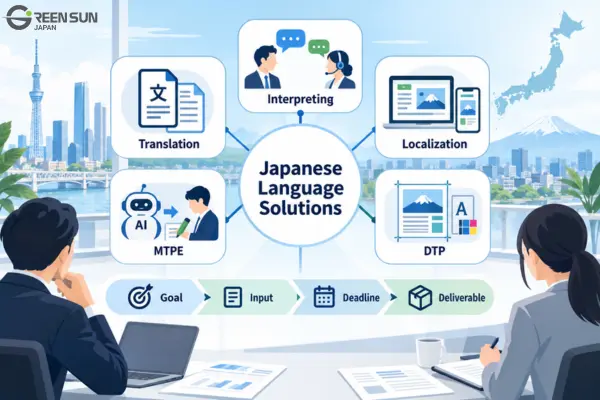
When businesses need to work with Japanese-language content, choosing the right service starts with understanding what they need to accomplish. Contracts require translation, meetings call for real-time interpreting, websites and apps need content that works within their interfaces, and catalogs may require layout adjustments after translation.
Choose services based on your deliverables, source materials, deadlines, and intended use. The matrix below compares translation, interpreting, localization, machine translation post-editing (MTPE), and desktop publishing (DTP), including when to combine them.
Quick Answer: Choose translation for written documents, interpreting for real-time communication, and localization for websites, apps, or software. If you already have machine-translated content, consider MTPE. If your final documents need specific formatting or layouts, DTP may also be necessary. Projects with multiple deliverables may benefit from combining these services.
Key Takeaways
・Start by identifying your deliverables rather than choosing a service based on its name.
・Consider your source materials, deadlines, and how the content will be used.
・Understand the differences between translation, interpreting, localization, MTPE, and DTP.
・Don’t assume every project needs MTPE or DTP.
・Assess each deliverable separately when a project involves multiple services.
1. How to Choose the Right Japanese Language Solutions for Your Business
Start with what you need to receive: a translated document, a working interface, an interpreter for a meeting, or a file ready for publication.
| Business Need | Source Materials | Scheduling Considerations | Expected Deliverable | Recommended Service |
|---|---|---|---|---|
| Review, understand, or publish documents | Word, Excel, PowerPoint, PDF | Document volume, review deadlines, publication date | Translated documents | Translation |
| Conduct meetings, negotiations, or training | Agendas, slides, reference materials | Date, time, duration, meeting format | Real-time language support | Interpreting |
| Prepare content for websites, apps, or software | UI strings, CMS exports, resource files, screenshots | Development, testing, and release schedules | Content adapted to the intended platform | Localization |
| Improve existing machine translations | Source text and machine-translated output | Content volume, required level of post-editing | Post-edited translations | MTPE |
| Prepare documents with specific layouts | InDesign, Illustrator, PowerPoint, PDF | Layout adjustments and review time | Publication-ready files in the required layout | DTP |
This matrix can help you avoid unnecessary work. If you only need a translated Word document for internal review, translation alone may be sufficient. However, if the document must retain its original layout and be ready for publication, you may also need DTP.
If your priority is written documents, review the scope of our translation services and specify the checks and delivery formats you need.
2. When Should You Choose Translation, Interpreting, or Localization?
Choose translation when you need written content in another language, interpreting when people need to communicate in real time, and localization when content must work within a specific digital environment.
The key distinction is the format: translation works with written content, while interpreting supports spoken communication.
Contracts, reports, user manuals, technical documents, and presentation slides generally require translation. Meetings, negotiations, interviews, and training sessions typically require interpreting. For interpreting assignments, businesses also need to specify the schedule, duration, subject matter, and whether the event will take place online or in person.
For websites, mobile apps, and software, localization addresses interface constraints and the context in which readers use the text.
For these projects, businesses should provide UI strings, CMS exports, screenshots, or details about how specific features work whenever possible.
Decide whether the text can be translated as a standalone document or needs to be checked within a website, app, or software build.
Practical Examples
・An English report for a Japanese office: Translation is usually sufficient.
・A training session with presentation slides and live Q&A: Translate the materials beforehand and arrange interpreting for the session.
・An app with menus, buttons, and system messages: Localization is generally more suitable than translating individual strings without context.
3. When Do You Need MTPE or DTP?
MTPE is worth considering when you already have machine-translated content. DTP becomes relevant when the final documents need to retain or follow a specific layout.
MTPE involves having a human linguist review and edit machine-translated text. ISO 18587:2017 sets requirements for full human post-editing of machine translation output.
If you’re considering MTPE, prepare the original source content, the machine-translated version, and clear expectations for the final result.
For documents with designed layouts, desktop publishing addresses how the translated text fits on the page.
Brochures, catalogs, manuals, and presentation slides may need changes to fonts, line breaks, text boxes, or the positioning of visual elements to accommodate the translated content.
If all you need is translated text in a Word document, DTP may not be necessary.
Quick Decision Guide
・Already have machine-translated content? Consider MTPE.
・Need a finished document with a specific layout? Consider DTP.
・Need both post-editing and layout adjustments? Combine MTPE and DTP.
・Only need the translated text? Neither additional service is necessarily required.
4. How to Combine Language Services in a Japanese-Language Project
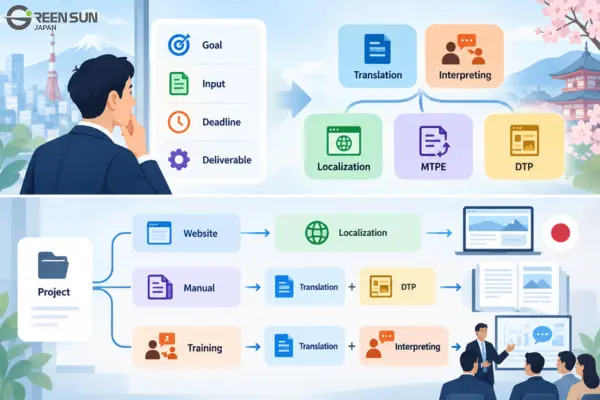
If your project involves several deliverables, it’s usually best to break it into separate tasks and choose the right service for each one.
This is more effective than treating everything as a single request to “translate into Japanese.”
For example, a product launch might involve localizing a website, translating and formatting a user manual, and providing interpreting support during a training session.
A Japanese translation of a Word contract for review may only require translation and an agreed review process, without localization or DTP.
Checklist Before Requesting a Quote
・Identify all the deliverables you need.
・Prepare the original files in suitable formats.
・Specify the source and target languages.
・Explain whether the content is for internal use or public release.
・Share any existing glossaries, style guides, or reference translations.
・Confirm the final deadline and any review milestones.
・For interpreting, provide the event date, time, duration, and subject matter.
・For localization, include screenshots or interface context where available.
・For MTPE, provide both the source text and machine-translated output.
・For DTP, specify the required final file format.
Providing these details upfront makes it easier to define the scope of work before the project begins, rather than adding services or revising requirements along the way.
5. Conclusion
Translation, interpreting, localization, MTPE, and DTP each serve a different purpose in a Japanese-language project.
The best approach is to identify your deliverables first, then consider the source materials, deadlines, and how the final content will be used.
Some projects only need one service, while others require a combination of solutions. Using a clear decision matrix helps businesses define their requirements, avoid unnecessary steps, and choose the services that best fit each deliverable.
6. FAQ
1. Where should businesses start when choosing Japanese language solutions?
Start by identifying what you need to receive, whether that’s a translated document, localized website or app content, or interpreting support for a meeting. Then consider your source materials, deadlines, and whether any additional services are required.
2. Can Japanese translation and interpreting be used in the same project?
Yes. For example, a training session may require presentation slides to be translated in advance and an interpreter to support the live presentation and Q&A. The two services complement each other because they address different communication needs.
3. When should businesses use Japanese localization solutions?
Localization is a good choice when content appears in websites, apps, or software and needs to work within a particular interface or feature. For standalone documents intended for reading, review, or recordkeeping, translation is generally sufficient.
4. How is MTPE different from conventional translation?
MTPE begins with machine-translated content that a human linguist reviews and edits. Conventional translation does not require a machine-generated draft. The appropriate choice depends on the materials available and the quality requirements of the project.
5. When should DTP be included in a translation project?
DTP is useful when the final documents need to maintain a specific layout, as is often the case with brochures, catalogs, manuals, and presentation slides. If you only need translated text in Word or another simple format, DTP may not be needed.
Green Sun Japan helps businesses prepare multilingual content for their target markets and intended uses, including documents, websites, software, and mobile applications.
・Multi-Format Translation and Localization: Support for documents, websites, software, and apps, tailored to your source materials and required deliverables.
・Project-Specific Quality Checks: Agree on reviews for meaning, terminology, context, formatting, and consistency.
・Scope Review: Share your files and deadline so the team can confirm the required services.
To get started, send Green Sun Japan your source files, links, glossaries, reference materials, screenshots, samples, or delivery requirements. We’ll review your needs and recommend an appropriate approach.