Japanese neural machine translation (NMT) speeds up document translation when source content is clear, repetitive, and uses standardized terminology. However, raw machine translation output is rarely a safe solution for all types of Japanese documents.
For internal reference materials or user-generated content (UGC) moderation, Japanese NMT delivers adequate quality cost-effectively. For customer-facing communications and technical documentation, a Japanese MTPE (Machine Translation Post-Editing) workflow can offer a practical balance. Meanwhile, legal, medical, and financial documents, as well as brand-critical marketing campaigns, still require handling by human experts.
📌 Key Takeaways / Direct Answer:
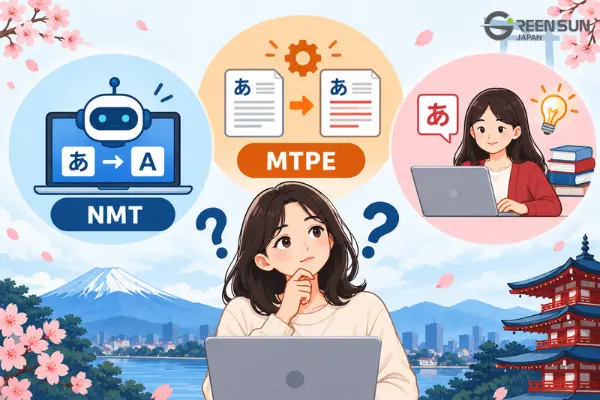
- Japanese NMT (Raw MT): Best suited for low-risk, high-volume, and internal-use content, such as support ticket categorization, skimming product reviews, or preliminary reference materials.
- Japanese MTPE (Machine Translation Post-Editing): The default choice for customer-facing content, such as e-commerce product descriptions, software UI strings, Help Center articles, and recurring notification emails.
- Human Translation: Recommended for business contracts, intellectual property registration filings, medical documents, audited financial reports, and creative brand slogans.
- The “fluency trap” of Japanese NMT: Neural Machine Translation systems (e.g., DeepL, Google Translate) produce very natural-sounding Japanese sentences but are prone to misinterpreting implied meanings, given the language’s frequent omission of subjects and its complex system of honorifics.
- Decision-making principle: Base your choice on risk level, the target audience, and the potential financial or legal consequences of errors; do not select a technology based solely on word count.
Contents
- 1. What is NMT in the context of Japanese, and why is it prone to the "fluency trap"?
- 2. When is raw NMT sufficient?
- 3. When is the Japanese MTPE process the optimal choice?
- 4. Serious errors that MTPE can rectify but NMT often overlooks
- 5. When Should Human Experts Lead the Translation?
- 6. Comparison table: Raw NMT vs. MTPE vs. Human translation
- 7. Conclusion
- Frequently Asked Questions (FAQ)
1. What is NMT in the context of Japanese, and why is it prone to the “fluency trap”?
NMT (Neural Machine Translation) uses deep learning models to predict word sequences based on full-sentence context, effectively replacing outdated statistical translation methods.
Modern tools (such as DeepL and Google Translate) generate Japanese text that is grammatically smooth. However, the critical weakness of NMT for Japanese lies in semantic accuracy:
- The tendency to omit subjects and objects: Japanese often implies the agent of an action based on context. NMT is forced to “guess” who is performing the action, leading to the misattribution of parties—such as between contract signatories or between a business and its customers.
- The nuances of the honorific system (*Keigo*): Incorrectly choosing between standard polite language (*Teineigo*), respectful language (*Sonkeigo*), and humble language (*Kenjougo*) can cause a customer service message to come across as condescending or disrespectful.
- Differences from Western languages: An AI-translated Japanese sentence may sound perfectly natural, yet its underlying meaning could completely invert legal obligations.
2. When is raw NMT sufficient?
Businesses can use raw Japanese NMT output directly—without human editing—when the following conditions are met:
- Low risk: Linguistic inaccuracies result in no financial loss, legal liability, or operational safety issues.
- Acceptance of preliminary translation: Intended for internal staff to quickly understand information and grasp key points, without external publication.
- Stable, structured data: Product specifications, standardized category labels, or unambiguous terminology strings.
| Use cases for raw NMT | Business objectives | Required level of control |
|---|---|---|
| Customer support ticket classification | Route requests to engineers for processing | Rapid comprehension; no need for publication. |
| Social media trend/review scanning | Measure market satisfaction | Grasping general sentiment (sentiment analysis). |
| Drafts for bilingual staff | Skim partner documents before meetings | Quick cross-referencing against the original text. |
| User-generated content (UGC) | Quickly moderate community comments | Automatic filtering of prohibited keywords. |
3. When is the Japanese MTPE process the optimal choice?
Japanese MTPE combines the text-generation speed of machines with the contextual judgment of human language experts. It can suit customer-facing or operational content when the review process matches the risks:
- E-commerce product descriptions: Requires rapid translation of thousands of SKUs while ensuring that feature names and product benefits remain accurate and engaging.
- Help Centers & FAQs: Ensures technical instructions are clear to prevent user errors.
- UI strings & software release notes: Manages Japanese character lengths to prevent button overflow and ensures consistency in module names.
- Internal communication documents: Maintains professionalism and standardization in exchanges between the Vietnam office and the Japanese headquarters.
4. Serious errors that MTPE can rectify but NMT often overlooks
| Types of Japanese NMT errors | Practical examples of machine translation errors | MTPE Processing Approach |
|---|---|---|
| Honorifics (Keigo) misuse | Using casual speech or confusing humble language with honorific language. | Adjusting the level of politeness to precisely align with B2B relationships and the brand voice. |
| Misidentification of the implicit subject | Automatically assigning "We" as the subject for Japanese sentences where the subject was omitted, instead of the intended "You" (the customer). | Tracing the full paragraph context to accurately identify the subject performing the action. |
| Incorrect counter words | Selecting the wrong counter for objects (e.g., using the counter for machinery, *dai*, instead of the counter for documents, *satsu* or *tsū*). | Standardizing counters based on actual product categories. |
| Incorrect scope of modification | Incorrectly linking a long modifying clause to the wrong subsequent noun. | Splitting sentences or restructuring word order to adhere to standard Japanese grammar. |
| Literal translation of idioms | Translating fixed idioms word-for-word, thereby completely losing the underlying cultural nuance. | Substituting terms with natural, equivalent phrases commonly used by native Japanese speakers. |
5. When Should Human Experts Lead the Translation?
Use a human-led workflow (or limit NMT to internal reference) when handling high-risk document categories:
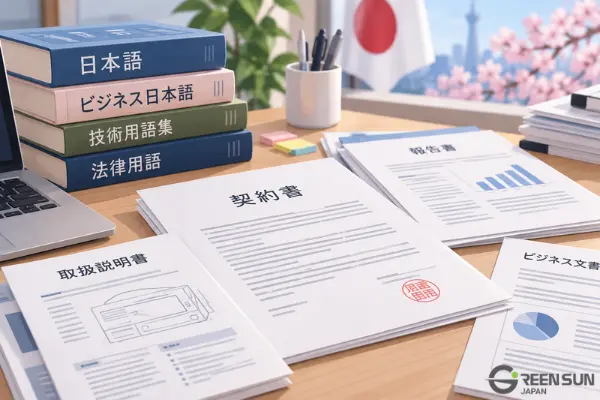
- Contracts and legal documents: Commercial contracts, shareholder agreements, terms of use, and regulatory filings.
- Medical and pharmaceutical: Medication dosage instructions, clinical trial protocols, and medical device operating manuals.
- Financial and investment reports: Audited financial statements, prospectuses, and investor relations (IR) materials.
- Key brand campaigns: Slogans, taglines, and brand positioning content that require emotional resonance and creative adaptation (transcreation).
The cost of inaccuracy: In these types of documents, a mistranslated modifier or an overlooked exception clause can lead to costly legal disputes or damage to a brand’s reputation.
6. Comparison table: Raw NMT vs. MTPE vs. Human translation
| Comparison Criteria | Raw NMT | Japanese MTPE | Fully Human Translation |
|---|---|---|---|
| Processing Speed | Nearly instantaneous (thousands of words per minute). | Can be faster when the machine output is suitable. | Slowest (depending on project volume). |
| Budget Cost | Usually lowest; tool and workflow costs still apply. | May cost less than human translation; savings depend on editing effort. | Highest (commensurate with premium quality). |
| Linguistic Accuracy | Low to Medium (prone to mistranslating proper nouns). | High (verified by bilingual experts). | Excellent (deep understanding of the text’s logic and nuances). |
| Terminology Control | Inconsistent, high risk. | Ensures consistency in accordance with the Style Guide. | Controlled through glossaries, review, and adaptation to the audience. |
| Scope of Application | Internal reference, large-scale data classification. | Websites, Help Centers, app UIs, product descriptions. | Contracts, legal and medical documents, PR campaigns. |
| Risk Tolerance | High risk. | Low to medium risk. | Strict review required for high-risk uses. |
7. Conclusion
Japanese Neural Machine Translation (NMT) technology delivers a significant boost in productivity; however, sustainable value is achieved only through strategic application rather than a one-size-fits-all approach.
No single method is optimal for every type of document. A practical localization workflow combines the speed of NMT for screening tasks, the precision of MTPE workflows for public-facing operational materials, and high-level human expertise for business-critical documents.
🚀 Flexible Japanese Translation Solutions with Green Sun Japan
Are you looking for a solution to optimize Japanese localization costs while maintaining brand consistency and technical accuracy?
Green Sun Japan offers Japanese translation workflows tailored to the specific risk level of your documents:
🤖 Standardized Japanese MTPE Process: Integrates advanced AI machine translation models with Translation Memory (TM) and specialized glossaries to accelerate large-scale projects.
🇯🇵 Team of Experienced Language Experts: Precisely handles the most complex aspects of the Japanese language, including *Keigo* (honorifics), implied subjects, and professional business writing styles.
⚡ 3-Step QA Process & 30-Minute Quotes: Rapid response, transparent pricing, and rigorous quality control prior to delivery.
👉 Contact Green Sun Japan today to submit sample documents and receive a consultation on the optimal Japanese translation workflow for your project.
Frequently Asked Questions (FAQ)
Q1. Is Neural Machine Translation (NMT) technology for Japanese inferior to that of other language pairs?
In terms of grammatical fluency, no; however, the risk regarding semantic accuracy is significantly higher. Japanese grammar relies heavily on context, frequently omitting subjects and using sentence-ending particles to convey attitude. NMT often produces sentences that sound natural but contain factually incorrect content or misattribute actions to the wrong parties.
Q2. Should DeepL or Google Translate be used for Japanese business documents?
They should only be used for comprehending internal documents or casual email exchanges. For documents intended for partners or clients, or for contracts, raw machine translations should not be used without review due to the high risk of errors regarding honorifics and specialized terminology.
Q3. Is the cost of the Japanese MTPE process significantly lower than that of manual translation?
MTPE can reduce cost and turnaround time when the source text is clear and the machine output is suitable. If the source is ambiguous or the output is poor, editing may take as much work as human translation. Request a quote based on a representative sample.
Q4. What is the most common mistake businesses make when implementing Japanese machine translation?
It is viewing machine translation as an “all-or-nothing” solution. Many organizations see it performing well on simple FAQs and hastily apply it to commercial contracts or complex technical documents, leading to serious legal repercussions and damage to business partnerships.