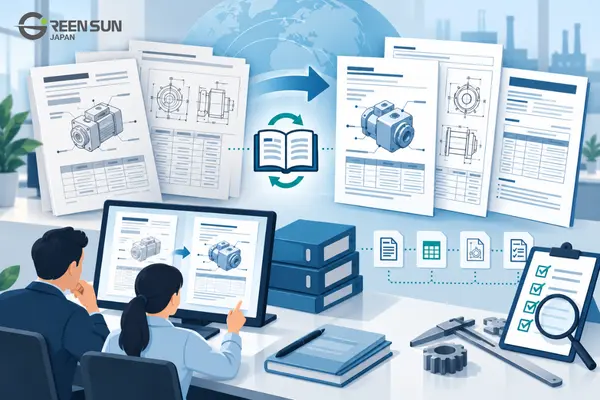
Translating Korean manuals, specifications, and supplier files involves much more than translating the text. These documents typically contain technical terminology, units of measurement, version codes, tables, and diagrams that require strict consistency across multiple files and updates.
Define the scope, terminology, revision control, desktop publishing (DTP), and quality assurance (QA) before work begins. Your provider needs to understand how the translated files will be used and updated.
Use this guide to plan a coordinated document translation workflow, from source-file preparation to final delivery.
📌 Direct Answer
Korean document translation services should cover both translation and document control. For manuals, technical specifications, and supplier files, the core scope typically includes glossary management, verification of numbers and units, revision control, handling of tables and diagrams, DTP, and final file verification.
When selecting a translation provider, evaluate how they manage terminology, version control, technical QA, and final deliverables—rather than focusing solely on per-word rates or turnaround times.
📌 Key Takeaways
・Define scope by document type: Manuals, specifications, supplier files, and DTP each have distinct requirements.
・Control terminology and technical data: Glossaries, part names, measurements, tolerances, and model numbers must remain consistent.
・Manage revisions clearly: Changes between versions must be identified and reflected consistently across translated files.
・Integrate DTP and visual QA into the workflow: These are crucial for tables, diagrams, callouts, and embedded text.
・Evaluate vendor processes: Focus on QA, version control, and the ability to deliver publication-ready files—not just per-word pricing.
Contents
1. What Korean Document Translation Services Should Cover
The scope of Korean document translation services should be defined based on the requirements of each document type, rather than applying a one-size-fits-all process to every file. Manuals, specifications, supplier files, and documents requiring DTP have different structures, technical complexities, and potential risks. Translation, QA, and final formatting requirements should therefore be tailored to each type.
| Document Type | Common Content | Key Risks | Recommended Scope |
|---|---|---|---|
| Manuals | Operating instructions, warnings, maintenance procedures, user guides | Inaccurate terminology, missing steps, errors in warnings, distorted layout | Translation, review, DTP, visual QA |
| Specifications | Dimensions, tolerances, technical specifications, product parameters | Errors in numbers, units of measurement, symbols, or terminology | Technical translation, terminology QA, numerical verification |
| Supplier files | Forms, inspection sheets, component data, verification documents | Inconsistencies across fields, duplicate files, or multiple versions | Translation, template handling, version control, QA |
| DTP/source files | InDesign, Illustrator, PDF, tables, and graphics | Text expansion, layout shifts, missing callouts or labels | DTP, handling of text in graphics, final visual QA |
Key elements to define clearly within the scope:
- Korean manual translation: Should include verification of headings, warnings, tables, callouts, cross-references, and final layout if the document is intended for publication.
- Korean technical document translation: Must prioritize terminology, numbers, units of measurement, tolerances, part numbers, model codes, and technical symbols.
- Korean supplier document translation: Requires strict control over templates, repetitive content, versions, and consistency across multiple files or batches of updates.
- DTP and visual QA: Should be included in the project scope from the outset if files contain diagrams, tables, embedded text, or require strict layout preservation.
When requesting translation quotes, businesses should clearly specify the document type, source file format, DTP requirements, QA level, and expected final deliverables. The clearer the scope, the easier it is for the translation provider to develop an appropriate workflow and minimize rework after translation.
2. How Terminology, Units, Diagrams, and Versions Should Be Managed
For technical documents, manuals, and supplier files, translation quality depends heavily on maintaining consistency across multiple files and revisions. Terminology, numerical data, diagrams, and version control should therefore be managed as part of the same workflow.
Key areas to manage include:
- Terminology and glossary: Product names, component names, technical terms, and approved phrases should be standardized before translation begins. If the business already has a glossary or reference translations, these should be used to maintain consistency.
- Numbers and units: Measurements, tolerances, decimal values, part numbers, and model codes require careful verification. Units of measurement should not be automatically converted unless explicitly specified in the project brief, as unnecessary changes may alter the technical meaning.
- Diagrams and embedded text: Labels, callouts, captions, legends, and text within graphics must be included in the project scope from the outset. Translating only the body text risks leaving the final file incomplete, even if the main text is translated accurately.
- Version control: Every file should have a clear revision history to identify the latest source document, highlight modified sections, and determine which content can be reused from previous translations.
For example, when a manual moves from Rev. B to Rev. C, compare the source versions, identify changed sections, and update the affected translations. Previously approved content can be reused where it remains valid, but related warnings, references, and diagrams still need checking.
This approach is especially useful when manuals and supplier files share terminology, data, and templates. Check affected cross-references and related files before approving the revised document set.
3. What a Reliable Translation and DTP QA Workflow Looks Like
A reliable Korean document translation workflow should clearly separate linguistic, technical, and layout review stages. Focusing solely on text review is insufficient, particularly for manuals, specifications, or supplier files containing extensive tables, numerical data, and graphics.
A typical workflow includes the following steps:
File assessment → terminology setup → translation → linguistic review → technical QA → DTP → visual QA → final delivery

Each step addresses a distinct set of risks:
- File assessment: Evaluates file formats, document volume, graphics, locked text, revision status, and output requirements before work begins.
- Terminology setup: Confirms glossaries, reference materials, previous translations, and required terminology that must be used consistently.
- Translation and linguistic review: Translates content in its technical context, followed by checks for accuracy of meaning, consistency, grammar, and readability.
- Technical QA: Focuses on verifying numbers, measurements, units, part numbers, model codes, missing text, duplicate segments, and cross-references.
- DTP: Integrates the translation into the final layout, addressing tables, callouts, diagrams, and formatting adjustments needed due to text expansion or reflow.
- Visual QA: Inspects the completed file to identify clipped text, overflow, misaligned elements, missing labels, or formatting errors.
- Final delivery: Provides the appropriate file versions and formats, following the agreed-upon naming conventions.
Linguistic and visual checks address different problems. A sentence can be accurate yet appear in the wrong place, disappear behind a diagram, or be cut off in the final PDF.
For Korean manual translation, DTP and visual QA are especially critical because end users rely directly on the document’s layout, safety warnings, and illustrations. For specifications and supplier files, technical QA requires greater attention to data, terminology, and revisions.
When selecting a translation provider, businesses should prioritize agencies with transparent QA processes that are tailored to their document types. A well-organized workflow helps minimize errors, reduce rework, and ensure that the final deliverables meet the agreed requirements.
4. How to Brief and Evaluate a Korean Document Translation Provider
An effective Korean document translation project begins with a clear brief. When a translation provider fully understands the document type, intended use, and output requirements, the provider can establish an appropriate workflow from the outset and minimize the need for rework after translation.
4.1. Preparing Your Translation Brief
When submitting a translation request, businesses should provide the following key information:
- Document type: Manual, technical specification, supplier form, inspection sheet, or other technical documentation.
- Languages and target audience: Specify the source and target languages and who will read or use the document.
- Source files: Provide editable files whenever possible, especially when working with tables, diagrams, or DTP.
- Glossary and reference materials: Provide approved terminology, previous translations, product documentation, or style guides.
- Revision information: Current version, revision history, or specific modified sections.
- Output requirements: Required final file formats, DTP requirements, visual QA, or bilingual files if needed.
- Timeline: Deadlines and delivery priorities if the project involves multiple files.
A thorough brief does not need to be long, but it should clarify any factors that could affect terminology, version control, and final formatting.
4.2. Choosing the Right Translation Provider
Ask prospective providers how they manage related files and revisions. Look for:
- Experience with manuals, technical specifications, and supplier documentation.
- A structured process for terminology management and consistent use of approved glossaries.
- The ability to handle multiple versions and regularly updated content.
- Technical QA processes to verify numbers, units, model codes, and critical data.
- DTP and visual QA capabilities for documents with complex tables, graphics, or layouts.
- A clear file delivery process that meets actual operational requirements.
For an overview of the language pair and supported project types, see our Korean translation services. Use the same source files and delivery requirements when comparing quotes.
5. Conclusion
A usable document set needs accurate language, consistent terminology, controlled revisions, and checked layouts. Agree on who will approve each stage before the project begins.
Before starting a project, businesses should prepare source files, glossaries, revision histories, and clear output requirements. This helps the translation provider define the exact scope, establish an appropriate workflow, and reduce rework throughout the project.
6. Frequently Asked Questions
Q1. What types of documents are covered by Korean document translation services?
A1. These services cover user manuals, technical specifications, supplier forms, inspection sheets, and other types of technical documentation, depending on the content and file format.
Q2. Does translating Korean manuals require DTP services?
A2. DTP services are often necessary, especially if the manual contains tables, diagrams, callouts, or complex layouts. Desktop publishing (DTP) helps preserve the original layout after translation and addresses issues such as text expansion. For such projects, businesses can use Green Sun’s DTP services to obtain publication-ready files.
Q3. How are updated manuals or specifications handled?
A3. The translation provider identifies modified sections between versions, reuses previously translated content where appropriate, and updates only the affected segments.
Q4. Should units of measurement be converted during translation?
A4. Units should only be converted if explicitly required in the project brief. Otherwise, units and technical notation should remain unchanged from the source document.
Why Choose Green Sun Japan for Korean Document Translation?
- Technical translation expertise: Translation of manuals, specifications, and supplier files while maintaining consistent technical terminology.
- DTP support: Adjusts layouts after translation, including tables, diagrams, and embedded text.
- Version control: Manages revisions and updated content across multiple document versions.
- QA-focused workflow: Carefully checks terminology, numerical data, units, and final deliverables before delivery.
- Flexible project support: Supports both single-file assignments and larger document sets with ongoing updates.
Need Korean translation services for manuals, technical specifications, or supplier documentation?
Contact Green Sun Japan today to discuss the right translation solution for your project.