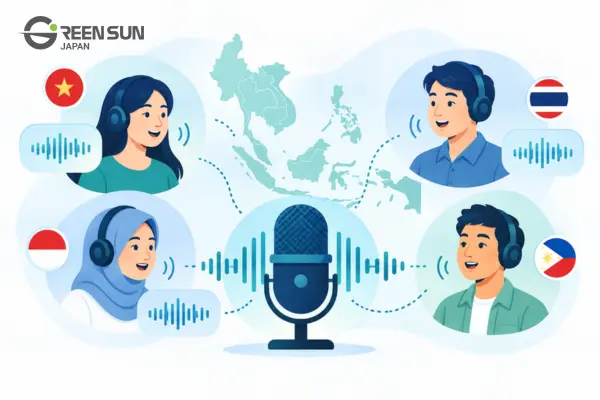
Speech data collection in Southeast Asia starts with a clear plan for who will speak, which languages and accents to cover, and how the recordings will be used. This guide covers speaker recruitment, consent, audio specifications, metadata, and quality checks for AI projects.

1. Define the speech data requirements
The dataset should match the intended AI application, cover the agreed languages and accents, meet the audio specifications, and have a documented basis for collecting and using the recordings.
The main requirements include:
- Languages and Regions: Identify target languages, accent groups, and distribution ratios based on the AI application’s needs.
- Participants: Recruit speakers based on age, gender, voice characteristics, and other criteria specified in the project brief.
- Consent: Inform speakers about the purpose of data collection and the permitted scope of data use, and document their consent.
- Audio Quality: Define file formats, recording specifications, equipment requirements, and recording conditions.
- Metadata and QA: Manage metadata, check recordings for errors and consistency, and verify that the data meets established acceptance criteria.
A speech collection project can include recruitment, recording, processing, QA, and delivery. Defining that scope early reduces the risk of unusable recordings or costly re-recording.
2. Build a speaker recruitment brief
A recruitment brief gives the collection team a practical description of the speakers and recordings the project needs.
2.1. Essential Information to Include in the Brief
Businesses should establish the key requirements before starting the project:
- Languages and Regions: Target languages, geographic areas, and regional accent groups to be included.
- Speaker Characteristics: Age, gender, native language, and other project-specific criteria.
- Data Volume: Number of participants, recording duration, and expected number of recording sessions.
- Recording Conditions: Equipment, recording environment, and remote or in-person recording methods.
- Participation Requirements: Ability to follow recording instructions, provide consent, and meet project schedules.
2.2. Screening and Verifying Participants
Once the brief is finalized, the data collection provider should evaluate speaker suitability by:
- Verifying language proficiency and regional accent characteristics against project requirements.
- Checking sample recording quality when necessary.
- Using unique identifiers to minimize duplicate participant recruitment.
- Establishing criteria for re-recording or replacing speakers who do not meet project requirements.
For example, a Vietnamese speech project might recruit speakers from Northern, Central, and Southern accent groups. The brief would specify the number of speakers and recording hours for each group, along with the equipment and recording conditions.
Use the brief to assess feasibility, estimate costs, and track recruitment against the agreed targets.
3. Plan language and regional accent coverage
A multilingual speech dataset should reflect the diversity of languages, regional accents, and speaker characteristics in the target market.
3.1. Identifying Target Languages and Accent Groups
Depending on the project scope, businesses should identify the languages and regional accent groups to be included. For example:
- Vietnamese: Recruit speakers across Northern, Central, and Southern accent groups, including specific regional variations when needed.
- Thai: Identify Standard Thai and relevant regional accent groups based on the intended application.
- Indonesian: Collect Standard Indonesian speech data along with pronunciation variations influenced by regional accents.
Coverage does not need to be equal across languages or accents. Set the distribution according to the intended users and the AI system’s requirements.
3.2. Monitoring Data Coverage
To minimize data gaps and imbalances, businesses should:
- Set Targets: Define the required number of speakers and recording duration for each language or accent group.
- Track Progress: Compare the data collected against the targets outlined in the project brief.
- Check for Duplicates: Ensure individual speakers do not contribute more than the permitted share of recordings.
- Supplement Data: Prioritize recruiting additional speakers for groups that have not yet met their targets.
Track actual coverage against the brief so the team can identify underrepresented groups and adjust recruitment before delivery.
4. Manage consent and data usage rights
Participants should understand why their voices are being recorded and how the recordings may be used, including any AI development or training use. Document the permitted uses before collection begins.
4.1. Essential Elements of a Consent Agreement
Before recording, confirm the applicable requirements and give participants clear information about:
- Purpose of collection: Explain the intended development, training, or evaluation use.
- Scope of Use: Specify which parties are authorized to access, use, and share the data.
- Data Retention Period: Define how long the data will be stored and how it will be handled after the project ends.
- Participant rights: Explain available access, withdrawal, and other request processes under the applicable rules.
- Consent Confirmation Methods: Document participant consent in writing or through appropriate electronic methods.
4.2. Controlling Data Access and Usage
Beyond obtaining consent, businesses should manage data access and usage throughout the project by:
- Using unique speaker identifiers instead of directly identifiable personal information where appropriate.
- Restricting data access based on roles and responsibilities.
- Maintaining consent records for verification and review.
- Establishing procedures for handling consent withdrawal and data deletion requests in accordance with applicable regulations.
Data protection requirements differ across Southeast Asia. Have the appropriate privacy or legal reviewer check the collection, consent, retention, and cross-border transfer requirements for the project. A consent form alone does not establish compliance.
5. Set recording specifications and metadata requirements
Set audio specifications and metadata requirements before recruitment so contributors and reviewers use the same requirements.
5.1. Defining Technical Recording Standards
Depending on the project’s objectives, businesses should specify the following recording parameters and conditions:
- Audio format and encoding: Specify the required container, such as WAV, and encoding, such as PCM, separately.
- Technical Specifications: Sample rate, bit depth, and number of audio channels.
- Recording Equipment: Smartphones, dedicated microphones, or other approved recording devices.
- Recording Environment: Quiet spaces or environments with background noise, depending on the data collection scenario.
- Audio Quality: Minimize distortion, audio dropouts, improper volume levels, and truncated recordings.
Technical specifications should be clearly documented in the project brief to ensure consistent recording practices among participants and quality assurance teams.
5.2. Managing Speech Data Metadata
Metadata describes the recordings and helps the team organize, find, and verify them. Common fields include:
- Speaker ID: A unique identifier for each speaker.
- Language/Dialect: The language and regional accent group.
- Recording ID: A unique identifier for each audio file or recording session.
- Device/Environment: Information about the recording equipment and environment.
- Duration: The length of the audio recording.
- QA Status: The quality assurance status of the recording.
Agree on file names, folder structure, and metadata formats, such as CSV or JSON, before delivery.
Collect only metadata needed for the project. Limit directly identifying information and keep participant records separate from recording files where appropriate.
6. Segment, transcribe, and check the recordings
Review the recordings against the project requirements before delivery. Depending on the scope, this may include segmentation, transcription, speaker labels, and timestamps.
6.1. Speech Data Segmentation and Transcription
Depending on the AI development objectives, businesses may require:
- Segmentation: Divide audio recordings into segments based on sentences, speaker turns, or specified time intervals.
- Transcription: Provide text that corresponds to the recorded speech when required by the project.
- Speaker Labeling: Assign speaker identifiers to individual audio segments.
- Timestamps: Mark the start and end times of each audio segment.
These requirements should be clearly defined in the project brief to ensure consistency in data processing and delivery formats.
6.2. Data Quality Assurance (QA) Criteria
QA should check both the audio and the accompanying information:
- Audio Quality: Check for background noise, distortion, audio dropouts, or truncated recordings.
- Information Accuracy: Verify language, regional accent groups, and speaker IDs against the metadata.
- Technical Specifications: Check file formats, recording duration, and technical parameters.
- Completeness: Confirm the number of files, total recording duration, and required metadata fields.
- Segmentation and Transcription: Verify alignment between audio recordings, segments, and transcripts when included in the project scope.
6.3. Handling Data That Does Not Meet Requirements
Files with identified errors should be classified and handled according to the agreed-upon acceptance criteria:
- Technical Errors: Request re-recording or replacement of files that do not meet technical standards.
- Incorrect Metadata: Verify and correct information using validated records.
- Insufficient Coverage: Recruit additional speakers or collect more recording hours for groups that have not met their targets.
- Segmentation or Transcription Errors: Correct the errors and recheck the data before acceptance.
Agree on inspection methods, acceptance thresholds, and the process for rework before collection starts.
7. Check coverage and quality before delivery
The Coverage × QA table helps businesses assess speech data coverage and quality against the original project requirements. It focuses on four key areas: Coverage, which tracks speaker numbers, recording duration, and distribution ratios; Quality Assurance (QA), which evaluates data quality, pass rates, and errors; Consent, which verifies participant consent and compliance with applicable data usage requirements; and Acceptance, which ensures that only deliverables meeting the agreed-upon criteria are approved.
| Category | Coverage | Quality Assurance (QA) |
|---|---|---|
| Language | All target languages are represented. | Verify language accuracy. |
| Regional Accents | All regional accent groups specified in the brief are represented. | Verify regional accent labels. |
| Speakers | The required number of speakers and target participant groups are covered. | Verify speaker information and check for duplicates. |
| Audio | Required recording durations and conditions are met. | Check for background noise, audio dropouts, and compliance with file format requirements. |
| Metadata | All required metadata fields are included. | Verify metadata accuracy and consistency. |
| Consent | All required participant consent records are available. | Verify consent scope and status. |
| Segmentation/Transcription | All required segments and transcripts are included. | Verify alignment between audio recordings and corresponding labels or transcripts. |
Use this table as a planning template. Set coverage targets, verification methods, and acceptance thresholds for the specific project.
8. Conclusion
A usable speech dataset depends on more than recording hours. Recruitment, coverage, permitted uses, metadata, and quality checks all need to match the intended application.
Agree on the brief and acceptance criteria first, then track coverage and quality throughout collection. Resolve gaps and errors before final delivery.

9. Frequently Asked Questions (FAQ)
Q1. How Can Businesses Ensure Regional Accent Coverage in ASEAN Speech Data Collection?
Businesses should identify target regional accent groups and allocate the required number of speakers and recording duration for each group. During data collection, they should compare actual coverage against the project brief to identify underrepresented groups and collect additional data where needed.
Q2. Is Participant Consent Required Before Collecting Speech Data?
Businesses must establish an appropriate legal basis before collecting speech data. When relying on consent, participants must be clearly informed about the purpose of data collection, the scope of data use, the retention period, and their rights under applicable regulations.
Q3. What Technical Standards Should Vietnamese, Thai, and Indonesian Speech Data Meet?
Vietnamese, Thai, and Indonesian speech data should meet project-specific requirements for audio format, sample rate, bit depth, number of channels, recording conditions, and metadata. The exact technical specifications depend on the intended AI application and should be agreed upon in the project brief.
Q4. What Should Businesses Prepare When Requesting a Speech Data Collection Quote?
Businesses should provide details about target languages and regional accent groups, the required number of speakers, recording duration, technical specifications, consent requirements, metadata, quality assurance (QA), and delivery scope. This information helps the service provider evaluate the workload and prepare an accurate quote.
Green Sun supports AI speech data collection and annotation, including recruitment, audio processing, transcription, and QA. Share your project requirements, target languages, speaker criteria, audio specifications, and delivery format to discuss the scope.