A revision request may concern an error, an updated source, or a preference for different wording. Check the source version and original requirements before deciding what needs to change, who will handle it, and whether it falls within the agreed scope.
Direct Answer
Compare the delivered translation with the source version and requirements used for the project. A mismatch may be a translation error; a later source update or a new wording preference needs a separate assessment. Agree on the scope, responsibility, and deadline before making revisions.
Key Takeaways
- Classify the request: Separate errors, source changes, and stylistic preferences.
- Check the evidence: Review the original source, delivered file, glossary, and brief.
- Agree on the work: Confirm revisions, deadlines, and any charges under the service agreement.

1. How to Distinguish Three Types of Post-Delivery Revision Requests
Classify each request against the source and requirements agreed at the start. The three categories below call for different actions.
1.1. Translation Error
A translation error occurs when the translation misrepresents the source text or fails to meet agreed requirements. Common issues include mistranslations, omissions, incorrect terminology, grammatical errors, and failure to follow style guidelines.
According to Multidimensional Quality Metrics (MQM), accuracy, terminology, and style issues are classified into separate error categories.
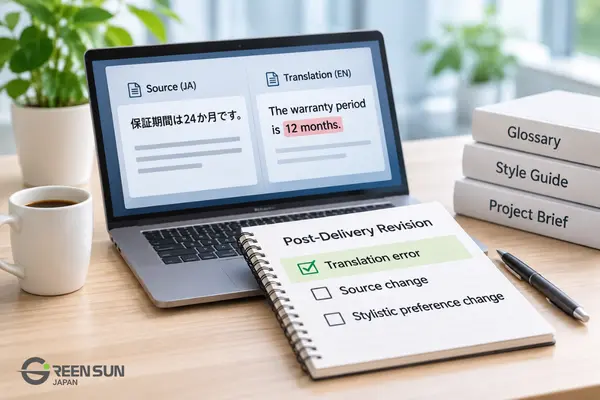
Example: The Japanese source states “保証期間は24か月です” (The warranty period is 24 months), but the English translation reads “The warranty period is 12 months.” This is a translation error because the warranty period does not match the source text.
1.2. Source Change
A source change occurs when a client modifies or adds to the source text after the translation has been completed. The resulting update request is not necessarily a translation error.
Check which source version the translator received and when the update was made. If the delivered translation matches that version, the new content is a source change.
Example: The original Japanese source states “納期は5営業日です” (The delivery time is five business days), correctly translated as “The delivery time is five business days.” After delivery, the client changes the source to “納期は7営業日です” (seven business days). This is a source update, not an error in the original translation.
1.3. Stylistic Preference Change
This type of request occurs when a client wants different wording, sentence structure, or tone, even though the existing translation is accurate and meets the original requirements.
The American Translators Association article on revision describes checking a target text against its source. For a wording request, also consult the project brief and approved style references before deciding whether the existing translation needs correction.
Example: The Japanese source “新しいコレクションをご覧ください” is translated as “Discover our new collection.” The client requests “Explore our new collection” instead. If both versions accurately reflect the source and meet the original guidelines, this may be a stylistic preference change.
However, if the translation does not follow the agreed style guide, the request may be classified as a quality issue.
📝Comparison of the Three Types of Revision Requests
| Request Type | Key Indicator | Basis for Classification |
|---|---|---|
| Translation error | Inaccurate translation or failure to meet requirements | Source text and original requirements |
| Source change | Source content has been updated | Version history |
| Stylistic preference change | Request for different wording | Project brief and style guide |
Base the classification on the source files and agreed requirements. A request for a change does not, by itself, establish that the translation was wrong.
2. How to Compare Source Texts, Translations, and Version History
Compare the source version, delivered translation, and original brief. Then review any later changes to determine why the requested revision is needed.
2.1. Review the Source Text and Delivered Translation
First, identify the source version used for translation and compare it with the delivered translation. Focus on the sections flagged for revision, particularly their meaning, numbers, terminology, and any potentially omitted information.
If the translation accurately reflects the original source, review the version history before classifying the request as a translation error.
2.2. Compare Version History and Original Guidelines
Compare the original source with the updated version, and review the project brief, glossary, and style guide to determine whether the requested revision falls within the agreed scope.
Example: The Japanese term “取扱説明書” was translated as “instruction manual,” but the client requests “user guide” instead. If “user guide” was specified in the original glossary, this may be a terminology error. If the requirement was introduced after delivery, the request should be treated as a new change.
2.3. Document Supporting Information and Revision History
A revision request evidence checklist should include:
- The source version and delivered translation.
- The location, details, and reason for the requested revision.
- Relevant reference materials or guidelines.
- The date of the change and the person who approved it.
This information can be recorded in a translation scope change log, along with the classification decision and revision status.
Keeping clear records helps both parties determine which requests fall within the original scope and which require additional agreement before revisions begin.
3. How to Agree on Revision Approach, Scope, and Deadlines
Agree on the changes, responsibilities, and deadline after classification. Use the service agreement to determine whether the work is included or needs a separate quote.
3.1. Determine the Appropriate Approach for Each Request Type
Each type of request requires a different approach:
- Translation error: Correct inaccurate translations or content that fails to meet the original requirements, and review related sections if necessary.
- Source change: Identify the changes to the source text and assess how much of the translation needs updating.
- Stylistic preference change: Clarify the preferred wording and check whether it aligns with the agreed project brief or style guide.
Example: A client requests replacing “instruction manual” with “user guide” throughout a document. If this terminology change was agreed upon after delivery, both parties should confirm the scope of the replacement and identify any sentences that may need further adjustments to maintain natural, consistent wording.
3.2. Agree on Revision Scope and Responsibilities
Before making revisions, both parties should confirm which requests fall within the original scope and which involve additional work. Classification helps clarify the reason for a request but does not automatically determine responsibility or revision costs.
For out-of-scope changes, the translation service provider should explain the additional work involved, communicate any extra charges, and obtain client approval. These details should be documented in writing to avoid misunderstandings.
3.3. Confirm Deadlines and Delivery Versions
Set the deadline according to the work, priority, and service terms. Confirm the final source version and consolidate feedback before the revision starts.
Once revisions are complete, the updated translation should clearly indicate its version number and the changes made. This helps both parties review the results, avoid using outdated files, and manage any future revision requests.
4. Examples of How to Classify Post-Delivery Revision Requests
The following illustrative Japanese-to-English examples show how the source, brief, and timing of a request affect its classification.
4.1. Translation Error: The Translation Does Not Match the Source
Example:
- Source text (JA): 本製品は屋内専用です。
- Delivered translation (EN): This product is suitable for outdoor use.
- Correct translation (EN): This product is for indoor use only.
Classification: Translation error. The delivered translation incorrectly describes how the product should be used, even though the source text has not changed.
Recommended action: Correct the error and review related sections. Responsibilities and revision deadlines should follow the original agreement.
4.2. Source Change: Information Updated After Delivery
Example:
- Original source text (JA): 受付時間は午前9時から午後5時までです。
- Delivered translation (EN): Business hours are from 9:00 a.m. to 5:00 p.m.
- Updated source text (JA): 受付時間は午前9時から午後6時までです。
Classification: Source change. The original translation was accurate, but the client changed the closing time from 5:00 p.m. to 6:00 p.m. after delivery.
Recommended action: Update the translation to “Business hours are from 9:00 a.m. to 6:00 p.m.” and confirm the revision scope and deadline according to the agreed terms.
4.3. Stylistic Preference Change: Adjusting the Tone
Example:
- Source text (JA): 詳細についてはお問い合わせください。
- Delivered translation (EN): Please contact us for more information.
- Client’s preferred wording (EN): Get in touch to learn more.
Classification: Stylistic preference change. Both versions convey the intended message. The client prefers a friendlier tone rather than correcting an error.
Recommended action: Confirm the preferred tone and identify which sections need updating. If the new request falls outside the original guidelines, both parties should agree on the scope before proceeding.
Classify the request using the source version and original requirements, then confirm the work needed to resolve it.
5. Conclusion
Check the source, delivered text, and original requirements before calling a revision an error. Record the reason for the change and agree on the scope, responsibilities, and deadline.
6. Frequently Asked Questions (FAQ)
Q1. Is changing the source text after delivery considered a translation error?
No. Changes to the source text after delivery are considered source changes, not translation errors. However, any errors in the original translation should be assessed and addressed separately.
Q2. What information and documents should be included in a translation revision request?
Include the source version, delivered translation, location of the requested change, proposed revision, and reason for the request. Attach a glossary or style guide if relevant.
Q3. Is a client’s request for different wording considered a translation error?
Not necessarily. If the translation is accurate and meets the original requirements, it is generally a stylistic preference change. However, failure to follow agreed guidelines may be a quality issue.
Q4. Are post-delivery translation revisions always free of charge?
No. Whether revisions are free or involve additional charges depends on the reason for the request, the scope of work, and the agreed service terms.
Need Professional Translation Services With a Clear Quality Control Process?
Green Sun Japan provides multilingual translation, revision, and quality checks against the agreed source and project requirements.
Explore Green Sun Japan’s translation services to find the right solution for your needs.