A dubbed video that sounds fluent is not necessarily ready for release. The translation may contain inaccuracies, proper names may be mispronounced, dialogue may be delivered too quickly to fit the available time, or voice usage rights may not have been clearly verified.
Even platforms like YouTube acknowledge that automatically generated dubbing can contain errors involving pronunciation, accents, background noise in the source audio, proper names, idioms, and specialized terminology. That’s why AI dubbing quality assurance should involve multiple layers of review rather than relying on a single listening pass or subjective judgment.
Direct Answer
AI dubbing quality assurance (AI dubbing QA) is the process of reviewing AI-assisted dubbed content before release. It involves six stages: verifying translation accuracy, checking proper names and pronunciation, aligning timing, evaluating naturalness, verifying voice usage rights, and approving the completed video.
Issues should be documented with timecodes, severity levels, and recommended corrective actions. Serious translation errors and unresolved voice usage rights must be addressed before release.
Key takeaways
- Dubbed content should not be evaluated solely on whether it “sounds natural.”
- Translation accuracy, proper names, numbers, and terminology should be checked before evaluating voice style.
- Sentence length directly affects speaking speed and synchronization with visuals.
- Voice usage rights are a separate approval requirement, not an audio quality issue.
- The person responsible for final approval should review the completed video in its entirety before release.
Contents
- 1. Verify Translation Accuracy Before Evaluating Voice Quality
- 2. Check Proper Names, Terminology, and Pronunciation
- 3. Review Timing and Synchronization with Visuals
- 4. Evaluate Speech Pacing and Naturalness
- 5. Verify Voice Usage Rights Before Approval
- 6. How Should Humans Approve the Final Dubbed Video?
- Conclusion
- FAQ (Frequently Asked Questions)

1. Verify Translation Accuracy Before Evaluating Voice Quality
If the content is inaccurate, even a natural-sounding voice cannot make the dubbed version acceptable.
The first step in AI dubbing QA is to compare the dubbed dialogue with the source material. Reviewers need to confirm that the target-language version preserves all essential information, introduces no unsupported details, and does not alter important elements such as numbers, dates, units of measurement, negative statements, or warnings.
Translation errors can be particularly difficult to detect by listening to the audio alone. An AI system can deliver a sentence with an incorrect meaning in a fluent, natural-sounding voice. Therefore, reviewers should examine the source dialogue, translated script, and corresponding audio together.
Errors that should be prioritized for correction include:
- Incorrect or missing information
- Omitted negative statements
- Incorrect numbers or units of measurement
- Incorrect product names
- Missing sentences
- Incorrect specialized terminology
- Dialogue assigned to the wrong speaker
In a multilingual dubbing review, content accuracy should take priority over issues involving voice quality, pacing, or emotional delivery.
2. Check Proper Names, Terminology, and Pronunciation
Personal names, brands, place names, and specialized terminology require separate checks because the written text may be correct even when the synthetic voice mispronounces it.
For example, YouTube’s automatic dubbing guidelines acknowledge that automated systems may struggle with proper names, idioms, and specialized terminology. This is why businesses should prepare a pronunciation checklist before approving the final dubbed version.
Items that should be reviewed individually include:
- Names of people and characters
- Company, brand, and product names
- Place names
- Abbreviations and acronyms
- Technical or industry-specific terminology
- Numbers and units when spoken aloud
For important names, an approved pronunciation should be established so reviewers have a clear reference. If a name has multiple possible pronunciations, neither the AI system nor the production team should guess when the business has an official pronunciation.
Pronunciation errors should be corrected when they misrepresent a name, create confusion, or noticeably affect the listening experience. Regenerating the entire audio track is not always necessary if only one segment contains an error. The affected segment can be corrected individually when the tools and workflow support it.
3. Review Timing and Synchronization with Visuals
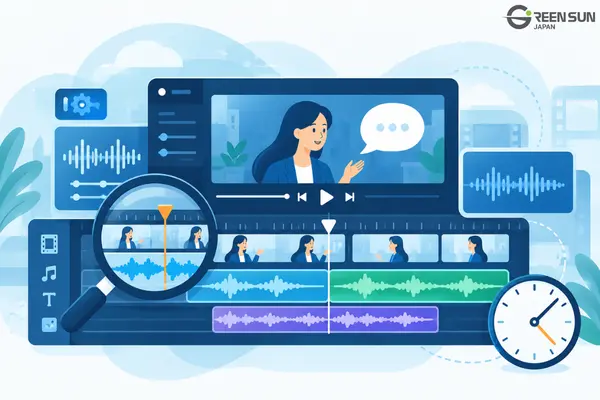
A translation may be accurate but too long for the original dialogue window, forcing the synthetic voice to speak unnaturally fast or fall out of sync with the visuals.
According to ElevenLabs’ documentation on using transcripts for dubbing, the start and end timestamps of individual segments are used directly to align dubbed audio. Translations that are significantly longer or shorter than the source can affect speech pacing.
During the review, check:
- Where each line of dialogue starts and ends
- Whether pauses occur at appropriate moments
- Whether speech is unnaturally accelerated to fit the available time
- Whether overlapping dialogue is handled correctly
- Whether dialogue extends into another scene
- Whether the audio ends too early or too late
If a sentence can only fit within the available time by increasing the speaking speed to an uncomfortable level, consider shortening the wording while preserving its original meaning. The goal is not to match the source word count exactly, but to achieve appropriate timing and clear, natural delivery.
It’s also important to distinguish timing synchronization from lip synchronization. Timing synchronization focuses on ensuring dialogue occurs at the correct point and follows the intended pacing of the content. Lip synchronization refers to how closely the audio matches a character’s mouth movements.
Agree on timing tolerances for the specific video format and viewing conditions before review. Use those criteria consistently when deciding whether a segment needs revision.
4. Evaluate Speech Pacing and Naturalness
Once translation accuracy and timing have been verified, the next step is to assess whether the voice sounds natural and fits the context.
In synthetic voice localization, naturalness is not simply about how closely an AI-generated voice resembles a real person. Reviewers should also evaluate speaking speed, stress, pauses, intonation, and emotional delivery.
Common warning signs include:
- A monotonous voice with little emphasis
- Stress placed on the wrong words
- Unnatural pauses between phrases
- Sudden changes in speaking speed
- Emotional delivery that does not match the scene
- Sentences that sound like disconnected segments stitched together
For example, Descript’s AI voice generation guidelines explain how punctuation can directly influence pacing and delivery. Meanwhile, ElevenLabs’ dubbing documentation notes that increasing similarity to the original voice may reduce naturalness in languages with different phonetic characteristics.
Therefore, a voice that sounds more like the original is not necessarily better localized. Voice identity may be important for character-driven or branded videos. For training and narration videos, intelligibility and natural pacing often deserve greater priority.
5. Verify Voice Usage Rights Before Approval
A dubbed video may meet audio quality requirements but still be unsuitable for release if the voice source or usage rights have not been verified.
Businesses should determine whether the voice comes from a preset voice library, was newly generated, or was cloned from a specific individual. If an individual’s voice is involved, consent and usage rights must be verified according to the service terms, contractual agreements, and applicable regulations.
For example, OpenAI’s current Service Terms prohibit using the Prompt-to-Voice feature to recreate a person’s voice without their explicit consent and the necessary rights. The terms also require disclosure that the voice content was AI-generated when this feature is used. These are requirements specific to that service and should not be generalized as identical rules across all platforms.
Before approval, verify:
- The source of the voice
- Who authorized its use
- Whether the permitted scope includes commercial use
- Whether restrictions apply to platforms, geographic regions, or usage periods
- Where consent records or approval documentation are stored
Platform terms, consent requirements, and legal regulations may change. They should be reviewed again based on the tools and markets involved when the project is implemented.
6. How Should Humans Approve the Final Dubbed Video?
The final version should be watched and reviewed as a complete video, as some issues only become apparent when audio, visuals, and scene transitions are combined.
The QA process should not end immediately after individual segments have been corrected. The person responsible for approval should review the completed video from beginning to end and recheck all modified segments.
The final checklist may include:
- Watch and listen to the entire video
- Recheck all corrected segments
- Verify proper names and terminology
- Confirm that dialogue is assigned to the correct speakers
- Check for clipped audio or missing sound
- Review scene transitions
- Confirm that no serious content errors remain
- Verify voice usage rights
- Record the person responsible for final approval
Issues should be documented using timecodes rather than vague feedback such as “the voice doesn’t sound natural.” For example, “00:01:22 – Product name mispronounced” or “00:02:45 – Speech is too fast.” This allows the production team to identify exactly which segment needs correction.
Illustrative Example: Logging Issues by Timecode
Consider a hypothetical AI-dubbed training video. The timecodes and issues below are provided solely to illustrate how QA findings can be documented. They do not represent data from an actual project.
The QA process may produce an issue log containing timecodes, error categories, priority levels, recommended corrections, resolution status, and approvers. The review scope, languages, and acceptance criteria should be agreed upon with the client in advance.
Classifying Issue Severity During Acceptance Review
- Critical: Incorrect meaning, omitted warnings, or unverified voice usage rights — suspend approval.
- High: Incorrect names, important terminology errors, or synchronization issues that cause misunderstanding — correct before acceptance.
- Medium: Speaking speed, pacing, or pronunciation issues that make the audio difficult to understand — correct according to project requirements.
- Low: Minor stylistic issues — evaluate against the agreed acceptance criteria.
These classifications are suggested quality management guidelines, not mandatory standards.
Example Issue Log by Timecode
| Timecode | Issue Identified | Priority | Recommended Action |
| 00:01:22 | Product name mispronounced | High | Check the terminology list and regenerate the segment |
| 00:02:45 | Sentence too long; speech is difficult to follow | Medium | Shorten the wording and readjust timing |
| 00:04:10 | Negative statement omitted | Critical | Correct the translation and review again |
| 00:05:30 | Unnatural pause | Low | Adjust the pause |
Error Categories, Detection Methods, and Recommended Actions
| Error Category | Detection Method | Recommended Action |
| Incorrect meaning or numbers | Compare against the source | Correct before release |
| Incorrect names or pronunciation | Listen and compare against the approved pronunciation list | Correct or regenerate the segment |
| Timing misalignment | Review the video and timestamps | Shorten the dialogue or readjust timing |
| Unnatural pacing | Have a linguistically qualified reviewer listen to the audio | Adjust or regenerate the segment |
| Unsuitable voice | Compare against project requirements | Reevaluate the segment or voice selection |
| Recurring errors | Review the entire dubbed version | Recheck the entire project |
| Unclear usage rights | Review supporting documentation | Withhold approval |
The table above provides a suggested review framework, not a mandatory legal standard or technical threshold.
Conclusion
AI dubbing quality assurance should go beyond asking whether a voice sounds human. A dubbed video should only be approved after passing six essential checks:
Accurate meaning → Correct pronunciation → Appropriate timing → Natural delivery → Verified usage rights → Final approval in the context of the complete video.
This layered approach also helps project teams distinguish issues that must be corrected from those that primarily affect the viewing experience, rather than assigning the same priority to every problem.
FAQ (Frequently Asked Questions)
Q1. Should translation accuracy or voice quality be reviewed first?
Translation accuracy should come first. If the content is incorrect, evaluating pacing, emotion, or voice naturalness offers limited value. Once the content has been verified, reviewers can proceed with audio quality checks.
Q2. Is it necessary to review the entire video again after making corrections?
Yes. Individual segments may sound fine on their own, but issues involving scene transitions, pauses, volume, or pacing between segments may still appear when everything is combined.
Q3. How should proper names be checked in AI-dubbed content?
Prepare a list of important names and their approved pronunciations. Then review the segments containing personal names, brands, products, or place names individually.
Q4. If a sentence is too long, should the voice be sped up or the translation shortened?
It depends on the situation. If increasing the speaking speed makes the dialogue difficult to understand or disrupts its natural rhythm, consider shortening the wording while preserving the original meaning.
Q5. Are lip synchronization and timing synchronization the same?
No. Timing synchronization focuses on when dialogue starts and ends and how it fits the video’s pacing. Lip synchronization focuses on how closely the audio matches mouth movements.
Q6. Can any AI-generated voice be used for commercial content?
Not necessarily. The voice source, service terms, scope of usage rights, and any required consent should be verified before release.
AI Dubbing Quality Assurance with Green Sun Japan
Your AI-dubbed video is complete, but are you confident in its accuracy, pronunciation, and listening experience before release?
Green Sun Japan can discuss the scope of multilingual dubbing review services, with a focus on the quality of the final dubbed content:
- Multilingual content review: Compare meaning, numbers, terminology, and proper names against the source material.
- Dubbing quality evaluation: Review pronunciation, timing, speech pacing, and naturalness.
- Timecoded issue reporting: Identify the exact segments requiring correction to support an efficient revision process.
- Final version review: Recheck the content and viewing experience after the necessary corrections have been made.
Contact Green Sun Japan with your target languages, video duration, source materials or transcript, and review requirements. Our team can discuss a suitable review scope covering content accuracy, pronunciation, timing, and timecoded issue reporting.