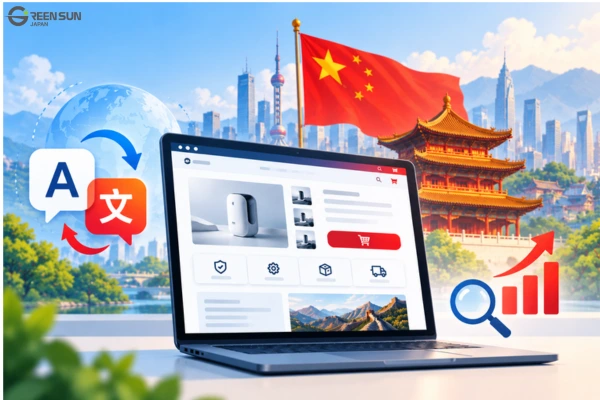
A Chinese website translation service involves more than converting source-language content into Simplified or Traditional Chinese. An effective localization project requires close coordination between product content, the user interface (UI), search intent, and the overall user journey.
Product pages, calls to action (CTAs), navigation menus, registration forms, and landing pages should be adapted to support the website’s business goals and user journey. At the same time, Chinese SEO localization should reflect how local users actually search on platforms such as Baidu or Google, rather than translating English keywords word for word.
📌 Key Takeaways / Direct Answer
- What the service should cover: Chinese website localization goes beyond text translation to address navigation structure, Chinese UI layout, form elements, and conversion paths.
- Chinese SEO principle: English keywords should not be translated directly into Chinese and treated as target keywords. Search terms should be validated against real user queries and aligned with search-engine guidelines, including Baidu’s recommendations on clear page titles and avoiding keyword stuffing.
- Localize CTAs around the intended action: Button copy should clearly reflect what happens after the click, such as requesting a quote, downloading a technical document, or starting a free trial.
- Test the live interface with Visual QA: Localized content should be reviewed in the actual website environment to identify issues such as text overflow, awkward line breaks, and incorrect multilingual links.
- Green Sun Japan localization support: The service covers website, software, and app localization, terminology consistency through glossaries and translation memory, SEO-related metadata localization, and display checks across different devices.
Contents
- 1. What Elements Should a Chinese Website Translation Service Cover?
- 2. How to Localize Product Pages for Better Conversion
- 3. Localizing CTAs, Menus, and Forms Around the User Journey
- 4. Build Chinese Landing Pages Around Search Intent
- 5. Core Technical Considerations for Chinese SEO Localization
- 6. Comprehensive QA Checklist Before Launching a Chinese Website
- 7. Conclusion
1. What Elements Should a Chinese Website Translation Service Cover?
Website translation focuses on accurately transferring content into the target language, while Chinese website localization also adapts the interface, navigation, search intent, and conversion journey for Chinese users. The localization scope should therefore be defined by individual website elements, not by text volume alone.
| Page Element | Localization Goal | SEO & UX Considerations |
|---|---|---|
| Product Title | Help users quickly identify the correct product or product line | Validate naming against how local users actually describe and search for the product |
| Product Description | Clearly communicate key functions, benefits, and technical specifications | Avoid literal keyword translation and use clear, natural wording appropriate for Chinese commercial content |
| Call to Action (CTA) | Guide users toward the next conversion action | CTA wording should accurately reflect what happens after the click |
| Menu & Navigation | Help users find the right content or product category | Avoid overly long labels that may cause navigation or layout issues |
| Forms | Collect inquiries, quotation requests, or service registrations | Review field labels, validation messages, and confirmation messages |
| Campaign Landing Pages | Match the specific search intent behind each campaign | Adapt headlines and information hierarchy to support fast scanning and decision-making |
| Title Tags & Meta Descriptions | Help search engines understand the purpose and content of each page | Avoid keyword stuffing and optimize copy for appropriate display on Baidu and Google |
| Internal Links | Guide users to relevant pages and supporting resources | Use natural, contextually meaningful anchor text |
| Image Alt Text | Support image indexing and accessibility | Localize alt text when the image provides meaningful product, technical, or contextual information |
2. How to Localize Product Pages for Better Conversion
Chinese product pages should be built around the information users need to understand, compare, and make a purchase decision, rather than simply translating each source paragraph.
- Prioritize information that directly influences decisions: Place the product line name, key use cases, technical specifications, quality certifications, and quote-request CTA in prominent positions where users can find them quickly.
- Preserve the accuracy of commercial information: Do not alter product claims, technical specifications, warranty terms, or payment conditions without confirmation from the relevant technical or business team.
- Keep product terminology consistent through a glossary: Product names, feature names, and model numbers should remain consistent across product pages, navigation menus, FAQs, and technical support materials.
3. Localizing CTAs, Menus, and Forms Around the User Journey
UI copy should be localized around the action users are expected to take at each stage of the website journey.
Typical conversion flow:
Landing Page ➔ CTA Button ➔ Form ➔ Validation Error Message ➔ Confirmation Page
Localize CTAs Based on the Expected Outcome
- Request a Quote: Use wording that clearly connects the CTA to a quote request, such as 获取报价.
- Download: Make it clear what users will receive, for example 下载产品目录 for a product catalog or 下载技术规格书 for a technical specification document.
- Contact Sales / Start Free Trial: Keep the wording concise, direct, and clear to encourage users to take the next step.
Keep Form Messaging Consistent
Field labels, placeholder text, validation messages, and success messages should follow a consistent tone and style throughout the form. Pronouns, level of formality, and action wording should also remain consistent so users do not encounter abrupt changes in tone during the conversion process.
4. Build Chinese Landing Pages Around Search Intent
A Chinese landing page does not always need to mirror the exact structure of its English source page, especially when local search behavior and purchasing patterns differ.
- Restructure the information hierarchy: Answer the three questions users are most likely to have as quickly as possible: What solution does this page offer? What is the core benefit? Where should I click to get advice or request support?
- Avoid literal translation of English keywords: Keyword research for the Chinese market should follow a search-intent-first process:
Source Keyword → Identify Search Intent → Research Natural Chinese Search Terms → Map Keywords to the Appropriate URL

5. Core Technical Considerations for Chinese SEO Localization
Effective Chinese SEO localization requires close coordination between localized content and the website’s technical setup.
Follow Baidu Search Resource Platform Guidelines
Baidu recommends page titles that are accurate, concise, and clearly reflect the page content. Excessive repetition or keyword stuffing in titles may reduce search visibility or cause Baidu to rewrite titles in search results.
Choose a title structure that clearly describes the page.
The exact format should still reflect the page’s actual purpose rather than forcing the same template across the entire website.
Use Clear URL Structures and Language Annotations
- Create separate URLs for each language or regional version: For example, /zh/ may be used for a general Chinese-language section, while more specific regional versions can use structures such as /zh-cn/, /zh-tw/, or /zh-hk/ when separate market targeting is needed.
- Implement hreflang correctly: Language and region annotations help search engines understand which localized page to show users in different markets.
- Keep internal links within the correct language version: Chinese pages should link to the corresponding Chinese-language content whenever possible, rather than unexpectedly sending users back to English pages.
Technical Note for Mainland China
If your website specifically targets users in mainland China, localization should also include testing for accessibility, page-load performance, and the availability of third-party resources in the target environment.
Hosting and CDN architecture may also need to be reviewed based on the website’s infrastructure, audience location, and performance requirements. These technical considerations should be treated separately from translation itself and evaluated as part of the broader China-market website strategy.
6. Comprehensive QA Checklist Before Launching a Chinese Website
| QA Category | Detailed Checks | Status |
|---|---|---|
| Linguistic QA | • 100% of visible content is in Chinese, with no unintended English strings left behind. • Product terminology and feature names are fully consistent with the approved glossary. • The wording is natural, professional, and free from overly literal machine-translation patterns. • The correct script is used consistently: Simplified Chinese or Traditional Chinese. | [ ] Pass |
| UX / Functional QA | • Chinese characters display correctly, with no missing-glyph or tofu-block issues. • CTA buttons and navigation labels do not overflow, wrap awkwardly, or break on mobile screens. • Forms, search filters, and the language switcher function correctly throughout the user journey. • Internal links point to the correct corresponding Chinese-language URLs. | [ ] Pass |
| SEO QA | • Title tags and meta descriptions are optimized for the search intent of each page. • hreflang annotations are implemented correctly for relevant language and regional versions. • Alt text for important images is localized where appropriate. • robots.txt directives and noindex tags do not unintentionally block important Chinese pages from being indexed. | [ ] Pass |
7. Conclusion
A Chinese website translation service creates the most value when it goes beyond text translation. A successful Chinese-language website should help users understand the product quickly, move through the conversion journey with minimal friction, and find content that matches their actual search intent.
By combining search-intent research, consistent product terminology management, and in-context visual QA, businesses can build a stronger digital foundation for reaching Chinese-speaking audiences across different markets.
Frequently Asked Questions (FAQ)
Q1. What is the difference between Chinese website translation and Chinese website localization?
Website translation mainly focuses on transferring the meaning of source-language content into Chinese. Chinese website localization goes further by adapting the overall user experience, including the UI layout, navigation, forms, search intent, and conversion flows. It may also include in-context testing to confirm that the localized content works correctly in the live website environment.
Q2. Do businesses need to localize the entire website at once?
Not necessarily. Businesses can begin with high-value pages such as the homepage, core product or service pages, campaign landing pages, and quote-request or contact pages. Once performance and traffic have been evaluated, localization can be expanded to blog content, support materials, and other lower-priority pages.
Q3. Does a Chinese website translation service include SEO keyword research?
Not always. SEO localization should be clearly defined in the project scope. A Chinese SEO localization process may include researching how local users actually search, rather than simply translating English keywords, and adapting title tags, meta descriptions, and page headings to match each page’s search intent.
Q4. Why is Visual QA important in website localization?
Reviewing text only in Word, Excel, or a translation management system cannot reveal many issues that appear after content is integrated into the website. Visual QA can identify problems such as truncated text, awkward button wrapping, missing Chinese glyphs, broken layouts, or links pointing to the wrong language version.
🚀 Comprehensive Chinese Website Localization Solutions from Green Sun Japan
Are you preparing to introduce your products or services to Chinese-speaking markets but unsure how to handle UI localization, terminology consistency, and SEO?
Green Sun Japan supports international businesses with specialized localization solutions for Chinese websites, software, and applications:
- 🌐 UI and conversion-flow localization: Adapt product pages, landing pages, navigation menus, CTA buttons, and forms to create a clear, natural user journey.
- 📝 Terminology and Translation Memory Management: Maintain consistent product names, technical specifications, and key terminology across pages and future content updates.
- 🔍 Visual QA and SEO support: Review localized content in the live website environment and support metadata, hreflang, and multilingual URL optimization for better search visibility on Baidu and Google.
👉 Contact Green Sun Japan to share your website and discuss a Chinese localization approach that fits your project.