

Professional Translation Workflow: From File Submission to Final QA
In a multi-language business environment, a single mistranslation can lead to flawed contracts, incorrect operational manuals, or misleading legal information. Therefore, what matters is not just the ability of the individual translator, but how the translation workflow is designed, whether it includes risk controls, and how it ensures translation quality assurance. This article will explain the professional translation process according to industry standards, clearly describing the translation process steps from file submission to final quality control, while highlighting how to combine human expertise and AI to optimize speed without compromising translation quality assurance.
· Key Factors That Ensure Accurate and Reliable Language Services
· Understanding the Complete Translation and Quality Control Process
· Choosing the Right Type of Translation for Business Documents
· Avoiding Translation Issues That Can Impact Business Performance
Contents
- 1. Overview of a Professional Translation Process
- 2. File Intake and Quotation Analysis in the Translation Workflow
- 3. Assignment and Translation in a Professional Translation Process
- 4. Editing, Proofreading, and QA to Ensure Translation Quality Assurance
- 5. Delivery and Human + AI Integration in the Translation Workflow
- 6. Why a Professional Translation Process Helps Reduce Risk
- 7. Conclusion
- FAQ

1. Overview of a Professional Translation Process
A professional translation process is a system of standardized steps designed to transform source files into complete translations that are accurate in meaning, terminology, formatting, and intended purpose. When a business applies a rigorous translation workflow, risks are significantly reduced because every potential error is met with a safeguard. This is why a translation workflow always accompanies input control, linguist vetting, multi-layered quality control, and technical checks before delivery.
In practice, many providers still think of the workflow process simply as “translate and deliver,” but in a professional translation process the roles of translation, editing, proofreading, and QA are always separate. This helps ensure consistent translation quality assurance across projects, especially when dealing with large volumes or multiple participants. When you understand the translation workflow, you will see why quotes vary, why timelines differ, and why quality can fluctuate even for the same language.
The central premise is that the translation process steps are not merely administrative tasks, but quality management mechanisms. If a single step is skipped, translation quality assurance will weaken, and a professional translation process becomes a high-risk operation.
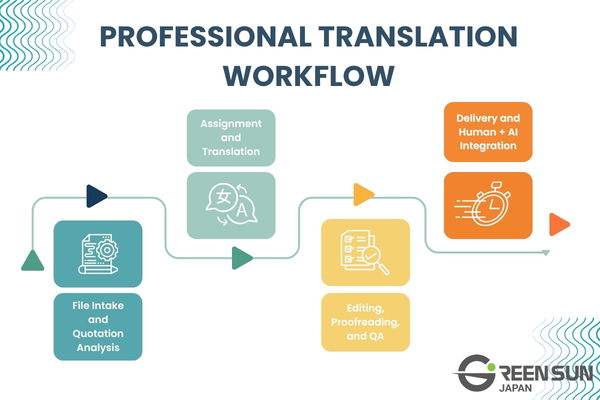
Professional Translation Workflow at a Glance
Roles and Responsibilities (RACI-lite)
Translator: Creates the draft translation based on the brief, terminology, and reference materials.
Editor: Checks for meaning, consistency, and logic, and polishes the flow according to the style guide.
Proofreader: Reviews “surface” errors (spelling, punctuation, formatting) and overall readability.
QA Specialist: Verifies the checklist (terminology, figures/units, proper names, tags/formatting). Project Manager (PM): Manages scope, schedule, delivery formats, and client feedback.
2. File Intake and Quotation Analysis in the Translation Workflow
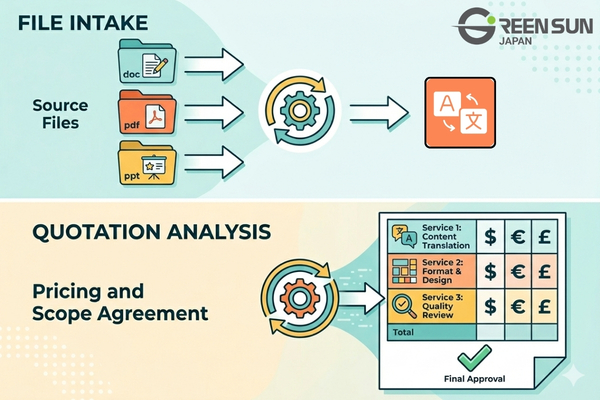
2.1. File Intake — Receiving Files and Requirements
The first step in the translation workflow is file intake. The client sends the files and describes the intended purpose, target audience, required delivery format, deadline, and reference materials. This is the starting point of the translation process steps, because if requirements are incorrect or missing, subsequent steps will require multiple revisions.
In a professional translation process, file intake also includes checking file processability—for example, are scanned PDFs, InDesign, multi-sheet Excel files, tagged files, or files with images being used? The goal is to reduce technical risks to ensure that translation quality assurance is not affected by file errors.
2.2. Analysis — Content and Risk Assessment
After file intake, the translation workflow moves to analysis. Here, the translation unit performs a quick read to determine the field, level of expertise, word count, repetition rate, formatting requirements, and terminology risks. If the documents are medical, legal, or technical, the translation process steps need an extra layer of control to ensure translation quality assurance.
In a professional translation process, analysis typically includes:
- Identifying mandatory terminology, style guides, numbering rules, and measurement units.
- Checking for sensitive content, safety warnings, and legal terms.
- Evaluating the required levels of editing and QA.
2.3. Quotation — Pricing and Scope Agreement
Quoting when following a translation workflow is not just based on word count, but also on the scope and level of control. A professional translation process will have clearly separate packages that offer translation only, editing included, proofreading included, or QA included, so customers can choose based on risk. When high translation quality assurance has to be ensured, a package that includes all translation process steps, especially editing, proofreading, and QA should be chosen.
At this stage, both parties agree on:
- The scope of what to translate and what not to translate.
- Terminology standards and reference materials.
- Delivery formats.
- Response time for queries.
When the scope is clear, the translation workflow becomes stable, minimizes unforeseen issues, and ensures better translation quality assurance.
3. Assignment and Translation in a Professional Translation Process
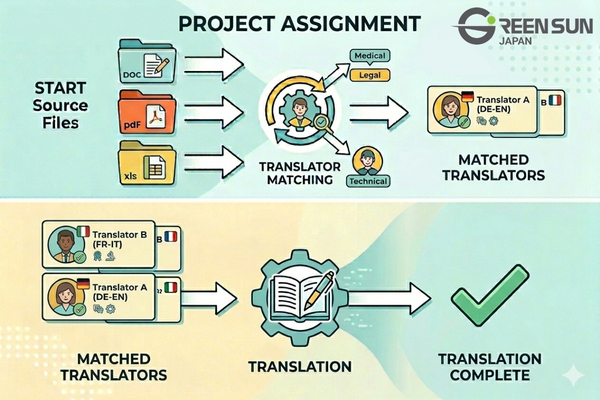
3.1. Translator Assignment — Matching the Right Linguist
A professional translation process does not assign translators randomly. A technical project needs someone with a technical background, a marketing project needs a creative thinker, and a legal project needs someone who understands clause structures. This is a vital step in the translation workflow because assigning the wrong person leads to root-cause failures.
Among the translation process steps, assignment also includes pairing translators with editors, establishing Q&A channels, and preparing resources such as glossaries, TMs (translation memories), and style guides. The goal is to create a foundation for translation quality assurance right from the start.
3.2. Translation — Executing According to Standards
In the translation step, the linguist does not just convert languages but adheres to communication goals, terminology, tone of voice, and formatting requirements. A good translation workflow will require the translator to:
- Stick to the meaning and intended use.
- Use the correct synchronized terminology.
- Note any ambiguities to be handled in the next step.
- Not arbitrarily omit any content.
When translation is performed following a professional translation process, translation quality assurance will increase significantly because errors are not made in the first place.
3.3. In-process Control to Ensure Translation quality assurance
Some common risks in translation include numerical errors, wrong units, mistranslated names, incorrect operational instructions, or misinterpreted negatives. Therefore, the translation workflow often has controls during translation, such as numerical checklists, terminology checklists, and self-checking before moving to editing. This is the level 1 layer of translation quality assurance.
The more layers there are to the translation process steps, the lower the risk, and that is the essence of a professional translation process.
4. Editing, Proofreading, and QA to Ensure Translation Quality Assurance
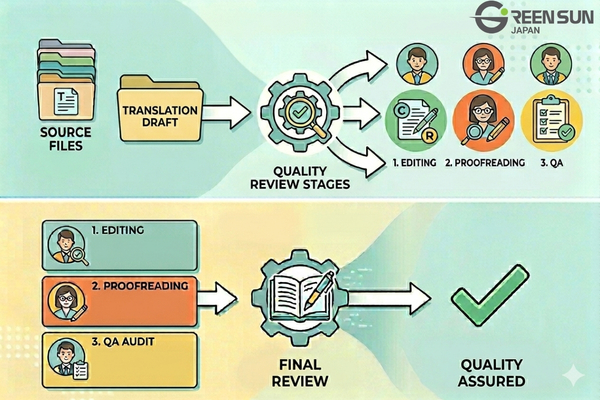
4.1. Editing, Proofreading, and QA to Ensure Translation Quality Assurance
After translation, the draft enters editing. The editor checks for accuracy in meaning, fluency, correct terminology, and consistency across the document. Editing is the center of translation quality assurance because it fixes errors that a translator might easily overlook when working alone.
In the translation workflow, editing typically handles:
- Hard-to-understand sentences or those that follow the source structure too closely.
- Terminology used inconsistently between sections.
- Logical errors, reference errors, and heading errors.
- Tone of voice consistency according to the style guide.
This is one of the translation process steps that illustrates a major difference between ordinary translation and a professional translation process.
4.2. Proofreading — Surface Error and Readability Check
Proofreading focuses on spelling, punctuation, formatting, line breaks, spacing errors, table errors, and overall readability. For documents to be published or sent to end-clients, proofreading is mandatory to ensure translation quality assurance.
In the translation workflow, proofreading is the level 2 layer of translation quality assurance, helping the translation stay clean, usable, and free of misunderstandings.
4.3. QA — Final Quality Audit Based on Defined Criteria
QA in a professional translation process is not just about re-reading. QA often uses checklists and tools to detect consistency errors, numerical errors, tag errors, terminology errors, and missing translations. QA also checks for correct formatting, structure, and delivery requirements.
✅QA Checklist (Quick Version)
- Terminology: consistent glossary/termbase, ensuring no mixed spellings or variations.
- Figures & units: decimal points, currencies, dates, and units of measure follow correct conventions.
- Proper names: company, product, locations, and characters are spelled correctly and consistently.
- Formatting: tables, line breaks, spacing, and punctuation remain intact and are not broken.
- Tags/placeholders: variables, links, technical symbols, and codes/IDs are accurate and unaltered.
- Tone of voice: appropriate for the channel (contracts, emails, technical documentation, marketing).
If translation quality assurance for technical documents is needed, QA is even more important because a small error can become an operational failure. This is where risks within the translation process steps are mitigated.
5. Delivery and Human + AI Integration in the Translation Workflow
5.1. Delivery — Correct Formatting and Post-delivery Support
Delivery is not just about sending a file. In a translation workflow, delivery includes a final check of formatting, filenames, versions, and instructions for using the translation. If there are bilingual files, clean files, or files with track changes, they must be clearly labeled.
A professional translation process also has a post-delivery support mechanism—for example, fixing minor errors, explaining terminology choices, and updating the glossary to ensure better translation quality assurance for the next time.
5.2. Human + AI Integration — Accelerating Without Losing Control
AI can speed things up, but if used incorrectly, it increases risk. The right way in a translation workflow is to use AI at support points without replacing quality control steps. For example:
- Use AI to suggest drafts, then the translator takes responsibility for refining them.
- Use AI to detect inconsistencies, then the editor decides if the inconsistency needs to be removed.
- Use AI to check terminology, then QA confirms whether the terminology is correct.
The key point is that the translation process steps still maintain the human role in semantic and risk-related decisions. When combined correctly, such a professional translation process is both fast and ensures translation quality assurance.
6. Why a Professional Translation Process Helps Reduce Risk
Supporting Data (Why Process & QA Matter)
According to a CSA Research Survey of 8,709 consumers across 29 countries, 76% prefer to buy products when information is in their native language; and 40% state they will never purchase from websites in a different language.
Furthermore, according to CSA Research: 75% of respondents are more likely to purchase from the same brand again if customer support/care is provided in their own language.
ISO 17100:2015: Outlines the requirements for high-quality translation services, emphasizing that structured processes and multiple review/QA layers are critical components to meeting client needs and mitigating risk.
📝 References:
- Bromberg & Associates (2024): Summary of the 2019 CSA Research survey on multilingual shopping behavior: 76% prefer buying in their native language; 40% do not buy from websites using other languages.
- CSA Research – Multilingual Digital Opportunity (Insights): 75% of respondents are inclined to repeat purchases if customer care is in their own language.
- ISO (ISO 17100:2015): Translation services — Requirements for translation services.
6.1. Structured Workflow Reduces Systemic Errors
Without a translation workflow, errors often do not appear immediately. They accumulate and then cause problems—and worse—during the publication or operational phase. A structured workflow helps detect errors early because each step has its own criteria. This is why translation process steps always have multiple layers, and why a professional translation process is considered a critical safeguard for your content.
For example, a translation might be accurate in meaning but inconsistent in terminology. Editing will catch this. Proofreading will catch surface errors. QA will catch numerical and formatting errors. Thus, translation quality assurance does not merely depend on luck.
6.2. Standard Workflow Optimizes Long-term Costs
Many businesses think the more steps a translation workflow has, the more expensive it is. But in reality, translation errors cause much higher costs because they create rework, internal disputes, delays, and legal risks. When a professional translation process is applied, it reduces revision cycles, minimizes disputes, and speeds up future projects as glossaries and resources are reused.
In other words, the translation process steps are prevention costs, while translation errors are correction costs. If translation quality assurance is a priority, a standard workflow is the logical choice.
6.3. Practical Checklist for Immediate Application
- Always describe the purpose and identify the target audience when sending files so the translation workflow runs in the right direction.
- Always agree on terminology from the start so that the translation process steps do not require backward corrections.
- Always require editing and QA for high-risk documents to ensure translation quality assurance.
- Always check delivery formats so that the professional translation process does not suffer from technical errors.
- Professional translation workflow includes: analysis → translation → editing → proofreading → QA to ensure accuracy and consistency.
- Terminology management (glossary/termbase) + checking figures/formatting helps mitigate risks in legal, technical, and business documentation.
- Multi-layered review processes help reduce corrections, shorten feedback loops, and protect corporate reputations when operating multilingually.
7. Conclusion
To ensure there is a professional translation process from file submission to final quality check in place, it is crucial to choose a provider with a clear translation workflow, assigned responsibilities for each step, a terminology system, and a multi-layered translation quality assurance mechanism. Green Sun Japan provides translation services following industry-standard translation workflows in which we implement all the necessary translation process steps, including file intake, analysis, correct personnel assignment, translation, editing, proofreading, QA, and formatted delivery. The strength of Green Sun Japan lies in terminology and quality control that follows a professional translation process, helping businesses reduce risks, save time on revisions, and feel secure when using translations for operations, legal, technical, or communication purposes.
FAQ
Question 1: Why is a translation workflow needed instead of just “translate and deliver”?
Answer: Because a translation workflow has control layers that help ensure stable translation quality assurance and reduce the risk of errors occurring.
Question 2: What are the minimum translation process steps required?
Answer: At a minimum, there should be file intake, analysis, translation, editing, proofreading, QA, and delivery to fulfill the spirit of a professional translation process.
Question 3: What does translation quality assurance usually check?
Answer: It checks for accurate meaning, terminology, consistency, figures, formatting, surface errors, and delivery requirements, depending on the document’s risk level.
Question 4: Does Human + AI integration reduce quality?
Answer: Not if AI only acts as support and humans retain semantic decisions, and provided the translation process steps still include editing, proofreading, and QA.
Question 5: When should I choose a full professional translation process?
Answer: When documents involve contracts, safety, operations, technical instructions, or published content, as these require high and consistent translation quality assurance.
Do you need to translate important documents and want to control risks from file submission to final QA?
Contact Green Sun Japan now for a free consultation on the right translation workflow for you, receive a fast quote, and get standard translations following a professional translation process, ensuring consistent translation quality assurance for your business.