

Simplified vs Traditional Chinese: Which One Is Right for Your English-to-Chinese Translation?
Have you invested in Chinese translation for your website or business documents but still failed to achieve the results you expected? One common reason is choosing the wrong Chinese writing system for your target market.
Although both are forms of written Chinese, users in Mainland China, Taiwan, and Hong Kong differ in the writing systems, vocabulary, and language conventions they use. Choosing the wrong version can make your website, documents, or marketing materials feel unnatural, reduce user trust, and weaken the overall impact of your message.
Choosing the right writing system is also a key part of Chinese localization. In this article, we’ll explain the differences between Simplified and Traditional Chinese and show you how to choose the right version when translating Chinese content for different markets.

1. Understanding the Two Chinese Writing Systems
Chinese is a complex language with thousands of years of history. In modern written communication, however, it is especially important to understand the difference between the two main writing systems.
1.1. What Are Traditional Chinese and Simplified Chinese?
📝 Traditional Chinese
Traditional Chinese uses the original forms of Chinese characters and preserves much of their classic structure. This writing system is mainly used in Taiwan, Hong Kong, and Macau.
Compared with Simplified Chinese, Traditional Chinese characters generally have more strokes and are often associated with a more formal, cultural, and traditional feel.
📝 Simplified Chinese
Simplified Chinese uses simplified forms of traditional Chinese characters. It was developed to reduce the number of strokes and make reading and writing more accessible. Today, it is primarily used in Mainland China, Singapore, and parts of the Chinese-speaking community in Malaysia.
Simplified Chinese is often seen as more modern, straightforward, and suitable for broader audiences.
Below are some examples of equivalent words in Traditional and Simplified Chinese:
| Traditional Chinese | Simplified Chinese | English meaning |
|---|---|---|
| 學校 | 学校 | School |
| 國 | 国 | Country |
| 體驗 | 体验 | Experience |
1.2. Simplified vs Traditional Chinese: Key Differences
Many people assume that simply converting characters between Simplified and Traditional Chinese is enough. In reality, the differences go far beyond character forms. They also include local vocabulary, writing style, and user expectations.
The table below provides a general comparison between Simplified and Traditional Chinese.
| Criteria | Simplified Chinese | Traditional Chinese |
|---|---|---|
| Main regions of use | Mainland China, Singapore | Taiwan, Hong Kong, Macau |
| Writing system | Simplified character forms | Traditional character forms |
| Impression | Modern, widely used, direct | Formal, refined, and more traditional |
| Vocabulary | Based on Mainland Chinese usage | Based on Taiwan/Hong Kong usage |
| Writing style | Direct and concise | Softer and more nuanced |
| Common search engines | Baidu | Google, Yahoo Taiwan |
| Language codes | zh-CN, zh-SG, zh-Hans | zh-TW, zh-HK, zh-Hant |
📝 Differences in Local Vocabulary
This is an area many businesses overlook when working on English-to-Chinese translation. The same concept may be expressed very differently by users in Mainland China, Taiwan, and Hong Kong.
For example, if a technology company translates “software” as 软件, it will sound natural to users in Mainland China. However, for customers in Taiwan, 軟體 is the more familiar term. Similarly, “taxi” is commonly translated as 出租车 in Mainland China, while 計程車 is more widely used in Taiwan.
🗨️ This shows that the difference between Simplified and Traditional Chinese is not just about “changing fonts.” It is directly tied to your target audience, Chinese localization strategy, and the professionalism of your brand.
2. How to Choose Between Simplified and Traditional Chinese
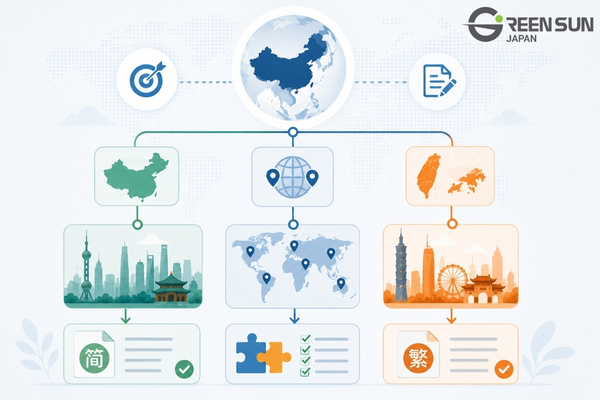
Choosing the right Chinese version should be based on two key factors:
・Target region
・Type of content being translated
2.1. Choose Based on the Target Region
This is the most important criterion. Where do you want to reach your customers?
🌏 Targeting Mainland China → Use Simplified Chinese
Simplified Chinese is the right choice if your business wants to reach customers in Mainland China, optimize content for Baidu, or promote products and services on platforms such as WeChat, Xiaohongshu, Weibo, and other local channels. For businesses planning English-to-Chinese translation for the Mainland China market, Simplified Chinese is usually the standard option.
🌏 Targeting Taiwan or Hong Kong → Use Traditional Chinese
Users in Taiwan and Hong Kong are more familiar with Traditional Chinese. If your business uses Simplified Chinese for these markets, the content may still be understandable, but it can feel less localized and less carefully adapted to the audience. This is especially important for industries where trust, professionalism, and brand image matter, such as finance, education, luxury products, legal services, and corporate communication.
🌏 Targeting Multiple Markets → Localize Separately
If your content needs to reach users in multiple Chinese-speaking markets, separate localization is the best approach. Instead of using one general translation for all regions, businesses should adapt the content for each market. This improves accuracy, reduces misunderstandings, and creates a more localized experience for readers in each market. In other words, effective Chinese localization is not only about language—it is also about market fit.
2.2. Choose Based on Industry and Content Type
📌 Technical, Medical, and Legal Documents:
These fields require a high level of accuracy in specialized terminology. Mainland China, Taiwan, and Hong Kong may use different legal, technical, or medical terms. For this reason, businesses should choose the appropriate writing system along with the terminology standards used in the target region. This is especially important when translating Chinese content that may affect compliance, safety, product usage, or legal interpretation.
📌Marketing and Branding Materials:
For marketing and branding, the choice between Simplified and Traditional Chinese often depends on audience expectations and brand positioning. Traditional Chinese is often suitable for premium products, cultural content, art-related materials, and brands that want to create a refined or classic impression. Simplified Chinese, on the other hand, is usually more suitable for modern, dynamic, and mass-market campaigns targeting Mainland China.
📌 Technology and E-Commerce Content:
For technology and e-commerce, the right Chinese version is closely connected to user experience and search behavior. Product pages, app interfaces, checkout flows, help centers, and customer support content should match the language habits of your target users. In this field, choosing the right writing system can also support SEO, improve product visibility, and make the customer journey smoother.
📌 Education and Academic Materials:
Traditional Chinese is often used in historical, cultural, and classical studies, especially in Taiwan and Hong Kong. Simplified Chinese is more commonly used in general education, professional training, and modern skills-based learning in Mainland China and other markets where Simplified Chinese is standard.
🗨️ In short, understanding the characteristics of each field helps businesses go beyond “correct translation” and achieve accurate, professional, and trustworthy localization for their target readers.
3. Common Mistakes in English-to-Chinese Translation
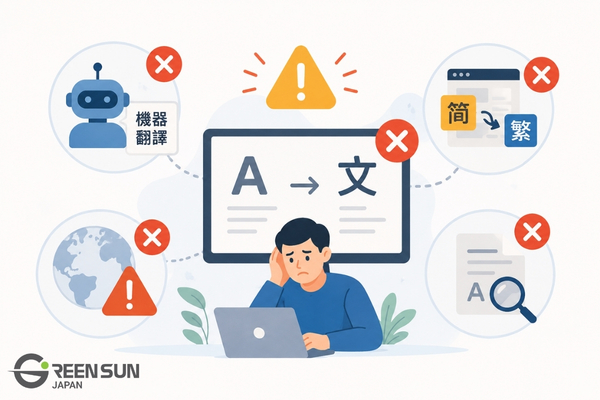
Based on our experience supporting clients across different industries, we often see the following mistakes reduce business credibility and weaken overall communication.
❌ Using One Translation for Every Market
The idea that “Chinese is Chinese, so one version is enough” is a major mistake. Users in Taiwan, Hong Kong, and Mainland China have different language habits, cultural expectations, and preferred expressions.
❌ Relying on Automatic Conversion Tools
Simplified-to-Traditional conversion tools only change character forms. They do not adjust writing style, local vocabulary, or cultural context. As a result, the content may sound awkward or unnatural to native readers.
❌ Overusing Machine Translation or AI
AI can help speed up the translation process, but it often misses cultural nuances and specialized terminology, especially in legal, technical, medical, or marketing materials. For professional English-to-Chinese translation, human review is still essential.
❌ Skipping QA or Native Review
Publishing translated content without quality assurance or native review can lead to formatting issues, terminology errors, or even serious cultural misunderstandings. This is especially risky when translating Chinese content for official documents, public websites, or customer-facing materials.
❌ Ignoring Local SEO
For websites and marketing campaigns, translation alone is not enough. If the content is not optimized with keywords based on local search behavior, your website may miss valuable traffic and your marketing costs may increase. This is where Chinese localization plays an important role.
🗨️ These are the reasons more businesses are taking multilingual translation and localization seriously instead of relying only on automatic tools.
4. Chinese Localization Strategy
Localization is more than translation. It is the process of adapting content, documents, or products so they feel natural and fully aligned with the target market. Below are several strategies for effective Chinese localization.
・Identify the Correct Writing System and Target Region: Choosing the right writing system—Simplified or Traditional Chinese—and the appropriate language variant, such as zh-CN, zh-TW, or zh-HK, from the beginning helps your content feel more natural and trustworthy to local audiences. It also helps businesses avoid unnecessary revision costs later in the project.
・Build a Glossary and Style Guide: For industries such as engineering, healthcare, legal, or finance, businesses should establish a terminology glossary and style guide before the project begins. This helps maintain consistency across all materials and creates a more professional impression.
・Localize Based on Content Type: Different types of content require different localization approaches. For example:
・Website / E-commerce → prioritize SEO and local keywords
・App / Game → focus on UI and user experience
・Manuals / Technical documents → prioritize accuracy and terminology consistency
When businesses translate Chinese content, adapting the localization strategy to the content type is just as important as the translation itself.
・Use Translation Technology Effectively: Professional translation providers often use CAT tools and Translation Memory systems to standardize terminology, maintain consistency across projects, and improve quality control. In modern English-to-Chinese translation workflows, combining AI with human review can also help optimize translation costs while maintaining quality.
・Native Linguistic Quality Assurance (LQA): All translated materials should be reviewed by native language specialists who understand the target market. This step helps ensure the content is culturally appropriate and aligned with local language habits and expectations. Not all translation companies provide native review or linguistic QA, so businesses should confirm this before choosing a translation service.
🗨️Businesses should view Chinese localization as an important part of their global expansion strategy, not simply a translation step.
5. Conclusion
Choosing between Simplified and Traditional Chinese is not simply a matter of changing character forms. It is a deeper localization decision that involves culture, audience expectations, and industry-specific communication.
To succeed in Chinese-speaking markets, businesses need to identify the right target region, understand the characteristics of their content, and avoid common mistakes such as relying too heavily on machine translation or automatic conversion tools. A well-planned Chinese localization strategy, combined with professional language expertise, can help your message sound more natural, professional, and effective for your target audience.
Why Choose Green Sun Japan for English-to-Chinese Translation?
Green Sun Japan provides professional English-to-Chinese translation and Chinese localization services tailored to your target market.
✅ Accurate Simplified & Traditional Chinese localization
✅ Native linguists with industry expertise
✅ CAT tools, Translation Memory, and AI-assisted workflows
✅ Strict quality assurance before delivery
👉 Need help choosing the right Chinese version for your content?
Contact Green Sun Japan for a free consultation.