Japanese AI translation is gaining attention among businesses for its ability to process content quickly, handle large volumes of text, and create useful first drafts for emails, internal documents, product descriptions, and website content. As AI becomes more common, many companies are starting to see a Japanese AI translator as a practical support tool for saving time and streamlining multilingual content workflows.
However, Japanese has many language-specific features, including heavy context dependency, honorific expressions, omitted subjects, and subtle communication nuances. Because of this, AI-generated translations may capture the general meaning but still lack the naturalness, accuracy, or tone required for business use. When companies translate Japanese content with AI or use AI for Japanese translation tasks, they need to carefully assess AI Japanese accuracy before using the translated text in customer emails, websites, technical documents, or marketing materials.
This article explores Japanese AI translation through real-world use cases, key advantages and limitations, and practical test examples. These insights can help businesses understand when AI translation is useful, when human review is necessary, and how to safely integrate AI into their translation workflow.
1. What Is Japanese AI Translation, and Why Are Businesses Interested in It?
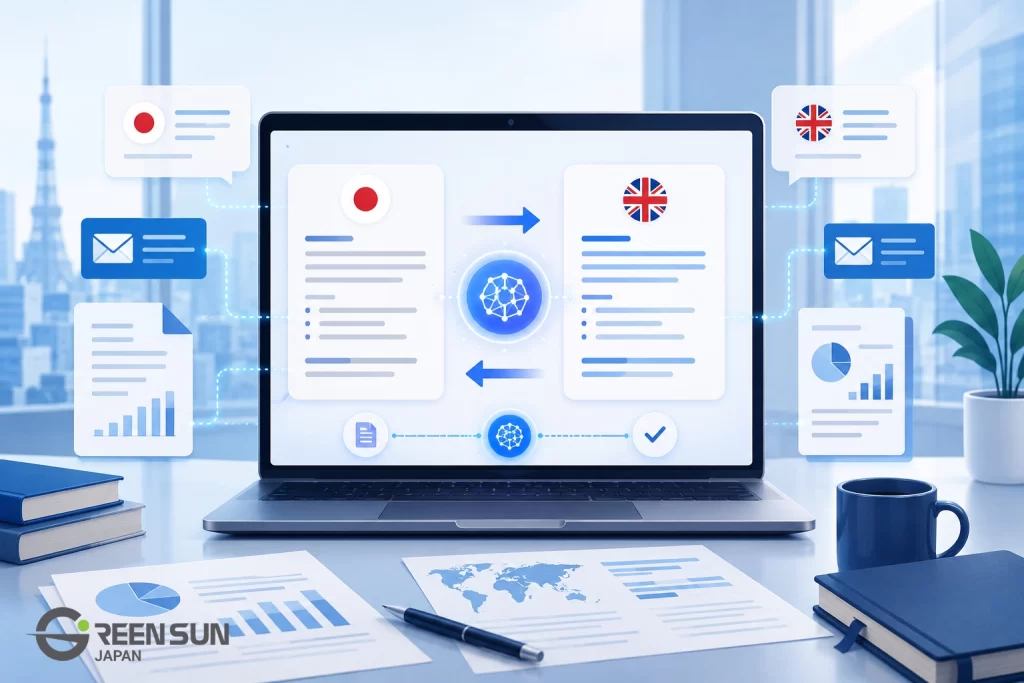
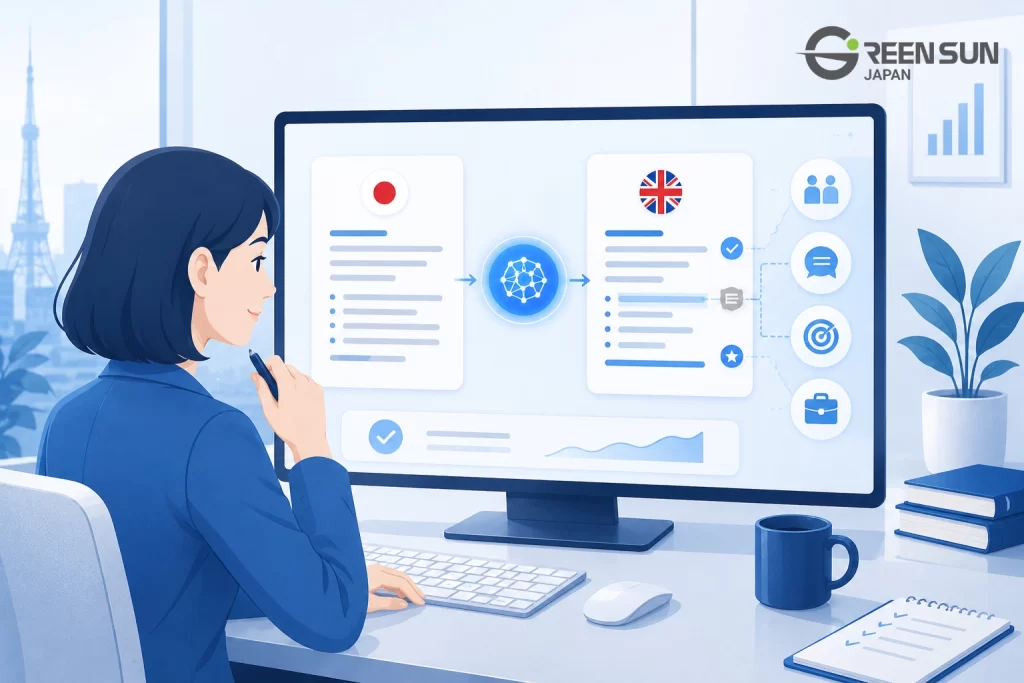
Japanese AI translation refers to the use of artificial intelligence tools to translate text or content from Japanese into another language, or from another language into Japanese. These tools may include Google Translate, DeepL, ChatGPT, Notion AI, or specialized machine translation systems.
In general, modern AI translation relies on machine learning and natural language processing models. These technologies analyze text, learn the relationships between words and phrases, and generate translations based on context. Elite Asia also describes AI translation as a technology that uses artificial intelligence algorithms and machine learning to analyze text data, understand word and phrase relationships, and support translation between languages.
Businesses are interested in using AI to translate Japanese content for three main reasons: speed, cost efficiency, and the ability to process large volumes of content. For documents that need to be understood quickly, AI can help staff grasp the main points within seconds. For repetitive content such as FAQs, product descriptions, internal emails, or technical document drafts, AI can also significantly reduce processing time.However, businesses should not treat AI translation as a complete replacement for a professional translation workflow. With Japanese, “getting the basic meaning right” is not always enough for customer emails, contracts, technical documents, corporate websites, or marketing content. AI Japanese accuracy should always be evaluated based on the document type, intended use, and level of risk.
2. Real-World Use Cases of Japanese AI Translation
2.1. Translating Emails and Internal Documents
AI is useful for quickly translating emails, internal announcements, or reference documents written in Japanese. In these cases, Japanese AI translation helps users understand the main message without waiting for a full human translation.
However, if the content is intended for Japanese customers or business partners, the level of politeness, formality, and business writing style should be reviewed carefully. A Japanese AI translator can help create a fast draft, but the final version still needs to be checked to avoid wording that sounds too direct, too casual, or insufficiently professional.
2.2. Translating Technical Documents and User Manuals
For short sentences, clear structures, and repetitive content, AI can support draft translation quite effectively. Even so, technical documents still require careful review of terminology, figures, units, and consistency to prevent errors during actual use.
2.3. Translating Websites, SEO, and Marketing Content
AI can help create quick draft translations for websites, SEO articles, and advertising content. However, these types of content need to be edited for search intent, brand voice, reader expectations, cultural context, and communication goals.
3. Practical Test: How AI Translates Japanese in Common Situations
3.1. Test 1: Japanese Business Email
Original Japanese sentence:
ご確認のほど、何卒よろしくお願い申し上げます。
A possible AI-generated translation:
Please confirm.
Analysis:
The AI translation captures the basic meaning, but it loses the polite nuance of the original sentence. In Japanese business communication, “何卒よろしくお願い申し上げます” expresses a formal, courteous, and standard tone commonly used in professional emails. When translated simply as “Please confirm,” the English sentence becomes short, slightly direct, and less polished than the original.
Suggested translation:
We would greatly appreciate it if you could kindly review and confirm this.
3.2. Test 2: Marketing or Website Content
Original Japanese sentence:
未来をつなぐ、新しいコミュニケーションのかたち。
A possible AI-generated translation:
A new form of communication that connects the future.
Analysis:
The AI translation is generally accurate, but it does not sound natural enough in English and lacks marketing appeal. The original Japanese sentence works like a slogan: concise, modern, and evocative. If translated too literally, the English version may sound stiff and may not fully communicate the intended brand value.
Suggested translation:
Connecting the future through a whole new way of communication.
Or, for a softer brand communication tone:
Opening up a new way to communicate and connect the values of the future.
4. Advantages and Limitations of Japanese AI Translation
4.1. Advantages of Japanese AI Translation
Speed: For short texts or documents that need to be understood quickly, AI can generate translations almost instantly. This is especially useful for businesses that regularly receive emails, internal documents, or reference materials in Japanese.
Ability to process large volumes: AI can support the translation of multiple passages, pages of content, or product descriptions in a short amount of time. For content with repetitive structures, Japanese AI translation can significantly reduce the time needed during the draft creation stage.
Support for language brainstorming: When users need multiple wording options, AI can suggest different translation approaches. This is particularly helpful for marketing content, article titles, and product descriptions.
4.2. Limitations of Japanese AI Translation
Risk of contextual errors: Because Japanese often omits the subject, AI may automatically add one or interpret the sentence in an unsuitable way. This can be especially risky in documents with multiple connected sentences, business emails, or legal content.
Difficulty with honorifics and communication nuances: A Japanese sentence may carry a formal, humble, or softened tone, but AI may translate it into wording that sounds too direct. This can make the translation feel unnatural in a business setting and may affect AI Japanese accuracy in professional communication.
Terminology risks: For technical, medical, financial, manufacturing, or legal documents, terminology must be translated consistently and accurately based on the specific field. AI may choose general words that do not fit the industry context, or translate the same term in several different ways.
Security concerns: Businesses should not enter confidential documents, contracts, customer information, internal data, or unpublished materials into public AI tools without fully understanding the platform’s security policy.
5. Conclusion
Japanese AI translation is a useful solution that helps businesses process content more quickly, especially for emails, internal documents, product descriptions, and draft translations. However, because Japanese includes complex elements such as context, honorifics, specialized terminology, and subtle communication nuances, AI-generated translations still need to be carefully reviewed before they are used in important documents.
Rather than relying entirely on AI, businesses should treat it as a support tool within the translation workflow. When combined with editing and quality checking, using AI to translate Japanese content can help save time and reduce costs while still ensuring the final translation is accurate, natural, and fit for purpose.
Need Accurate Japanese Translations?
Need Japanese translations that are accurate, natural, and fit for purpose? Green Sun Japan provides Japanese translation, editing, and translation quality checking services to help businesses make effective use of AI while maintaining strong control over translation accuracy.
Contact Green Sun Japan today for consultation on the right translation solution for your business.