

Japanese Contract Translation: Legal Risks Companies Should Avoid
In international business, a contract is more than a legal document; it is a vital shield protecting your company’s interests. With Japan’s distinct Civil Law system and sophisticated drafting style, even a minor oversight in Japanese contract translation can weaken key clauses, leading to prolonged legal disputes and significant financial loss.
Many businesses mistakenly believe that literal translation is sufficient. However, the profound differences between Japanese legal reasoning and international conventions demand a higher level of precision.
This article analyzes common legal translation mistakes, explores practical scenarios, and provides essential strategies to ensure accuracy in your Japanese contract translation projects.
1. The Challenges of Japanese Legal Translation
The difference between Japanese and Western languages lies not just in vocabulary, but in the “mental architecture” of the sentences. If a translator focuses on literal meaning while lacking a grasp of legal logic, they can easily transform a mandatory obligation into a vague suggestion, undermining the entire agreement.
1.1. Decoding Japanese Nuance: Beyond Literal Translation
Japanese legal language is fundamentally different from English. While English legal drafting prioritizes directness and specific liability, Japanese documents favor refined, indirect expressions. Complex sentence structures, the use of honorifics (Keigo), and the frequent omission of subjects create interpretative gaps. Elements such as the nuanced use of particles (e.g., “も” or “は”) require a translator who is highly attuned to legal intent to grasp the true meaning.
Notably, the term “ものとする” (monotosuru) is a classic pitfall. This is a deeming provision that establishes a binding legal obligation, not an option. Translating this as “may” or “is considered to” (implying a choice) can distort the entire commitment of the contract, leading to unwanted disputes over contractual responsibilities.
· Explore the latest developments in AI-powered translation
· Discover the strengths and limitations of AI for Japanese
1.2. Navigating Civil vs. Common Law
Beyond linguistic barriers, Japanese contract translation is challenging due to inherent differences in legal systems.
Japan operates under a Civil Law system, where many rights and obligations are already codified. Consequently, Japanese contracts are often concise, as the parties assume that the Civil Code will fill in any gaps—for example, the standard clause “契約不適合については民法の定めによる“ (Matters concerning non-conformity with the contract shall be governed by the provisions of the Civil Code).
Conversely, in Common Law systems (e.g., the US or UK), contracts must explicitly define breach events, damages, and dispute resolution mechanisms. Therefore, a competent translator must understand the legal context behind the words to adjust the phrasing appropriately for the target legal system, rather than simply translating word-for-word.
2. Five Common Legal Translation Mistakes
Translating legal documents requires precision; even a small error can lead to significant disputes. Below are five of the most common legal translation mistakes found in Japanese-to-English contract work:
2.1. Over-Literal Translation
This is a frequent pitfall for those new to legal translation. Translators often attempt to remain “faithful to the original” by mirroring Japanese sentence structures, which results in unnatural or inappropriate English legal phrasing.
・Japanese: 「甲は乙に対して損害を賠償する責任を負う。」
・Literal (Inaccurate): “Party A bears responsibility to compensate damages to Party B.”
・Professional: “Party A shall be liable for damages incurred by Party B.”
The literal version is grammatically understandable but lacks the professional tone required in legal drafting. Legal English relies on specific terminology and conventions that cannot be captured through word-for-word translation.
2.2. Misinterpreting Legal Terminology
Many Japanese legal terms lack perfect English equivalents. Relying solely on a dictionary without legal expertise often leads to incorrect terminology choice.
For example, the term 「不可抗力」 (fukakouryoku) translates literally to “impossible force,” but in an international contract, the only acceptable and precise term is “force majeure.” Using the wrong term can cause significant ambiguity regarding contractual protections.
2.3. Incorrect Handling of Deeming Provisions
The structure “ものとする” (monotosuru) is frequently mistranslated as a statement of expectation or intent (e.g., “may” or “is expected to”). However, in Japanese legal writing, this is a deeming provision establishing a binding obligation.
・Example: “本契約の期間は1年ものとする”
・Common Mistake: “The contract term is expected to be 1 year.” (Suggests a preference).
・Correct Translation: “The contract term shall be 1 year.” (States a mandatory obligation).
This underscores the necessity for businesses to prioritize professional Japanese contract translation over general translation services to avoid costly misinterpretations of contractual intent.
2.4. Misidentifying Responsible Parties
Japanese legal writing frequently omits subjects, relying on context to define roles. Without a meticulous analysis of this context, translators can easily misattribute contractual obligations.
・Example: 「契約違反があった場合、速やかに通知するものとする。」 (In the event of a breach, [party] shall notify promptly.)
In this scenario, it is critical to determine who bears the duty to notify: the breaching party or the aggrieved party? Failure to clarify these roles creates dangerous ambiguity, potentially leading to disputes over legal obligations.
2.5. Terminological Inconsistency
A common error is the inconsistent use of English terms for a single Japanese concept. For instance, translating “解除” (kaijo) interchangeably as cancel, terminate, or rescind can be catastrophic. In legal English, these words hold distinct meanings:
・“Cancel”: A general voiding of an agreement.
・“Terminate”: Ending the contract’s effect from that point forward.
・“Rescind”: Nullifying the contract as if it never existed.
In a legal document, consistency is paramount. If the Japanese original uses only one term, the English translation must maintain that consistency to prevent the counterparty from assuming each term implies a different legal consequence. Professional agencies mitigate this by developing project-specific glossaries and utilizing translation memory tools.
3. Practical Scenarios: Legal Consequences of Poor Translation
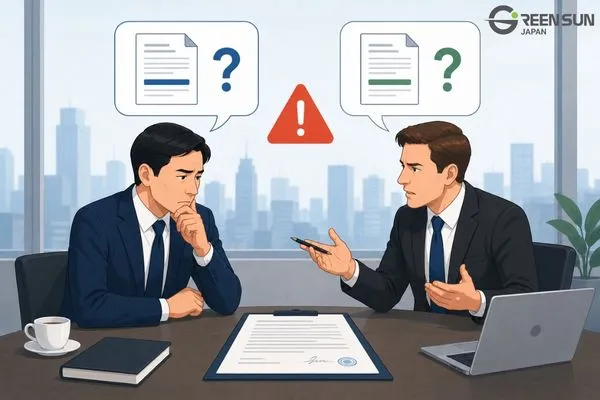
These translation errors are not merely linguistic issues. In practice, many international commercial disputes arise because the parties interpret the same translated contract clause differently. Below are several typical scenarios.
📝Case 1: The Cost of Ambiguity: Loss of Distribution Rights
In a distribution agreement, the Japanese original stated:
「契約違反があった場合、本契約を解除するものとする。」
However, the English translation was rendered as:
“This Agreement may be terminated in the event of a breach.”
The use of “may terminate” led the foreign party to believe that termination was merely an optional negotiation point. Conversely, the Japanese party understood this as a binding, automatic right upon breach. When operational errors occurred, the Japanese partner immediately terminated the agreement. The foreign enterprise lost its exclusive distribution rights in the Japanese market and faced months of costly renegotiations.
📝Case 2: Liability Exposure: Uncapped Damages
Regarding liability clauses, the Japanese contract stated:
「通常損害に限り賠償責任を負う。」
However, the English translation was shortened to:
“The party shall be liable for damages.”
This translation omitted the critical limitation: “limited to ordinary damages.” When a shipping incident occurred, the counterparty demanded compensation for lost profits and indirect damages. Because the English contract failed to clearly limit the scope of liability, the company faced a claim significantly higher than anticipated, alongside additional legal expenses to defend the interpretation of the clause.
📝Case 3: The Force Majeure Trap: When Excuses Aren’t Enough
In a manufacturing contract, the Japanese clause stipulated:
「不可抗力とは、地震、津波その他の自然災害に限る。」
However, the English translation vaguely stated:
“Force majeure includes unforeseen events beyond the parties’ control.”
This translation led the company to assume that supply chain disruptions or component shortages were covered under force majeure. When a delivery delay occurred due to material shortages, the company invoked the force majeure clause to waive liability. However, the Japanese party argued that the original contract strictly limited force majeure to natural disasters, excluding standard supply chain risks. Consequently, the company was deemed in breach of contract and forced to pay damages.
4. Reducing Legal Risks in Japanese Contract Translation
To transform your translation into a shield that protects your business rather than a liability, follow these three core principles:
- ・Prioritize “Legal Localization” over Literal Translation: Never settle for word-for-word translation. A high-quality translation must reflect the legal mindset of the target jurisdiction. For instance, specialized terms like monotosuru must be handled with precision to convey the intended legal obligation, rather than just a loose interpretation.
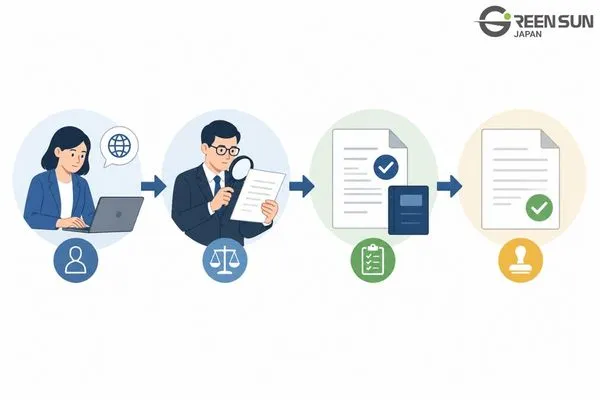
- ・Implement a Multi-Layered QA Process: Never rely on a single translator. A standard workflow must involve a legal-specialist translator paired with a professional proofreader. The use of a project-specific glossary throughout the translation is mandatory to ensure terminological consistency.
- ・Choose Partners with Local Expertise: Prioritize partners with a presence in the target market (e.g., Japan). Their deep understanding of the “pulse” of local law and commercial reality is a strategic advantage that AI and low-cost services may not be able to fully replicate.
5. Frequently Asked Questions (FAQ)
Q1. Can AI or machine translation be used for Japanese contracts?
While AI and machine translation are useful for drafting or basic terminology research, they currently lack the precision required for high-stakes legal documentation. Clauses regarding liability, indemnification, or jurisdiction must be reviewed by human translators with deep legal expertise to ensure complete accuracy.
Q2. How do I ensure consistency in lengthy contracts?
Developing a project-specific glossary at the outset and utilizing Computer-Assisted Translation (CAT) tools—which maintain a Translation Memory—is the most effective way to ensure that terminology is interpreted consistently throughout the entire document.
Q3. Do minor translation errors truly have major consequences?
Yes. In legal documents such as contracts, a single mistranslated or ambiguous phrase can fundamentally alter the scope of liability, conditions for termination, or rights to compensation. Such errors often trigger commercial disputes that damage your company’s reputation and lead to significant financial loss.
Q4. When should a business engage professional legal translation services?
You should utilize professional services for critical documents such as commercial contracts, NDAs, distribution agreements, M&A documents, and intellectual property filings. Investing in professional legal translation is significantly more cost-effective than managing the consequences of potential disputes or contract renegotiations.
6. Conclusion
As we have explored, the nuances of Japanese legal drafting go far beyond mere linguistics—they are deeply rooted in a distinct legal system and commercial culture. A single error is not just a translation mistake; it is a significant operational risk that can compromise your legal standing and financial health.
Professional translation is more than a service; it is a strategic investment in your company’s risk management and sustainable growth. By partnering with experts who understand the “legal architecture” behind Japanese documents, you transform your contracts from a potential liability into a robust shield. Secure your interests today by choosing precision, experience, and deep local expertise.
Green Sun Japan – Your Professional Partner in Japanese Translation
Need a reliable partner for your legal translation projects? Choose Green Sun Japan to benefit from:
・Expertise: A team of experienced Japanese-English legal translation specialists.
・Quality Assurance: A multi-tier quality control process that ensures high accuracy and consistency.
・Versatility: Support across various domains, including commercial contracts, technical documentation, and international corporate materials.
Beyond Japanese, Green Sun Japan also provides professional translation services in Chinese, Vietnamese, and other major languages for global enterprises.
Contact us today for a consultation tailored to your business needs!