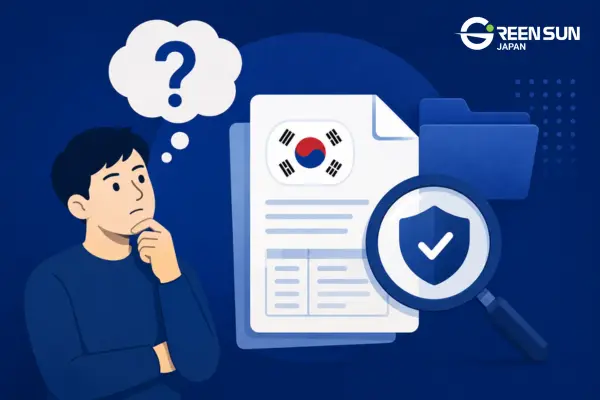
In Korean document translation, not all file types require the same level of quality assurance. Documents such as user manuals, technical specifications, QC sheets, supplier documents, and compliance materials often carry a higher level of risk. Even a minor error in terminology, figures, units of measurement, or safety warnings can directly affect production processes, product quality, and legal compliance.
Use this guide to assess each file’s risk, choose additional checks, and prepare the materials reviewers need. The classification table is a planning aid; the intended use and consequences of an error determine the final review scope.
📌 Key Takeaways / Direct Answer:
What Extra QA Involves: Extra QA consists of independent, in-depth quality assurance layers—such as Bilingual QA, Numeric QA, and Format/DTP QA—performed after the standard translation process to minimize high-risk errors involving specifications, safety warnings, numerical data, and consistency.
Risk-Based Classification: Add review where an error could affect production, safety, a contractual obligation, or an acceptance decision. A file’s label alone does not determine its risk: an internal note can contain critical instructions, and a brochure can include regulated claims.
Essential Quality Control Checkpoints: For Korean technical translation, Numeric QA—including checks of decimal values, minimum and maximum tolerances, and units of measurement—is essential. Terminology should also be verified against the approved glossary to ensure consistency and accuracy.
Green Sun Japan’s Approach: Green Sun Japan provides flexible Korean document translation services based on each document’s level of risk, combining specialized translators with a multi-layer QA process to help ensure accuracy and reliability before release.
Contents
- 1. What Is Extra QA and Why Can’t the Same Process Be Applied to Every Document?
- 2. 5 Factors That Make a Korean Document a “High-Risk Document”
- 3. Risk Classification Table and Recommended Workflow
- 4. Detailed 6-Step Workflow for High-Risk Korean Documents
- 5. Checklist for Preparing Files Before Translation
- 6. Conclusion
- 7. Frequently Asked Questions (FAQ)
1. What Is Extra QA and Why Can’t the Same Process Be Applied to Every Document?
For manufacturing translation and other projects where an error could have serious consequences, additional QA targets the details most likely to cause problems, including:
Specialized terminology and glossary consistency.
Figures, units of measurement, minimum/maximum tolerances, and part numbers.
Safety warnings, such as Warning, Caution, and Prohibition notices, as well as operating conditions.
Bilingual comparison to ensure that no sentences, paragraphs, tables, or other content are omitted.
Desktop publishing (DTP) layout, illustrations, captions, and cross-references.
Match the review scope to the consequences of an error. Specify which checks need a separate reviewer and which require a subject-matter expert. Internal circulation alone does not make a document low risk.
2. 5 Factors That Make a Korean Document a “High-Risk Document”
In Korean document translation, a file is generally classified as high-risk when it has one or more of the following characteristics:
- Contains a high density of figures and units of measurement: Technical specifications, data sheets, and QC sheets often contain dimensions, voltage, pressure, tolerances, and other numerical data. An error in a single decimal point can result in incorrect technical specifications.
- Contains safety instructions and warnings: Machinery operation manuals may include emergency shutdown procedures, safety warnings, and troubleshooting instructions. Korean user manual translation requires a high level of accuracy to help prevent workplace accidents.
- Contains a high density of specialized terminology: Industries such as mechanical engineering, semiconductors, automotive, electronics, and medical devices use highly specialized terminology that cannot always be translated accurately based on standard dictionary definitions alone.
- Has a complex file structure: Files with multiple embedded tables, electrical circuit diagrams, CAD drawings, or PDF technical drawings increase the risk of hidden text or other content being missed during translation.
- Is used directly for acceptance or legal purposes: Quality control (QC) documents and compliance certifications may be used for regulatory approval, inspections, or business acceptance. Translation errors in these documents can lead to rejection by regulatory authorities or business partners.
3. Risk Classification Table and Recommended Workflow
| Document Type | Common Examples | Risk Level | Key Points to Control | Recommended Workflow |
|---|---|---|---|---|
| User Manuals | User Manual, Operation Manual, Installation Guide | High | Terminology, operating procedures, safety warnings, UI text | Translation ➔ Editing ➔ Bilingual QA ➔ Format QA |
| Technical Specifications | Technical Specifications, Data Sheets, Technical Drawings | Very High | Figures, units of measurement, tolerances, model numbers, part numbers | Translation ➔ Numeric QA ➔ Specialist Review ➔ Final QA |
| QC Check Sheets | QC Sheets, Inspection Sheets, Test Reports | Very High | Pass/fail criteria, measurement limits, test data | Translation ➔ Bilingual QA ➔ Numeric QA ➔ QA Review |
| Supplier Documents | Supplier Manuals, Quotations, Component Specifications | Medium–High | Item codes, versions, bilingual tables, terminology consistency | Glossary Setup ➔ Translation ➔ Editing ➔ Consistency QA |
| Compliance Documents | CO/CQ Certificates, Audit Reports, Compliance Commitments | Very High | Referenced standards, legal requirements, legal terminology | Specialist Translation ➔ Independent Review ➔ Final QA |
| Business Documents | Proposals, Financial Reports, B2B Contracts | Medium | Financial figures, payment terms, legal entity names | Translation ➔ Editing ➔ Linguistic QA |
| Marketing Materials | Brochures, Company Profiles, Product Catalogs | Low–Medium | Natural writing style, brand tone, visual content | Translation/Localization ➔ Editing |
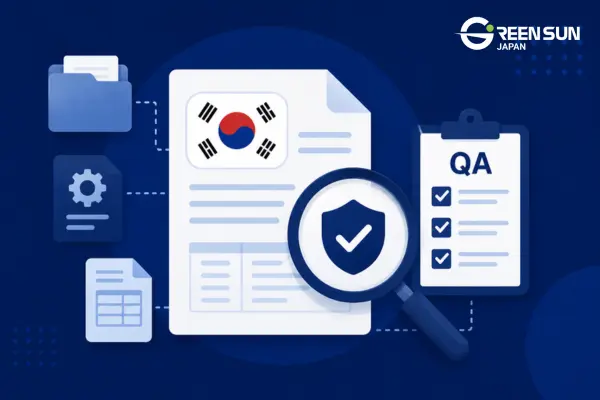
4. Detailed 6-Step Workflow for High-Risk Korean Documents
| Process Step | Control Focus | Specific Actions |
|---|---|---|
| 1. File & Risk Analysis | Determine the required level of control | Review the file format (scanned or editable), assess the document’s risk level and intended use, and assign the appropriate personnel. |
| 2. Glossary Setup | Ensure terminology consistency | Establish an approved list of component names, product codes, abbreviations, and Do-Not-Translate (DNT) terms. |
| 3. Translation by Specialists | Ensure subject-matter accuracy | Assign translators with practical experience in the relevant technical field, such as mechanical engineering, electronics, IT, or medical devices. |
| 4. Independent Bilingual QA | Verify accuracy against the source | Compare each sentence in the original Korean with the translation to identify and correct omissions, mistranslations, and errors in safety warnings. |
| 5. Numeric & Domain QA | Verify numerical and technical accuracy | Independently check all decimal values, dimensions, minimum/maximum tolerances, units of measurement, and part numbers. |
| 6. DTP & Final QA | Ensure final formatting accuracy | Review and adjust table layouts, fonts, images, and other formatting elements to ensure the delivered file matches the original design. |
5. Checklist for Preparing Files Before Translation
| Item to Prepare | Details to Check | Benefits |
|---|---|---|
| Latest Version | Confirm that the source document is the latest approved version and that an outdated draft is not being used. | Avoid unnecessary retranslation costs when changes are made later. |
| Editable Format | Provide editable Word, Excel, PowerPoint, or InDesign files instead of unclear scanned PDFs whenever possible. | Preserve the original formatting more accurately and reduce processing time. |
| Glossary | Provide a list of internal terminology, preferred translations, or existing translation conventions used by the company. | Ensure consistency with previously completed projects and approved terminology. |
| Mark Non-Translatable Content | Identify part numbers, model numbers, programming code, and other content that must remain unchanged in Korean or English. | Reduce the risk of technical codes or identifiers being translated incorrectly. |
| Define the Intended Use | Clearly state whether the translation will be submitted to regulatory authorities, used for internal training, or used in production operations. | Help the translation provider apply the most appropriate workflow and QA level. |
6. Conclusion
Classify files before requesting quotes, identify the details that need additional checking, and agree on how reviewers will record and resolve issues. Reassess the scope when a file’s intended use changes.
Discuss Your Korean Document QA Requirements
For help scoping a project, describe how each file will be used and which errors would have the greatest impact.
Green Sun Japan provides specialized translation solutions tailored to the risk level and requirements of each document:
Subject-Matter Review: Identify the technical or legal expertise the document requires and confirm reviewer availability before work begins.
🛡️ Multi-Layer Extra QA Process: Independent quality control covering terminology, accuracy, and consistency, along with specialized Numeric QA for technical specifications and numerical data.
⚡ Language Asset Management: Translation Memory and client-specific glossary setup and synchronization to maintain terminology consistency and help reduce costs for long-term projects.
Contact Green Sun Japan to share a sample document and discuss the review scope your project needs.
7. Frequently Asked Questions (FAQ)
Q1. Can Korean document translation retain the original formatting?
Yes. For editable formats such as Word, Excel, PowerPoint, Adobe Illustrator (AI), InDesign, and vector PDFs, the translation provider can generally retain the original layout. For scanned documents, a dedicated DTP team can recreate the layout as needed.
Q2. Is a glossary required before starting Korean technical translation?
A glossary is highly recommended, especially for large projects involving multiple technical specifications or supplier documents. If the company does not already have one, Green Sun Japan can help extract key terms and create a standardized glossary before translation begins.
Q3. Does Korean user manual translation require a specialized translator?
Yes. The translator should understand both the language and the technical operating principles involved. This helps prevent translations that may be linguistically correct but inaccurate in the context of the equipment’s actual functions or operation.
Q4. What does Numeric QA check in technical documents and QC sheets?
Numeric QA is a specialized, independent review of numerical data. It checks decimal separators, tolerance values (±), minimum and maximum limits, units of measurement (mm, bar, °C, V), and part numbers against the source document.
Q5. Can AI be used for Korean technical translation?
Machine translation or AI may support an approved workflow, provided confidentiality requirements permit its use. However, for technical documents, QC sheets, safety manuals, and compliance documents, AI-generated translations should undergo thorough editing and QA by qualified human experts before use.
Q6. When does Korean business document translation require Extra QA?
Additional QA is appropriate when documents contain binding legal provisions, critical financial figures in audit reports, or commercial contracts signed with Korean business partners.