

Why Are Korean and Japanese So Similar? Key Similarities and Differences Explained
Korean and Japanese often feel remarkably similar, especially to beginners. Both share a comparable sentence structure, use grammatical particles, feature complex honorific systems, and have a substantial amount of vocabulary influenced by Chinese. However, upon closer inspection of their writing systems, pronunciation, and grammatical mechanics, they remain two distinctly different languages.
Just how similar are Korean and Japanese, really? This article explores the most important similarities and differences between the two, helping learners understand why they are so often compared and which language might be easier to learn depending on their background.
📌Direct Answer
Korean and Japanese are primarily similar in their overall structure rather than in their sounds or writing systems. Both generally use Subject-Object-Verb (SOV) word order, particles, an agglutinative structure, and honorific systems, and both have many words influenced by Chinese. Nevertheless, they differ significantly in their writing systems, pronunciation, and many specific grammatical rules.
📌Key Takeaways
・Similarities: Similarities between Korean and Japanese include SOV sentence structure, grammatical particles, agglutinative features, honorific systems, and a significant amount of Sino-Xenic (Chinese-derived) vocabulary.
・Differences: When analyzing differences between Korean and Japanese, the primary contrasts lie in their writing systems, phonology and pronunciation, and specific grammatical rules.
・Not Mutually Intelligible: Similarities in Korean and Japanese language structures do not mean that speakers of one can understand the other; knowing Korean does not automatically provide an understanding of Japanese, and vice versa.
・Complex Genetic Relationship: The ancestral relationship between Korean and Japanese remains the subject of complex academic debate. Superficial similarities are insufficient to conclude that they definitively descended from a single proto-language, as linguists continue to offer differing interpretations of their historical ties.
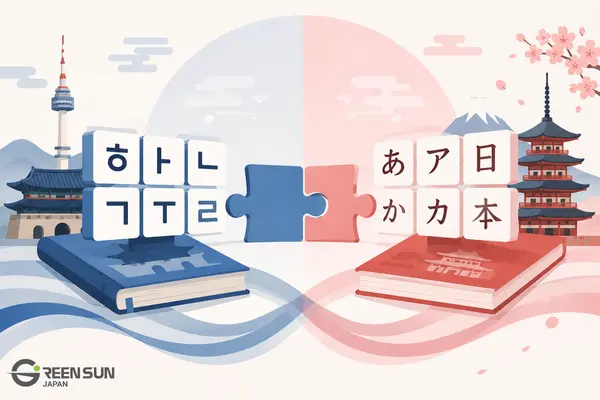
1. Why Do Korean and Japanese Seem So Similar?
From a linguistic perspective, Korean and Japanese share numerous similarities in their structure and sentence organization. Both languages typically place the verb at the end of the sentence, use grammatical particles to indicate grammatical functions, and feature rich systems of verb conjugation. These characteristics make their sentence construction feel quite similar, even though the specific rules do not completely match.
This resemblance is also tied to the history of language contact and cultural exchange in East Asia. Both languages were significantly influenced by Chinese—particularly in their writing systems and vocabulary—yet each adapted and developed these elements in distinct ways.
However, structural similarity does not mean the two languages have been proven to share a common origin. In historical linguistics, traits like similar word order are insufficient to establish a common ancestor. The historical relationship between Korean and Japonic remains a subject of ongoing research and debate; therefore, it is important to distinguish between typological similarities, the effects of language contact, and hypotheses regarding the historical relationship between the two languages.
2. Key Similarities Between Korean and Japanese
Despite being distinct languages, Korean and Japanese share several prominent similarities in grammar and information structure. The most noticeable likenesses lie in their word order, particles, agglutinative structure, honorific systems, and layers of Chinese-influenced vocabulary.
✅ Similar Sentence Order and Grammatical Structure
Both Korean and Japanese generally use Subject-Object-Verb (SOV) word order, where verbs tend to appear at the end of the sentence. Subjects can also frequently be omitted when they are clear from the context.
Examples:
・Korean: 저는 사과를 먹어요 (jeoneun sagwareul meogeoyo) — “I eat an apple.”
・Japanese: 私はりんごを食べます (watashi wa ringo o tabemasu) — “I eat an apple.”
In both sentences, the word for “apple” precedes the verb “eat.” As a result, learners familiar with the sentence structure of one language may find this aspect of the other relatively familiar.
✅ Shared Use of Particles and Agglutinative Structure
Both languages employ particles after nouns to mark functions such as topics, subjects, or objects. Additionally, much grammatical information is expressed by attaching suffixes to verb roots. Because of these traits, Korean and Japanese are frequently described as agglutinative languages.
✅ Developed Honorific Systems and Politeness Levels
Korean and Japanese both convey social relationships, levels of formality, and respect through language. Speakers can alter verb forms, vocabulary, or expressions depending on who they are speaking to and the conversational context. However, the honorifics and speech levels of the two languages follow their own distinct rules and do not correspond directly.
✅ A Substantial Portion of Chinese-Influenced Vocabulary
Both languages possess a significant layer of vocabulary borrowed from or formed using elements of Chinese origin, commonly referred to as Sino-Korean and Sino-Japanese vocabulary.
Example: The word for “university” shares the same origin in 大學 / 大学:
・Korean: 대학 (daehak)
・Japanese: 大学 (daigaku)
This example demonstrates how the two languages can share the origin and meaning of certain words while developing different pronunciations. This is especially evident in academic, administrative, and conceptual vocabulary rooted in Chinese.
3. Differences Between Korean and Japanese
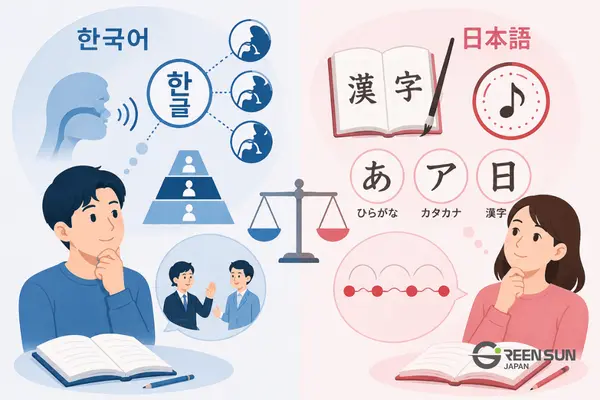
Despite many structural similarities, Korean and Japanese differ significantly in their writing systems, pronunciation, and grammatical mechanics. The table below summarizes the most important differences:
| Feature | Korean | Japanese |
|---|---|---|
| Writing System | Primarily uses Hangul, in which consonant and vowel characters are grouped into syllabic blocks. Hanja appears only in limited contexts today. | Uses a combination of Hiragana, Katakana, and Kanji. Each script serves distinct functions within a text. |
| Chinese Characters | Hanja once played a vital role but is used much more sparingly in modern Korean. | Kanji remains an essential component of the modern Japanese writing system. |
| Sound System | Features consonant contrasts typically described as plain, aspirated, and tense. For example, 달 (dal, "moon") and 딸 (ttal, "daughter") differ in their initial consonant. | Lacks the same consonant contrast system found in Korean. Japanese organizes rhythm by morae, and sound length can change meaning. For example, おばさん (obasan, "aunt") and おばあさん (obāsan, "grandmother"). |
| Grammar | Has a rich system of verb endings to express tense, aspect, modality, politeness, and various nuances. | Also uses verb endings and auxiliary forms, but the conjugation patterns and grammatical categories do not correspond directly with Korean. |
| Particles | Uses particles like 은/는 (eun/neun), 이/가 (i/ga), and 을/를 (eul/reul), with specific rules for topics, subjects, and objects. | Uses particles like は (wa), が (ga), and を (o), which have some similar functions, but their scope and usage are not identical to Korean. |
| Honorifics and Politeness | Features multiple speech levels and honorific forms expressed through endings, vocabulary, and certain grammatical structures. | Distinguishes between plain and polite forms and also uses the keigo system, which includes honorific and humble forms organized differently from those in Korean. |
The crucial point is that typological similarity does not mean the two systems function identically. A Korean speaker may recognize familiar concepts when learning Japanese—such as particles, verb-final sentences, or honorifics—but still needs to learn how they are formed and used in Japanese.
4. Korean vs. Japanese at a Glance: Which Is Easier to Learn?
4.1. Quick Comparison Between Korean and Japanese
Korean and Japanese share many structural similarities while presenting different challenges for learners. The table below summarizes the key points before exploring which language may be more accessible for different groups of learners.
| Feature | Korean | Japanese |
|---|---|---|
| Basic word order | Usually SOV | Usually SOV |
| Writing system | Mainly Hangul | Hiragana, Katakana, Kanji |
| Particles | Yes | Yes |
| Honorifics | Extensive | Extensive |
| Chinese-derived vocabulary | Significant | Significant |
| Pronunciation | More consonant contrasts | Mora-based sound system |
| Chinese characters today | Limited Hanja use | Kanji widely used |
| Mutual intelligibility | No | No |
4.2. Which Language Is Easier to Learn?
There is no absolute answer as to whether Korean or Japanese is easier. The level of difficulty depends on the learner’s native language, previous foreign-language learning experience, and personal goals.
・For English speakers: Korean is generally more accessible in terms of its writing system thanks to Hangul, whereas Japanese requires mastering Hiragana, Katakana, and numerous Kanji. However, Korean still poses distinct challenges with pronunciation, verb endings, and speech levels.
・For Mandarin speakers: Japanese may offer an advantage because learners can recognize Kanji and a portion of Chinese-derived vocabulary. Korean also features many Sino-Korean words, but this connection is less visually direct in modern writing.
・For those who already know Korean or Japanese: Familiarity with SOV word order, particles, and honorifics can make certain aspects of the other language easier to grasp. Even so, vocabulary, pronunciation, and writing systems must still be studied independently.
Ultimately, neither language is universally easier. The degree of ease or difficulty largely depends on the learner’s background and learning goals.
· Choosing Between Simplified and Traditional Chinese for Your Content
· Key Questions to Ask When Choosing a Japanese Translator
· Common Legal Risks in Japanese Contract Translation
· Essential Steps for Localizing a Website for the Japanese Market
5. Conclusion
Korean and Japanese share notable similarities in word order, particles, agglutinative structure, honorifics, and vocabulary influenced by Chinese. However, they remain distinctly different in their writing systems, pronunciation, and the mechanics of many grammatical structures.
These similarities can help learners of one language adapt more quickly to certain concepts in the other, but they do not make the two languages mutually intelligible. When comparing Korean and Japanese, a more accurate approach is to examine each specific linguistic feature rather than viewing them as nearly identical systems.
6. Frequently Asked Questions
Q1. Do Korean and Japanese share similar vocabulary?
Partially. Both languages possess a significant amount of vocabulary derived from or influenced by Chinese, known as Sino-Korean and Sino-Japanese vocabulary. Because these words were adopted and developed independently in each language, they often share similar origins and meanings but have different pronunciations. For example, “university” is 대학 (daehak) in Korean and 大学 (daigaku) in Japanese.
Q2. Are Korean and Japanese mutually intelligible?
No. Korean and Japanese are not mutually intelligible without prior study. Despite sharing similarities in structure and vocabulary, the two languages differ significantly in pronunciation, writing systems, and grammatical rules.
Q3. Is Korean grammar similar to Japanese grammar?
There are several notable similarities. Both generally use Subject-Object-Verb (SOV) word order, particles, and verb-final structures, and both feature systems for conveying different levels of politeness. However, the usage of particles, verb conjugations, and specific grammatical rules differs between the two languages.
Q4. Is Korean or Japanese easier to learn for English speakers?
There is no absolute answer. Korean is generally more accessible in terms of its writing system thanks to Hangul, whereas Japanese requires learning Hiragana, Katakana, and Kanji. Nevertheless, both present distinct challenges in grammar, pronunciation, and expressions of politeness.
Need Professional Korean Translation?
Green Sun Japan provides professional Korean translation with three-step quality control, specialized industry expertise, and fast response times. From business documents to technical content and localization, our team helps ensure your Korean content is accurate, natural, and fit for purpose.
Contact Green Sun Japan for a tailored consultation and quote.