

Vietnamese Machine Translation Services for E-commerce Catalogs
When an e-commerce catalog includes thousands of SKUs, and each product has a title, short description, bullet points, specifications, variations, warnings, and SEO content, translating everything manually into Vietnamese can quickly slow down the publishing schedule.
That is why many e-commerce teams use Vietnamese machine translation services to process content more efficiently. However, machine translation should not be used as a simple “translate and publish” solution. For SKU descriptions, marketplace listings, and product content, translations need a glossary, Vietnamese MTPE, and QA to prevent incorrect specifications, inconsistent terminology, broken formatting, or mismatches with product images.
This article serves as both a how-to guide and a decision guide to help catalog teams understand when to use MT, when machine translation post editing Vietnamese is needed, when full MTPE is required, and how to manage large volume Vietnamese translation through a practical e-commerce workflow.
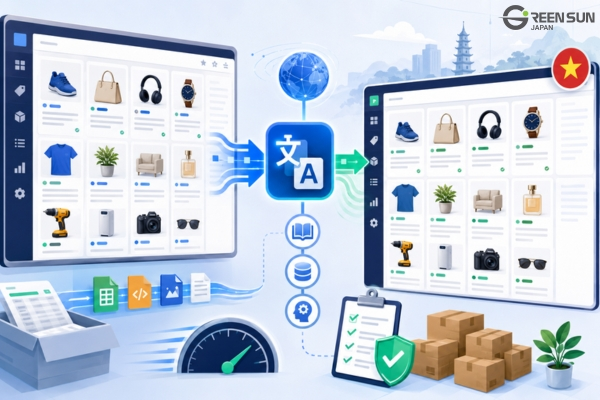
1. When Should You Use Vietnamese Machine Translation Services?
Vietnamese machine translation services work best for content with a clear structure, high volume, and frequent repetition, such as colors, sizes, materials, technical specifications, short descriptions, and some SKU descriptions. With a strong glossary and proper QA, MT can significantly reduce catalog processing time while improving Vietnamese AI translation quality across each batch.
However, not all content carries the same level of risk. Simple product attributes may only need MT + quick QA, while product claims, warnings, usage instructions, SEO titles, and marketplace listings require more careful Vietnamese MTPE before publishing.
| Content type | Recommended handling method | Objective |
|---|---|---|
| Colors, materials, sizes | MT + quick QA | Correct data and consistent terminology |
| SKU descriptions, bullet points | Light MTPE | Clear content with no incorrect benefits |
| Marketplace listings, titles, SEO meta content | MTPE + SEO editing | Correct keywords and character limits |
| Instructions, warnings, product claims | Full MTPE | Accurate and safe for publishing |
| Landing pages, brand copy | Human translation | Natural wording and the right brand voice |
This classification helps teams avoid translating everything manually while making sure AI is not used for high-risk content without the right level of review.
2. Preparing SKU Files, Glossaries, and Rules
To make large volume Vietnamese translation effective, catalog files should be standardized before translation begins. Each SKU needs a unique code, and fields such as Product Title, Short Description, Bullet Points, Material, Size, Color, Warning, SEO Title, and Meta Description should be separated into clear columns. Elements that do not need translation, such as SKU ID, barcode, model number, URL, or technical tags, should be locked or clearly marked with notes.
A glossary is the foundation of e-commerce translation into Vietnamese. Without one, the same term may be translated in different ways across thousands of SKUs. For example, “case” may refer to a phone case, box, cover, or suitcase, depending on the product category. A glossary should include category names, materials, product parts, units of measurement, colors, warning phrases, marketplace terminology, and terms that should not be translated, such as brand names, model numbers, and series names.
In addition to a glossary, teams need clear rules for measurements, units, HTML tags, placeholders such as {color}, {size}, and {brand}, title shortening, and bullet point style. These rules make Vietnamese MTPE and machine translation post editing Vietnamese more consistent, instead of leaving each reviewer to edit based on personal preference.
3. Workflow for Processing Large-Volume Catalogs
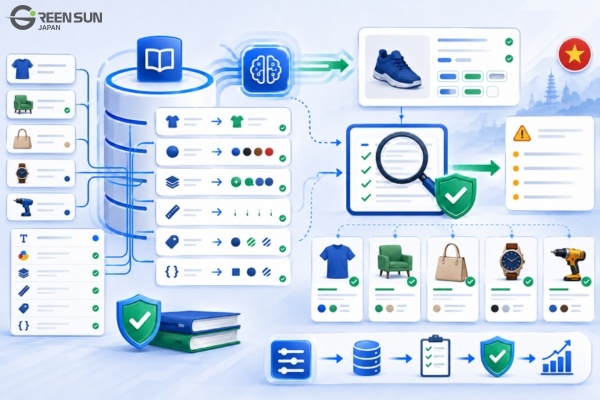
A good workflow should start with a pilot. For projects involving 5,000, 20,000, or 50,000 SKUs, teams should select 100–300 representative SKUs to test how AI handles titles, descriptions, specifications, HTML tags, and terminology. After the pilot, errors should be reviewed by category. Terminology issues should lead to glossary updates, overly long titles should lead to rule adjustments, and specification errors should trigger stronger QA checks for numbers and units.
Once the pilot is stable, the large batch can move forward. For e-commerce translation into Vietnamese, it is not always necessary to follow the original file order. Priority should be given to best-selling products, products scheduled for advertising campaigns, seasonal products, or SKUs with high traffic. Long-tail SKUs can be processed with a lighter MTPE level to optimize large volume Vietnamese translation.
A compact workflow may look like this: standardize files, classify content, build a glossary, run a pilot, update rules, translate the large batch, perform machine translation post editing Vietnamese, run automated QA, conduct sample-based manual QA, import the content into a CMS or marketplace, preview it on desktop and mobile, and then publish.
The key point is that QA should not happen only at the end. QA should be used before translation, after machine translation, after MTPE, and after import. This helps teams catch recurring errors early, such as translating “navy” as “naval forces” instead of “navy blue,” and improve Vietnamese AI translation quality at the system level.
4. QA Checklist Before Publishing
Before publishing, teams should check SKU IDs, model numbers, brand names, specifications, units, quantities, glossary compliance, titles, bullet points, HTML tags, placeholders, and actual display. This step is essential for making sure Vietnamese AI translation quality is reliable enough for e-commerce use.
For marketplace listings, titles should be clear, not too long, and include keywords naturally without incorrect model information. Bullet points should be easy to scan, accurately describe product benefits, and avoid adding claims that do not appear in the source text. For SKU descriptions, the content must match the images, variations, colors, quantities, and product use without creating confusion.
A translation that looks fine in Excel may not work well on a live website. After import, teams should preview several representative SKUs on both desktop and mobile to check whether titles are cut off, bullet points are easy to read, size charts are aligned, and descriptions keep the correct format. This is also the final step in machine translation post editing Vietnamese before publishing.
5. Conclusion
Vietnamese machine translation services can help e-commerce teams process catalogs faster, especially when SKU volume is large and publishing deadlines are tight. However, to use them effectively, businesses need a clear workflow that includes file standardization, glossary creation, pilot testing, Vietnamese MTPE, data QA, format checks, and post-import preview.
Green Sun Japan supports e-commerce teams with Vietnamese machine translation, MTPE, glossary preparation, SKU file handling, and quality checks for catalogs, marketplace listings, and product data. By combining AI-assisted translation with human review, we help businesses publish Vietnamese content more efficiently while keeping terminology, specifications, and formatting under control.
If you are planning to localize a large product catalog into Vietnamese, contact Green Sun Japan for advice on a workflow that fits your product type, schedule, and budget.
6. FAQ
1. Are Vietnamese Machine Translation Services Suitable for an Entire Catalog?
Yes, but the processing level should be divided by content type. Simple attributes can be handled with MT + quick QA. SKU descriptions, marketplace listings, warnings, and SEO content should include Vietnamese MTPE.
2. What Is Vietnamese MTPE in E-commerce?
Vietnamese MTPE is the process of reviewing and editing machine-translated Vietnamese content. It includes checking terminology, specifications, formatting, titles, bullet points, and readiness for publishing.
3. How Can You Know Whether an AI Translation Is Good Enough to Publish?
You need to check SKU IDs, models, figures, units, glossary compliance, HTML tags, placeholders, titles, bullet points, and actual display after import.
4. Is a Glossary Necessary When Translating a Large Catalog?
Yes, it is essential. A glossary keeps terminology consistent across thousands of SKUs and improves Vietnamese AI translation quality across each batch.
5. Where Should Large Volume Vietnamese Translation Begin?
It should begin with file standardization, content classification, glossary creation, and a small pilot before processing the large batch.

Do you need large volume Vietnamese translation for catalogs, SKU descriptions, or marketplace listings? Contact Green Sun Japan for advice on a machine translation + MTPE workflow that fits your products, budget, and timeline.
✓ Fast response – Support in Japanese within 30 minutes during Japan business hours via email, Skype, phone, and other channels.
✓ High-quality translation – Translations are checked through a 3-step review process, with review by native Japanese translators and QA tool checks.
✓ Strong technical and IT capabilities – We can handle multiple file formats, including websites, applications, catalogs, and product data, and use CAT tools to ensure productivity and consistency.