

Japanese Obon Festival: Meaning, Dates, Customs, and Cultural Significance
The Japanese Obon Festival (Obon) is one of the most important seasonal traditions in Japan. It is a time when families honor their ancestors, return home, visit graves, and take part in customs such as Bon Odori dancing and Toro Nagashi lantern ceremonies. In many parts of Japan, Obon is observed in mid-August, although the exact timing varies by region. For readers outside Japan, the best way to understand Obon is not as a tourist spectacle first, but as a period shaped by remembrance, family connection, and long-standing ritual practice (Japan Travel, Japan Guide ).
Obon is often described as a Buddhist festival, which is correct, but that description only covers part of it. In practice, Obon is also about homecoming. Many people return to their hometowns, spend time with relatives, visit family graves, and take part in customs that have been handed down over generations. That is why Obon sits at the intersection of spiritual observance, family reunion, and seasonal tradition (Rakuten Travel).
That mix of meanings is also what makes Obon difficult to explain well in English. A literal definition may tell readers what Obon is, but it does not always show why it matters.
📌 Key Takeaways / Direct Answer:
- Cultural Essence of Obon: Obon is a traditional Japanese Buddhist-Shinto custom dedicated to honoring deceased ancestors, who are believed to temporarily return to the living world. Far from being a somber or frightening holiday, it is a warm, reflective, and communal time for family reunions and homecoming.
- Regional Timing Variations: While observed nationwide from August 13 to 16 (Hachigatsu Bon), certain areas like Tokyo observe it in mid-July (Shichigatsu Bon), while other regions follow the lunar calendar (Kyureki Bon).
- Core Rituals & Customs: Major traditions include grave cleaning (Ohakarimairi), setting household altars (Butsudan) with cucumber/eggplant spirit animals, community folk dancing (Bon Odori), and floating lantern farewell ceremonies (Toro Nagashi).
- Localization Impact for Japan Content: Translating Japanese cultural topics into English requires nuanced localization that preserves context and tone rather than relying on literal, flat terms like “Festival of the Dead.” Green Sun Japan provides certified Japanese-to-English localization tailored for tourism, cultural, and market-facing business communications.
1. What Is the Japanese Obon Festival?
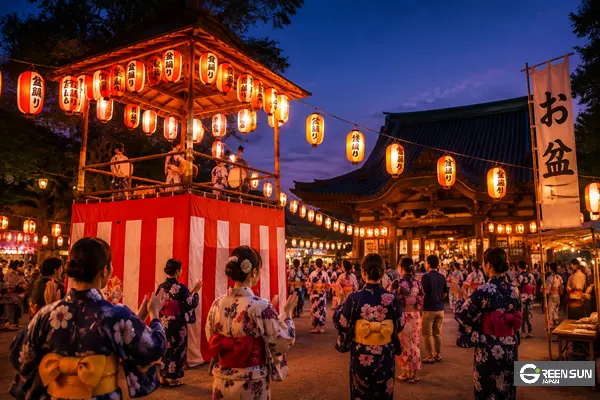
At its core, Obon is a time to honor the spirits of deceased ancestors. Families believe that during this period, the spirits of the dead return to visit the household, and the living prepare to welcome them properly. That preparation may include cleaning the home, visiting family graves, setting out offerings, and lighting lanterns to guide the spirits.
In English, Obon is sometimes reduced to a phrase like “festival of the dead”, but that wording can feel too blunt. It misses the tone of the season. Obon is not treated in Japan as something frightening or dark. It is reflective, respectful, and often communal (Japan Guide).
That distinction matters if the content is written for overseas readers. A phrase can be technically correct and still leave the wrong impression.
· Practical etiquette tips for experiencing Obon respectfully
2. When Is Obon Celebrated?
In most parts of Japan, Obon is observed from August 13 to 16. Even so, the timing is not exactly the same nationwide. Some regions, especially around Tokyo, observe Obon in mid-July, while other areas follow the lunar calendar, which can shift the dates into late August or September (Japan Travel, Rakuten Travel, Japan Guide).
| Regional Obon Type | Observance Dates | Primary Regions | Cultural & Travel Context |
|---|---|---|---|
| Hachigatsu Bon (August Obon) | August 13 – 16 | Most of Japan (Kansai, Tohoku, Rural areas) | The standard nationwide peak. Major domestic travel rush across trains, flights, and hotels. |
| Shichigatsu Bon (July Obon) | July 13 – 16 | Tokyo, Kanagawa, parts of Shizuoka | Follows the solar calendar immediately after the Meiji calendar reform. |
| Kyureki Bon (Old Lunar Obon) | Varies yearly (Late Aug – Sept) | Okinawa, Amami Islands, parts of Kanto | Follows the traditional lunar calendar; dates shift annually. |
This is often the first point of confusion for international readers. One article may refer to August, another to July, and both may be correct depending on the area. That is why Obon should not be described as a single fixed-date festival without regional context.
The timing also matters for travel. Obon is one of the busiest domestic travel periods in Japan because many people head back to their hometowns. Trains, flights, roads, and hotels can all become crowded. For visitors, that means Obon can be a rewarding time to experience Japanese tradition, but it also requires planning ahead.
3. Main Obon Customs and Traditions
One of the most familiar Obon customs is visiting family graves. Families often clean the gravestones, bring flowers, light incense, and make food offerings. These acts are not just formalities. They are expressions of remembrance and respect, and for many households they are one of the emotional centers of the holiday (Japan Travel, Japan Guide).
| Customs & Rituals | Japanese Name | Cultural & Symbolic Meaning |
|---|---|---|
| Grave Cleaning | Ohakarimairi (お墓参り) | Families clean gravestones, offer fresh flowers, light incense, and offer food as an act of gratitude. |
| Spirit Animals | Shoryou-uma (精霊馬) | Cucumbers (carved as horses for fast arrival) and eggplants (carved as oxen for slow, reluctant departure) are placed at altars (Japan Travel). |
| Household Altars | Butsudan (仏壇) | Special food offerings and lanterns are arranged before the butsudan to welcome ancestral spirits home. |
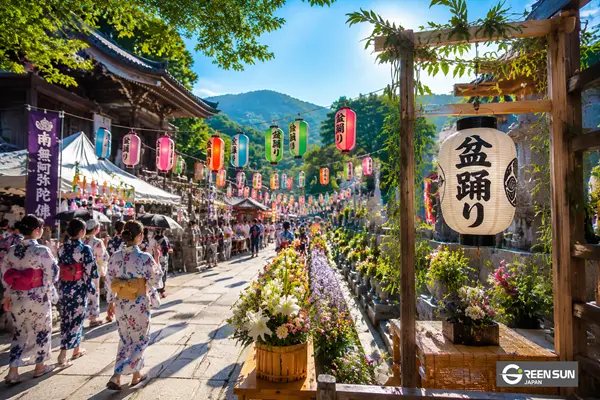
| Community Folk Dance | Bon Odori (盆踊り) | A communal dance performed during the festival; serves as community memory carried through movement and music (Rakuten Travel). |
| Lantern Lighting | Mukaebi / Okuribi | Light is used symbolically to guide spirits home and later guide them back (Rakuten Travel, Japan Guide). |
For English-language audiences, Bon Odori is often the most approachable part of Obon because it is visible and easy to describe. Even so, it helps to explain that it is tied to remembrance, seasonal gathering, and local identity. Without that context, the phrase “traditional dance” does not say enough.
4. What Is Toro Nagashi?
Toro Nagashi is the floating lantern ceremony often associated with the closing of Obon. Lanterns are placed on water and allowed to drift away, symbolically guiding ancestral spirits back to the other world.
This is one of the most memorable visual scenes connected with the Japanese Obon Festival, but it should not be treated as decoration alone. The ceremony carries emotional weight. It marks farewell, transition, and gratitude. Strong English-language writing about Obon should explain what Toro Nagashi means, not simply mention that it looks beautiful.
In cultural writing, beauty without context is rarely enough.
5. Why Obon Still Matters
Obon remains meaningful because it brings together several ideas that travel well across cultures: memory, family, place, and continuity. Even readers unfamiliar with Japanese customs can usually relate to the instinct to remember those who came before, return home at a meaningful time of year, and keep family traditions alive.
What makes Obon distinct is the way those ideas are expressed through specifically Japanese forms: the altar, the offerings, the grave visit, the lantern, the dance, the regional calendar, and the local festival atmosphere. That combination of private feeling and public tradition is what gives Obon its cultural depth.
It is also what makes Obon a useful example of why cultural writing needs careful translation and localization. A direct explanation may cover the facts, but it does not always carry the tone. And with cultural subjects, tone is part of the meaning.
6. Writing About Obon for International Readers
If the audience is outside Japan, the goal should not be to simplify Obon until it loses its shape. The better approach is to explain it clearly while preserving the terms and ideas that make it distinct. In many cases, that means keeping words like Obon, Bon Odori, and Toro Nagashi, then explaining them in natural English the first time they appear.
This usually works better than forcing every cultural term into a short English equivalent. A literal translation may look safe, but it often makes cultural writing sound flat. Readers do not only need a label. They need enough context to understand why the tradition matters.
This is especially true for tourism content, educational content, destination pages, event promotion, and market-facing communication related to Japan.
🚀 Enhance Your Japanese Cultural & Business Content with Green Sun Japan
When Japanese cultural topics are translated for overseas readers, the challenge is rarely just language. It is context.
Green Sun Japan helps businesses and organizations present Japan-related content in English that is accurate, natural, and easy to follow:
- 🌸 Culturally Grounded Translation: Native Japanese-to-English localization that preserves tone, context, and authenticity.
- ⚡ Rapid 30-Minute Business Response: Prompt, professional project scoping and consultation.
- 🛡️ 3-Tier Quality Assurance: Rigorous Translation ➔ Editing ➔ Cultural QA workflow to eliminate awkward phrasing.
7. Frequently Asked Questions (FAQ)
Q1. Is Obon a public holiday in Japan?
Obon itself is not an official national public holiday set by law, but almost all Japanese companies, offices, and institutions close for several days around August 13–16 to allow employees to return to their hometowns.
Q2. Can international tourists participate in Bon Odori dances?
Yes! Most neighborhood Bon Odori festival dances welcome tourists and visitors to join the dancing circle around the yagura stage. The movements are repetitive and easy to learn on the spot.
Q3. How does Obon differ between Tokyo and other regions?
Tokyo celebrates Obon primarily in mid-July (Shichigatsu Bon), whereas the majority of Japan celebrates in mid-August (Hachigatsu Bon). Tokyo’s celebration tends to be more urban, while rural regions feature extensive family grave visits and local ancestral bonfires (Okuribi).
Q4. Why is professional localization necessary for Japanese cultural topics?
Literal translation often strips away context, turning meaningful cultural practices into confusing phrases (e.g., mistranslating Shoryou-uma cucumber horses). Professional localization explains the intent, history, and emotional resonance in natural, engaging English.