

Myanmar Document Translation: How to Prevent Unicode, Font, and Layout Errors in Official Files
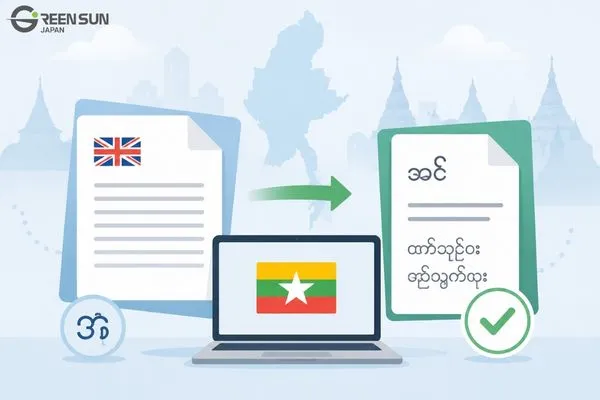
Myanmar is a market with immense potential for international businesses. However, preparing legal dossiers or technical manuals for Burmese document translation presents a significant technical hurdle: font rendering bugs and distorted layouts.
Many organizations have faced critical setbacks when their Myanmar certified translation, despite being linguistically flawless, suffers from corrupted characters, missing diacritics, or random line breaks when opened on a partner’s or auditor’s computer. In official files, even a minor display glitch can alter contract clauses, trigger document rejections, stall project timelines, and cause significant financial losses.
Why is the Burmese language so prone to layout and rendering issues? How can you ensure that your English to Burmese documents remain accurate both linguistically and technically? In this article, localization experts from Green Sun Japan break down the root causes of these errors and share the most effective ways to safeguard your files from Unicode, font, and layout failures.
1. The Core Challenge of Burmese Document Translation: Zawgyi vs. Unicode
To understand why Myanmar documents frequently experience text corruption, it is essential to look at a unique technological quirk within the country: the historical coexistence of two character encoding standards—Zawgyi and Unicode.
Years ago, the vast majority of internet users in Myanmar adopted the Zawgyi font because of its convenience during the country’s early digital boom. However, Zawgyi does not comply with international standards, making it incompatible with modern operating systems and translation software. To align with global digital infrastructure, the Myanmar government officially mandated a nationwide transition to Unicode in 2019. While this migration has progressed significantly, it has left behind a persistent “encoding mismatch” between legacy Zawgyi files and modern Unicode devices.
The core dilemma in Burmese font issues during translation boils down to two factors:
・The Encoding Clash: If your system runs on Unicode but the source document was typed using Zawgyi (or vice versa), the text breaks instantly, showing up as illegible blocks or garbled text.
・Uncontrolled Output: When translating English to Burmese documents, if the linguist fails to strictly manage the output encoding, the final file delivered to a client or regulatory body can easily turn into a chaotic jumble of characters.
For official files, this font mismatch does more than ruin the visual layout—it undermines your corporate credibility in front of local authorities and stakeholders. Therefore, enforcing strict encoding control, standardizing your font guidelines, and hiring specialized translators are essential to avoiding Myanmar Unicode translation errors.
2. Three Common Layout and Font Failures in Burmese Document Translation
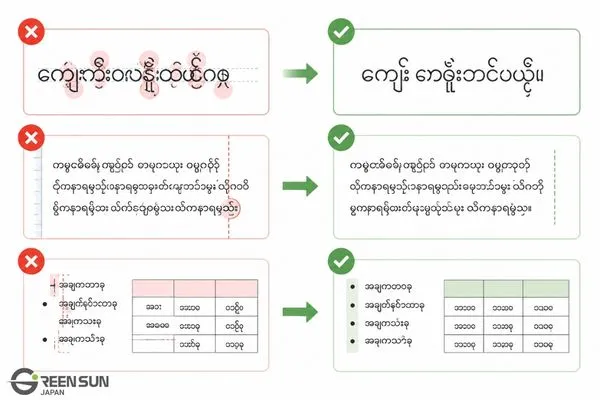
When handling Burmese document translation or converting English to Burmese documents, even the slightest formatting discrepancy can damage a document’s readability and accuracy. Below are the three most prevalent errors found in official Myanmar files:
❌ Text Overlapping and Missing Diacritics
Unlike Latin-based scripts, such as English or Vietnamese, where characters sit side by side on a single linear path, the Burmese script features a complex “stacked” structural hierarchy. A single syllable consists of a primary consonant combined with vowel marks, medials, or diacritics positioned above, below, to the left, or to the right of the root letter. Furthermore, the language uses “stacked characters,” or vertical consonant clusters, to represent double consonants.
Without a synchronized encoding system during translation, standard software fails to interpret these placement rules. As a result, upper and lower diacritics may collapse into each other and form an unreadable black blur, or worse, critical vowel markers may disappear entirely. In official legal or technical documents, the loss of a single diacritic can completely change the meaning of a word, triggering severe compliance risks.
❌ Paragraph Layout and Line Breaking Faults
In native Burmese writing, text flows continuously without spaces between individual words; white space is reserved exclusively to separate clauses or entire phrases.
This characteristic creates a major challenge for word processors like MS Word and Computer-Assisted Translation (CAT) tools. When a string of text hits the right margin, the software’s default word-wrapping algorithm may blindly split words in half to force a new line. Breaking lines at incorrect grammatical points disrupts the text structure and changes the original context—a critical vulnerability when dealing with sensitive contract clauses or compliance requirements.
❌Bullet Alignment and Text Direction Disruption
Corporate documents, standard operating procedures (SOPs), and technical manuals rely heavily on bulleted lists, numbered sequences, and tables. When files are converted from English to Burmese, the overall text volume typically expands by 20% to 30%. This expansion is coupled with a different grammatical structure, as Burmese is a Subject-Object-Verb (SOV) language.
This major structural shift can easily disrupt the original layout. Bullet points may fall out of alignment, and text inside table cells may overflow or be clipped out of view. If the desktop publishing (DTP) team handles the layout without a native understanding of Burmese typography, they may easily overlook truncated text, hidden text, or overlapping strings, compromising the integrity of the document.
📌 The Takeaway: Catching these technical anomalies with the naked eye is virtually impossible if you do not read Burmese. A document that appears perfectly “fitted” on your local monitor can easily turn into a formatting disaster once printed or rendered on another operating system.
3. Expert Guide: How to Prevent Font and Layout Errors in Myanmar Document Translation
3.1. Enforce Strict Unicode Standardization from Day One
The most important baseline rule is to require your language service provider to use a 100% internationally compliant Myanmar Unicode translation workflow.
・Recommended Typefaces: Fonts such as Pyidaungsu, Myanmar Text, or Padauk are currently the safest, most reliable choices. They ensure consistent text rendering across all major operating systems, including Windows, macOS, iOS, and Android.
・Managing Legacy Files: If your source material was accidentally created using outdated Zawgyi encoding, you must run it through trusted Zawgyi-to-Unicode converters before importing it into translation tools. This step helps prevent post-export data corruption.
3.2. Integrate Professional Desktop Publishing (DTP) Services
・Professional DTP is essential for preserving layout integrity after translation, especially in documents with tables, bullet points, forms, or fixed formatting.
・Burmese text expansion and complex script behavior can disrupt spacing, alignment, and line breaks if the layout is not manually adjusted.
・A skilled DTP team can rebuild the translated file, check text flow, correct alignment, and ensure the final document remains visually consistent with the source.
3.3. Utilize the “Zero-Width Space” (ZWSP) Technique
Because the Burmese script is written continuously, default word-wrap engines often break sentences at ungrammatical points. To solve this, localization engineers embed an invisible Unicode character called the Zero-Width Space (ZWSP) at correct word boundaries.
・The Invisible Guide: ZWSP is completely invisible to the end reader, yet it functions as a digital marker that tells the system exactly where it is grammatically safe to break a line.
・Natural Flow: This practice ensures that when a sentence hits the margin, it moves to the next line smoothly while preserving its original meaning, which is vital when translating English to Burmese documents.
3.4. Execute a Rigorous Post-Layout Review (Layout Sign-Off – LSO)
A localized file that renders beautifully on a designer’s workstation might still look completely broken on a client’s device. Implementing a formal Layout Sign-Off (LSO) protocol serves as your final line of defense.
・Cross-Platform Compatibility Audits: The finalized deliverables should be exported to static PDF formats to lock in the typography, then verified across multiple device profiles.
・Native In-Context Review: A native Burmese linguist must perform a final visual review of the post-DTP layout. Their linguistic intuition helps them instantly spot dropped vowel markers, clipped lines, or faulty word wraps that a non-native quality assurance team would miss.
3.5. Partner with Certified Myanmar/Burmese Translators
The foundation of any successful compliance filing or corporate deployment is working directly with professionals who specialize in Myanmar certified translation. They provide immediate risk mitigation at the point of data entry through three core assets:
・Native-Level Expertise: Deep mastery of Burmese syntax, honorifics, and corporate registers ensures that your messaging sounds authoritative and is formatted correctly.
・Regulatory and Legal Fluency: Thorough familiarity with the strict vetting criteria of local authorities in Myanmar helps ensure that technical jargon is translated precisely, leaving no room for ambiguity.
・Technical Literacy in Unicode Standards: Certified professionals are highly trained in using modern Computer-Assisted Translation (CAT) software. They proactively monitor output variables to prevent the accidental introduction of legacy Zawgyi text fragments.
4. Conclusion
Managing Myanmar document translation projects has always been a complex undertaking, even for global enterprises with extensive international experience. Issues like font corruption, overlapping characters, and broken layouts do more than ruin the visual presentation—they directly threaten the legal validity and timeline of critical compliance filings. By standardizing Unicode usage, integrating specialized DTP engineering, and partnering with verified native linguists, your business can gain full control over these digital assets and significantly reduce technical risks.
5. Frequently Asked Questions (FAQ
Q1: Why does my document look fine on my monitor but appear corrupted when opened in Myanmar?
A: This happens due to an encoding mismatch between legacy Zawgyi fonts and the modern Unicode standard. To resolve this, both parties must use the same Unicode-compliant typefaces, such as Pyidaungsu or Myanmar Text.
Q2: Can I just use free online font converters to fix my files?
A: Only for short, plain text snippets. For official documents with complex layouts, tables, and lists, automated web converters can cause serious formatting issues. These files require manual, professional DTP adjustments to preserve structural integrity.
Q3: Does embedding the “Zero-Width Space” (ZWSP) character alter the actual content of my document?
A: Not at all. ZWSP is a completely invisible digital marker that adds no visual elements to the page. Its sole function is to tell word-wrapping engines where a word grammatically ends, allowing text to drop to the next line naturally without distorting the original context.
Q4: Do Computer-Assisted Translation (CAT) tools automatically fix Burmese font and layout issues?
A: No. While modern CAT software can store data in standard Unicode strings, it cannot automatically manage complex script behaviors like line breaks or expanding table constraints. You still need a specialized combination of native in-context review and manual DTP post-processing.
Partner with Green Sun Japan: Flawless Burmese Documents, 100% Peace of Mind
Do not let rendering bugs or distorted layouts jeopardize your brand reputation and project timelines in the Myanmar market.
At Green Sun Japan, we provide a comprehensive suite of localization solutions designed to secure your critical files from start to finish:
・Certified Native Experts: A dedicated team of certified Burmese linguists with deep technical and regulatory fluency.
・Advanced DTP Engineering: Flawless reconstruction of highly complex file types (including Word, Adobe InDesign, Illustrator, and PDF).
・Guaranteed Integrity: A strict Myanmar Unicode translation workflow that ensures clean, reliable deliverables ready for regulatory submission.
Ready to secure your Burmese files against formatting failures?
👉 Contact Green Sun Japan today for your free consultation and customized project quote!