

Translating English to Korean: A Linguist’s Guide to Honorifics and Formality Levels
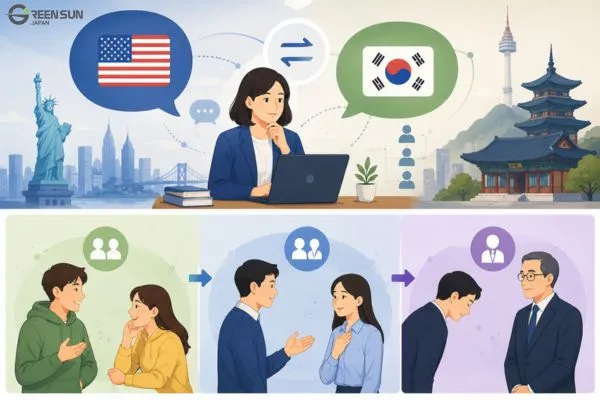
In the localization industry, Korean is widely considered one of the most challenging languages to translate because of its complex honorific system and multiple levels of formality. Unlike English, Korean changes depending on age, social status, relationship dynamics, and communication context.
As a result, English to Korean translation requires far more than language proficiency alone. It also demands a deep understanding of Korean culture, communication styles, and sociolinguistics.
In this article, we’ll explore how Korean honorifics work, break down the differences between formal vs. informal Korean, and examine the key Korean translation rules professional linguists use in real-world localization projects.
English to Korean translation is difficult because Korean requires translators to adjust sentence endings, honorifics, pronouns, titles, and tone according to the relationship between the speaker and listener. A good Korean translation must be accurate in meaning, culturally natural, and appropriate in formality level.

1. What Makes English to Korean Translation Difficult?
Unlike European languages, Korean encodes social relationships directly into grammar — making every translation decision inseparable from cultural context.
1.1. English and Korean Follow Different Communication Structures
One of the biggest challenges in English to Korean translation comes from the way the two languages approach communication.
In English, many expressions can be used with almost anyone without changing the sentence structure significantly.
For example, the phrase:
“Did you eat?”
can naturally be used with friends, coworkers, supervisors, customers, or teachers.
In Korean, however, translators must first understand the relationship between the speaker and listener before selecting the correct expression.
For example:
・먹었어? → casual
・드셨어요? → polite
・식사하셨습니까? → highly formal
Although all three expressions mean “Did you eat?”, each one communicates a different level of respect, social distance, and formality.
This is why Korean localization requires much deeper contextual analysis than simple word-for-word translation.
1.2. Korean Relies Heavily on Context
English communication often centers on delivering information clearly and directly.
Korean, by contrast, places much greater emphasis on the listener. Speakers constantly adjust their language based on social hierarchy, age, familiarity, and communication context.
This affects:
・verb selection,
・sentence endings,
・honorific usage,
・pronouns,
・and vocabulary choices.
Even a simple sentence can change dramatically depending on who is speaking and who is listening.
2. What Are Korean Honorifics?
Korean honorifics are language forms used to show respect, politeness, and social hierarchy. They affect verbs, nouns, pronouns, titles, and sentence endings.
2.1. Honorifics Are Central to Korean Communication
Korean honorifics operate at every level of the language — from verb stems and noun choices to sentence-final endings — not merely as a stylistic add-on, but as a structural requirement.
In Korean honorifics translation, linguists are not simply translating meaning. They must also accurately reflect the social relationship between characters, coworkers, customers, or brands and their audiences.
Many Korean learners assume that adding “요” to the end of a sentence automatically makes it polite. In reality, honorifics influence nearly every part of the language, including verbs, nouns, pronouns, titles, suffixes, and sentence structure.
| Korean Level | Used With | Example | Tone |
|---|---|---|---|
| Casual Korean | Friends, family members, younger people | 먹었어? | Relaxed and personal |
| Polite Korean | Customers, coworkers, strangers | 드셨어요? | Respectful and professional |
| Highly Formal Korean | Legal, official, and corporate contexts | 식사하셨습니까? | Formal and authoritative |
This table shows that Korean honorifics do not only change sentence endings. They can also change the core vocabulary used in professional, formal, or respectful communication.
2.2. Why Honorifics Matter in Localization
In Korean localization, honorifics directly affect:
・user experience,
・brand image,
・customer trust,
・and overall communication tone.
For example, if a financial app uses language that feels too casual, users may perceive the brand as unprofessional.
On the other hand, if a mobile game or entertainment platform sounds overly formal, the content may feel cold or unnatural.
Choosing the correct speech level is essential for creating a natural user experience.
3. What Is the Difference Between Formal and Informal Korean?
The main difference between formal and informal Korean is the level of politeness used toward the listener. The correct form depends on age, relationship, social status, and communication setting.
3.1. Casual Korean
Casual Korean is commonly used with:
・close friends,
・younger people,
・family members,
・or individuals with a close personal relationship.
Examples:
・뭐 해? → “What are you doing?”
・괜찮아? → “Are you okay?”
This speech style feels relaxed, friendly, and personal.
However, using casual Korean in workplaces, customer support, or professional settings can come across as rude or unprofessional.
3.2. Polite Korean
Polite Korean is the most commonly used speech level in modern Korean society and appears frequently in localization projects.
It is widely used in:
・websites,
・applications,
・customer service,
・workplaces,
・and conversations with strangers.
Examples:
・감사합니다 → “Thank you”
・잠시만 기다려 주세요 → “Please wait a moment”
This level balances professionalism, friendliness, and natural communication.
3.3. Highly Formal Korean
Highly formal Korean is commonly used in:
・legal documents,
・corporate announcements,
・news reports,
・military communication,
・academic materials,
・and official speeches.
Examples:
・성함을 입력하십시오 → “Please enter your full name”
・회의를 곧 시작하겠습니다 → “The meeting will begin shortly”
If overused in regular apps or websites, this level of formality can feel emotionally distant or overly rigid.
4. Why Does Literal English to Korean Translation Often Fail?
Literal English to Korean translation often fails because Korean expresses relationships, context, and tone differently from English.
4.1. Language Reflects Relationships, Not Just Meaning
One of the most common mistakes in English to Korean translation is following the original English structure too closely.
In reality, a single English sentence may require completely different Korean translations depending on the relationship between the speaker and listener.
For example, the sentence:
“Can you send me the file?”
may become:
・파일 보내줄래? → casual
・파일 보내주실 수 있나요? → polite
・파일을 보내주시기 바랍니다 → formal
Although the core meaning stays the same, the emotional tone, professionalism, and level of respect change significantly.
4.2. Context Matters More Than Literal Accuracy
One of the most important Korean translation rules is prioritizing natural communication over direct translation.
For example:
English:
“You worked hard.”
Literal translation:
당신은 열심히 일했습니다.
Natural Korean expression:
수고하셨습니다.
The second version sounds far more natural because it reflects Korean communication culture rather than simply translating each word individually.
This is also one of the areas where machine translation still struggles without sufficient context.
4.3. Korean Frequently Omits Pronouns
English relies heavily on pronouns such as “I,” “you,” “he,” and “she.”
Korean often omits the subject entirely when the meaning is already understood from context.
For example:
・보고서 끝냈어요?
sounds much more natural than:
・당신은 보고서를 끝냈어요?
Overusing pronouns is one of the clearest signs of machine-translated Korean or translations that follow English sentence structures too closely.
4.4. Titles Often Matter More Than Names
In Korean business culture, titles frequently carry more importance than personal names.
This is a critical detail translators must understand when handling corporate or workplace-related content.
Examples include:
・팀장님 → team leader
・부장님 → department manager
・교수님 → professor
A sentence like:
“David said…”
may need to be translated as:
데이비드 부장님께서 말씀하셨습니다.
if David holds a higher position within the organization.
5. Why Is Korean Localization More Than Translation?
Korean localization goes beyond translation because it adapts tone, cultural expectations, calls to action, UX wording, and brand voice for Korean users.
5.1. Korean Users Prefer Softer Expressions
English marketing copy often uses direct calls to action such as:
“Buy now!”
However, translating this too literally into Korean can sound overly aggressive.
Korean localization typically uses softer, more inviting expressions such as:
・지금 확인해보세요
・지금 만나보세요
This style aligns better with Korean customer expectations, UX writing practices, and communication preferences.
5.2. Cultural Adaptation Matters as Much as Grammar
Successful Korean localization requires more than grammatically correct sentences.
Translators must also adapt:
・communication tone,
・humor,
・calls to action,
・wording choices,
・and corporate messaging.
This is why professional Korean localization projects still rely heavily on experienced linguists instead of depending entirely on machine translation.
6. Conclusion
English to Korean translation involves much more than converting words from one language into another.
It requires the translator to ask not just what is being said, but who is speaking, to whom, and why — and to reconstruct that dynamic faithfully in Korean.
To produce high-quality localization, translators must understand:
・Korean honorifics,
・formal vs. informal Korean,
・and the practical Korean translation rules used in professional communication.
Although AI translation technology continues to improve rapidly, Korean remains one of the most difficult languages to localize because of its context-dependent structure and complex social hierarchy.
As a result, human editing and localization expertise still play a critical role in ensuring translations sound accurate, natural, and culturally appropriate.
7. FAQ
1. Why is English to Korean translation difficult?
Beyond grammar, Korean translation requires the translator to reconstruct the social dynamic of the original scene — something no style guide can fully prescribe. Translators must choose the right honorifics, sentence endings, pronouns, titles, and tone.
2. Why Are Honorifics Important in Korean?
In Korean honorifics translation, honorifics directly influence communication tone, professionalism, user experience, and cultural appropriateness.
3. Can machine translation handle Korean honorifics?
Machine translation can handle simple Korean sentences, but it often struggles with honorifics, omitted subjects, emotional nuance, and formality levels when context is unclear.
4. Is Korean Localization Important?
Yes. Korean localization helps content align naturally with Korean culture, communication styles, and user expectations.

The considerations above illustrate why experienced human linguists remain essential in Korean localization. Green Sun Japan’s team applies these principles across every project — from mobile apps to legal documentation.
Green Sun Japanprovides specialized English to Korean translation services delivered by experienced linguists who understand cultural nuance, communication tone, and professional Korean honorifics translation across multiple industries.
We provide:
・contextually accurate translations with the appropriate formality level,
・natural honorific usage tailored to the target audience,
・fluent content that does not feel machine-translated,
・multi-layer quality review before delivery,
・and consistent terminology management throughout the entire project.
From websites and mobile apps to games and business documents,Green Sun Japandelivers Korean localization that feels natural to Korean users while following professional translation standards and communication practices.
👉 ContactGreen Sun Japantoday to find the right localization solution for your project.