

Vietnamese Legal Translation Services: Contracts & Compliance
Vietnamese legal translation services are used for documents such as contracts, licenses, compliance records, internal policies, and corporate documents—materials where translation errors could change how legal rights, obligations, or requirements are understood. For this reason, high-risk legal documents need more than translation and proofreading. An appropriate workflow should combine translators with legal experience, terminology management, independent review, and QA checks for legal entity names, numbers, defined terms, numbering, and cross-references.
For Vietnamese legal translation, the level of review should match the document’s risk. Contracts, licenses, regulatory filings, and documents used in official procedures typically require specialized translators, independent reviewers, and QA before use. AI/NMT can support low-risk reference materials, but raw machine translation should not be used for documents that could create or modify legal rights and obligations. This is particularly important for areas such as contract translation and compliance translation in Vietnamese, where accuracy and consistency are critical.
The article below explains which documents require a high level of translation control, highlights common errors, and helps businesses choose between AI/NMT, MTPE, and human translation.
Contents
- 1. How is Vietnamese legal translation different from standard document translation?
- 2. Which types of Vietnamese legal documents require high accuracy?
- 3. Six Legal Translation Errors That Can Create Major Risks
- 4. Recommended Workflow for High-Risk Legal Document Translation
- 5. Choosing a Vietnamese Legal Translation Service and Selecting Among AI, MTPE, and Human Translation
- 6. FAQ

1. How is Vietnamese legal translation different from standard document translation?
Vietnamese legal translation differs from standard document translation because the translation must be accurate and preserve the legal rights, obligations, conditions, exceptions, and implications of the original document. Even a minor change in wording can affect how a clause is interpreted, especially in contracts, licenses, or regulatory filings.
For example, in English contracts, terms such as shall, may, must, liability, indemnity, and termination must be translated according to the specific legal context. Inconsistent translations across clauses can obscure the parties’ responsibilities or the scope of their obligations.
Beyond terminology, Vietnamese legal translation services require careful checks of legal entity names, authority names, document reference numbers, dates, defined terms, item numbering, and cross-references between sections, clauses, or annexes. For high-risk documents, this usually means adding a review by someone experienced with legal texts.
It is also important to clearly distinguish among legal translation, legal review, and legal advice. The translator conveys the source accurately, while the reviewer checks terminology, consistency, and wording that could affect interpretation. Evaluating legal validity, recommending clause amendments, or providing legal opinions, however, falls within the scope of a lawyer or authorized legal professional.
2. Which types of Vietnamese legal documents require high accuracy?
In Vietnamese legal translation, documents that directly establish rights, obligations, or liabilities, as well as those used in official procedures, generally require the highest level of accuracy. The level of review should also reflect the potential consequences of any translation error.
| Document Type | Elements to Control | Risk of Translation Errors | Risk Level |
|---|---|---|---|
| Contracts and agreements | Rights, obligations, payment terms, indemnity, liability, termination, and dispute resolution | Changes the understanding of the parties’ rights or obligations | Very high |
| Licenses and licensing files | Legal entity names, issuing authorities, license numbers, scope of operation, validity periods, and conditions | Creates inconsistencies with the original documents or affects cross-checking and processing | Very high |
| Regulatory and compliance files | Legal requirements, compliance obligations, procedures, forms, and reporting information | Leads to misinterpretation of regulatory requirements or compliance obligations | Very high |
| Policies and internal governance documents | Mandatory provisions, authority, duties, exceptions, and scope of application | Causes employees or stakeholders to misunderstand policies or responsibilities | High |
| Charters, resolutions, and meeting minutes | Authority, decisions, voting ratios, titles, and dates | Distorts the content of decisions or the basis for corporate governance | High |
| Powers of attorney and corporate records | Principal, attorney-in-fact, scope of authority, validity period, and legal entity information | Misrepresents the scope of authority or information used in official procedures | High |
Among these, Vietnamese contract translation projects, licensing documents, and regulatory files typically require the most thorough review because errors can directly affect a business’s rights, obligations, or official procedures. In Vietnamese compliance translation projects, consistency across regulations, procedures, forms, and related documents is also particularly important.
Therefore, rather than applying the same workflow to every document, businesses should categorize documents by risk before translation. This helps identify which materials need specialized translators, reviewers experienced with legal documents, and an independent QA step.
3. Six Legal Translation Errors That Can Create Major Risks
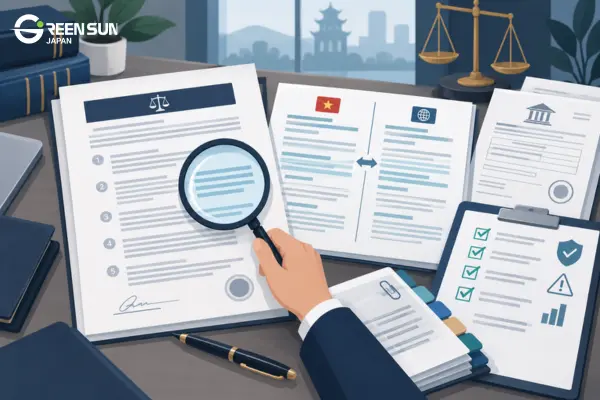
In Vietnamese legal translation, even a small error in wording, figures, or references can affect how the parties’ rights and obligations are understood. Below are six types of errors that require strict control when translating contracts, licenses, and other legal documents.
💡 Mistranslating Words That Express the Degree of Obligation
Words such as shall, must, may, and should cannot be translated the same way in every context. Depending on the clause, they may express a mandatory obligation, permission, an option, or a recommendation.
For example:
- The Buyer shall make payment within 30 days. → Bên mua phải thanh toán trong vòng 30 ngày.
- The Buyer may terminate the Agreement. → Bên mua có quyền/có thể chấm dứt Hợp đồng.
If may is translated as “phải” (must), an option may incorrectly become a mandatory obligation.
💡 Inaccurately Translating Legal Terminology
Terms such as liability, indemnity, warranty, representation, governing law, and termination can have specific meanings depending on the document and legal context. Relying only on dictionary definitions without considering context can lead to misunderstandings about the meaning of a clause.
Therefore, in contract translation Vietnamese projects, terminology should be translated consistently and in a way that reflects the nature of each clause rather than through mechanical word-for-word translation.
💡 Inconsistent Terminology Within the Same Document
Translating the same legal concept in different ways can create ambiguity. For example, if a defined term is established as “Effective Date” (Ngày Có Hiệu Lực), the same wording should be maintained throughout the contract.
For projects involving multiple related contracts, policies, or records, a glossary and Translation Memory should be used to help maintain terminology consistency.
💡 Omitting Conditions, Exceptions, or Negative Words
Words and phrases such as unless, except, provided that, subject to, notwithstanding, and not can significantly change the scope or meaning of a clause.
For example, omitting except can turn a rule with specific exceptions into one that appears to apply in all cases. This type of error is particularly risky in contracts and compliance translation Vietnamese projects.
💡 Incorrect Legal Entity Names, Figures, or Legal Information
Company names, license numbers, effective dates, ownership percentages, monetary amounts, and regulatory authority details must be carefully checked against the source document.
For example, a wrong digit in a license number or confusion between a parent company and a subsidiary can make the translation inconsistent with official records.
💡 Incorrect Numbering and Cross-References
Legal documents often contain numerous references, such as “Clause 5.2,” “Section 3,” “Annex A,” or “Schedule 2.” In long documents with multiple heading levels, numbering and cross-reference errors can occur easily.
For example, if the source text states “subject to Clause 8.2” but the translation refers to Clause 8.3, the reader may apply the wrong conditions or obligations.
For this reason, Vietnamese legal translation services should include a dedicated QA step that checks language accuracy, defined terms, figures, legal entity names, numbering, and cross-references. For high-risk documents, an experienced legal reviewer should also review the translation before delivery or official use.
4. Recommended Workflow for High-Risk Legal Document Translation
For contracts, licenses, regulatory filings, and documents used in official procedures, Vietnamese legal translation services should follow a workflow with several review stages. For a broader explanation of file intake, review, and QA, see our professional translation workflow. A suitable workflow may include seven steps:
Source Review → Risk Classification → Terminology Setup → Translation → Legal-Experienced Review → QA → Final Approval
👉Step 1: Review the Source Document
Before translation begins, the team should identify the document type, latest version, language pair, intended purpose, and formatting requirements. Any unclear points in the source text should also be flagged and verified with the client rather than interpreted based on assumptions.
👉Step 2: Classify the Risk Level
Assess each document based on the possible consequences of a translation error. Contracts that are about to be signed, licenses, and filings submitted to regulatory authorities are generally considered higher risk than documents used solely for internal reference.
👉Step 3: Set Up and Control Terminology
Before translation begins, the team should agree on glossaries, defined terms, legal entity and authority names, and terms that should remain untranslated. For long-term projects, Translation Memory can also be used to maintain consistency across multiple documents.
👉Step 4: Translate with Subject-Matter Expertise
Translators should have experience with the relevant document type and understand how legal terminology is used in context. In contract translation Vietnamese projects, particular attention should be paid to rights, obligations, conditions, exceptions, liabilities, and termination clauses.
👉Step 5: Conduct an Independent Legal-Experienced Review
High-risk translations should be independently reviewed by someone experienced in handling legal documents. The review should cover not only wording but also legal terminology, defined terms, rights and obligations, conditions, exceptions, and consistency across clauses.
👉Step 6: Perform Final QA
Before delivery, elements that are especially prone to error and could have a significant impact should be checked again, including:
- Legal entity names and authority names
- Amounts, percentages, and dates
- License numbers and file codes
- Defined terms
- Articles, clauses, and annexes
- Cross-references
- Formatting and missing content
👉Step 7: Obtain Final Approval from the Client or Legal Counsel
For documents that are about to be executed, submitted to regulatory authorities, or used in matters with significant legal consequences, the client or legal counsel may need to review and approve the translation before official use.
This workflow helps ensure that Vietnamese legal translation is managed according to the level of risk rather than through a single process applied to every document. Just as importantly, legal translation and legal review do not replace legal advice. When assessing the validity, enforceability, or application of a clause, businesses should consult an authorized legal professional.
5. Choosing a Vietnamese Legal Translation Service and Selecting Among AI, MTPE, and Human Translation
When choosing a Vietnamese legal translation service, consider more than cost and speed. The key consideration is whether the provider can design a workflow that matches the document’s risk level and appropriately combines AI/NMT, MTPE, and expert human translation.
A reliable provider should be able to assess document risk, assign translators and reviewers experienced with contracts and legal filings, and apply terminology, quality, and security procedures suited to sensitive documents. Instead of asking only about the rate per word, businesses should also ask who will translate the document, who will review it, and what the quality control process includes.
Workflow selection should begin with an assessment of the document’s risk level:
- Low risk (internal reference documents): AI/NMT may be used with basic checks to improve speed and cost efficiency. Raw machine translation should not be used for documents that create or affect legal liability.
- Medium risk (internal regulations and compliance documents): MTPE (Machine Translation Post-Editing) can help balance speed and quality, provided that a qualified translator reviews the full text. This approach may be suitable for certain compliance translation Vietnamese projects.
- High risk (contracts, NDAs, and licenses): Prioritize expert human translation to preserve the relationships between clauses, exceptions, obligations, and the scope of liability. This is particularly important for contract translation Vietnamese projects.
- Very high risk (dispute files, litigation documents, and regulatory filings): A stricter workflow is typically required, including expert translation, independent review, and a final check by legal counsel where appropriate.
The guiding principle is to assess risk first and select the technology second. A professional provider does not necessarily exclude AI from the process; instead, it determines when technology can be used as a support tool and when human expertise is necessary to maintain accuracy and reduce legal risk.
· AI Translation for Vietnamese Tones and Regional Dialects
· Vietnamese Translation Pricing and Cost Factors
6. FAQ
📍Q1. Does Vietnamese legal translation require a translator with legal knowledge?
Yes. For contracts, licenses, regulatory filings, and other documents that may affect legal rights and obligations, the translator should understand relevant legal terminology and document structures. For high-risk documents, the translation should also be reviewed by someone with experience handling legal texts.
📍Q2. Does Vietnamese contract translation require a second review?
A second review is recommended, especially for contracts used in negotiations, signing, or the performance of obligations. A Vietnamese contract translation workflow may include a specialized translator, an independent reviewer, and a final QA step to check defined terms, figures, clauses, and cross-references.
📍Q3. Do legal translations always require notarization or certification?
No. Not all legal translations require notarization or certification. The requirement depends on the document type, intended use, and the rules of the receiving authority or organization. Businesses should confirm these requirements in advance to select the appropriate service. Our guide to certified and notarized translation explains the distinction.
📍Q4. How can consistency in legal terminology be maintained?
For large projects, a Vietnamese legal translation provider should establish a glossary, a list of defined terms, and a Translation Memory before or during the project. Related documents should also be managed centrally to help ensure that the same term is translated consistently across files.
📍Q5. What should a business provide to receive a legal translation quote?
To receive a more accurate quote, businesses should provide the source file, language pair, intended purpose, preferred deadline, and formatting requirements. If available, they should also provide glossaries, previous bilingual contracts, terminology preferences, and any notarization or certification requirements at the outset.
📍Q6. How are costs calculated for Vietnamese legal translation services?
Costs typically depend on the word or page count, language pair, document complexity, turnaround time, and required level of review. High-risk documents that require specialized translators and multiple layers of quality control are generally priced differently from legal documents intended only for internal reference. See the Vietnamese translation cost guide for a breakdown of general pricing factors.
Need a reliable translation of high-risk legal documents? Green Sun Japan provides Vietnamese legal translation services with translators experienced in the subject matter, terminology management, multiple review stages, and thorough QA for contracts, licenses, and compliance records.
👉 Contact Green Sun Japan to discuss the right workflow and request a quote for your documents.