

Japanese Machine Translation Services: When MTPE Is the Right Fit for Manuals, Help Centers, and High-Volume Content
As businesses expand globally, the need to deliver information quickly and accurately in Japanese has become increasingly important—especially for technology companies, manufacturers, and international service providers. However, translating large volumes of content manually, from user manuals and technical documentation to FAQs and knowledge bases, can be both time-consuming and expensive.
This is why Japanese Machine Translation Services, combined with Japanese MTPE (Machine Translation Post-Editing) performed by professional linguists, have become a practical solution for many organizations.
In this article, you’ll learn what Japanese MTPE is, when machine translation is the right choice, and when human translation remains essential. We’ll also explore how businesses can build an effective Japanese AI Translation Workflow that combines Japanese Translation Automation with Human Review Japanese Translation to achieve the right balance of speed, cost, and quality.
1. Why Japanese Machine Translation Services Are Becoming More Popular
As the volume of content requiring translation continues to grow, relying solely on manual translation is no longer practical for many organizations. Businesses must constantly balance speed, quality, and cost, and Japanese Machine Translation Services offer a compelling solution.
Faster Turnaround Times
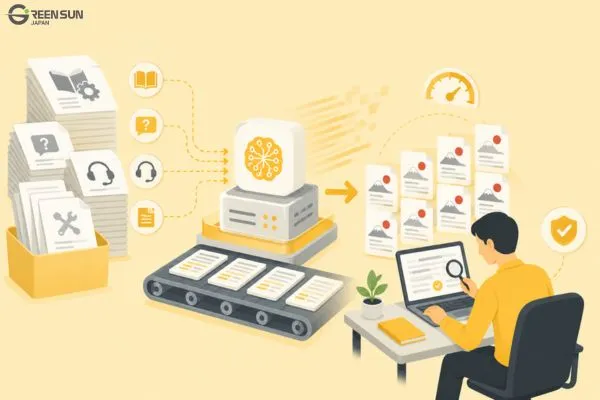
Machine translation can process thousands of pages of content in minutes rather than weeks or months. Whether translating user manuals, technical documentation, FAQs, or support articles, machine translation dramatically accelerates the initial draft process. When combined with MTPE for Japanese, organizations can significantly reduce project timelines while maintaining the required level of accuracy.
Lower Translation Costs
Cost savings are another major advantage. Since machine translation generates the first draft, editors spend less time translating from scratch and can focus on refining and correcting the content. This makes MTPE particularly valuable for businesses managing large content libraries or frequently updated documentation.
Greater Consistency
Maintaining consistent terminology, style, and formatting across large-scale translation projects can be challenging. By combining machine translation with professional post-editing, organizations can achieve greater consistency throughout their content. When integrated into a structured Japanese AI Translation Workflow and supported by Japanese Translation Automation, businesses can streamline translation processes while reducing inconsistencies in terminology and formatting.
2. What Is MTPE and When Is It Appropriate?
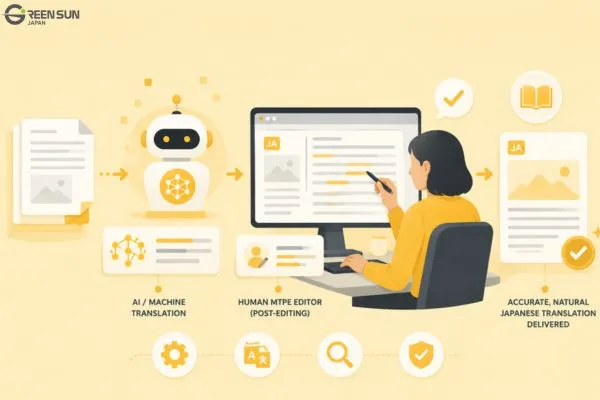
MTPE (Machine Translation Post-Editing) is the process of having professional editors review and refine machine-translated content. Editors correct terminology, improve sentence structure, verify context, and ensure the final text is accurate, natural, and aligned with business objectives.
Machine translation post-editing works particularly well for Japanese content with standardized structures, repetitive language, and limited creative requirements. Typical examples include:
・User manuals
・Help center articles
・FAQs
・Knowledge base content
・Technical documentation
By applying MTPE, businesses can efficiently process large volumes of content while maintaining consistency in terminology, tone, and style. This approach reduces both translation time and overall costs while still delivering professional-quality results.
MTPE Limitations
Despite its advantages, MTPE is not suitable for every type of content.
Creative materials such as marketing campaigns, branding content, advertising copy, and literary works require nuanced language and emotional impact that machine translation cannot fully capture.
Similarly, high-risk content—including legal agreements, medical documents, and sensitive technical materials—requires thorough Human Review Japanese Translation to ensure accuracy, compliance, and reliability.
A Practical Hybrid Approach
To maximize efficiency and quality, organizations should classify content based on complexity and risk.
・Low-risk, structured content → MTPE
・Creative or high-risk content → Human translation
This hybrid model enables businesses to balance speed, cost efficiency, and translation quality across different content types.
3. When to Use Japanese MTPE
Japanese MTPE is most effective for content that follows a structured format and uses consistent terminology.
User Manuals
User manuals are ideal for MTPE because they typically contain short sentences, repetitive structures, and standardized terminology. Examples include:
・Equipment operation manuals
・Software user guides
・Product handbooks
Machine translation can quickly generate a draft, while MTPE ensures accuracy and readability.
Help Center Content
Help center articles often provide step-by-step instructions and straightforward solutions to specific problems. Their predictable structure makes them highly suitable for MTPE.
FAQs and Knowledge Base Articles
FAQs and knowledge base content are usually concise, repetitive, and updated frequently. Machine translation combined with MTPE helps organizations maintain consistency while accelerating publication.
Technical Documentation
Technical documents containing specialized terminology can also benefit from Japanese post-editing services, provided experienced editors review the content.
Decision Matrix: Which Content Is Suitable for Japanese MTPE?
| Content Type | Risk Level | MTPE Suitable | Reason |
|---|---|---|---|
| User Manuals | Low | ✅ | Clear structure and limited creativity |
| Help Centers | Low | ✅ | Easy to translate and edit |
| FAQs | Low | ✅ | Short, repetitive content |
| Knowledge Base Articles | Medium | ✅ | High volume and terminology consistency |
| Technical Reports | Medium | ✅ | Requires terminology control |
| Internal Training Materials | Medium | ✅ | Suitable when creativity is minimal |
| Marketing Content | High | ❌ | Requires creativity and persuasive language |
| Branding Content | High | ❌ | Requires a unique voice and style |
| Legal Contracts | Very High | ❌ | Errors create significant risk |
| Medical Documents | Very High | ❌ | Requires maximum accuracy |
4. When Not to Use MTPE
Japanese MTPE is not appropriate for content that demands creativity, emotional nuance, or carries significant risk.
Creative and Emotional Content
Content such as advertising campaigns, PR materials, storytelling, and promotional copy depends on style, emotion, and audience engagement. MTPE can convey the core meaning, but it cannot consistently deliver the intended emotional impact.
Brand-Focused Content
Brand messaging often requires careful word choice, tone, rhythm, and cultural adaptation. These elements are difficult to achieve through machine translation alone.
High-Risk Content
Legal contracts, medical documents, technical procedures, and regulatory materials require exceptional accuracy. Even minor translation errors can lead to serious consequences. In these cases, MTPE may serve as a supporting tool, but it should never replace professional human translation.
For these content types, experienced human translators remain the safest and most effective option.
5. Choosing Between MTPE and Human Translation
Before selecting a translation method, businesses should evaluate three key factors:
・Content type
・Risk level
・Intended use
Large-scale content with a standardized structure and minimal creative requirements—such as user manuals, FAQs, help center articles, and technical knowledge bases—is generally well suited for Japanese MTPE.
On the other hand, creative, sensitive, or high-risk content—including marketing materials, branding assets, legal documents, and medical content—should be translated entirely by professional human translators.
Many organizations achieve the best results through a hybrid approach:
・Use MTPE for technical and repetitive content.
・Use human translation for creative and high-stakes content.
By classifying content according to complexity and risk, businesses can optimize efficiency while maintaining high translation standards across all Japanese-language materials.
6. Conclusion
Japanese Machine Translation Services, combined with Japanese MTPE and professional human review, offer an efficient and cost-effective solution for organizations managing large volumes of content.
This approach helps businesses:
・Reduce translation costs
・Accelerate project timelines
・Maintain terminology consistency
・Improve operational efficiency
This post-editing approach is particularly effective for user manuals, help center articles, FAQs, knowledge bases, and technical documentation. However, marketing content, branding materials, legal contracts, and medical documents should continue to be translated by experienced human professionals to ensure accuracy, nuance, and compliance.
By implementing a structured Japanese AI Translation Workflow that combines Japanese Translation Automation with Human Review Japanese Translation, organizations can achieve faster, more consistent, and higher-quality Japanese translations while minimizing risk.
7. FAQs
1. Is Japanese MTPE as accurate as human translation?
Japanese MTPE is highly effective for structured content such as user manuals, FAQs, and help center articles. However, creative and high-risk content should still be translated by professional human translators.
2. What types of content are best suited for Japanese Machine Translation Services?
User manuals, help center articles, FAQs, knowledge base content, and technical documentation with clear structures are generally the best candidates.
3. Should MTPE be used for marketing content?
No. Marketing content relies on creativity, emotional nuance, and brand voice, making professional human translation the preferred option.
4. Why is a human editor still necessary?
Machine translation can produce contextual errors, terminology inconsistencies, or unnatural phrasing. Human editors refine and validate the content to ensure quality and accuracy.
5. Can Japanese Translation Automation replace human translators?
No. Automation can significantly improve efficiency, but human expertise remains essential for quality control, especially for sensitive, creative, or high-risk content.

Need to translate large volumes of Japanese content while maintaining quality and controlling costs?
GreenSun Japan combines Japanese Machine Translation Services, Japanese MTPE, and professional linguistic review to help businesses scale their multilingual content efficiently.
With GreenSun Japan, you can expect:
1. Thoroughly reviewed translations with accurate meaning and terminology.
2. Consistent terminology, style, and formatting across all project content.
3. Faster turnaround times through the integration of Japanese MTPE and Japanese Translation Automation.
4. Experienced editors who ensure translations sound natural, clear, and aligned with your business goals.
Contact GreenSun Japan today to discuss a customized translation solution and discover how our quality-focused approach can support your Japanese localization projects.