

Japanese Website Translation Service for Japanese Businesses in Singapore
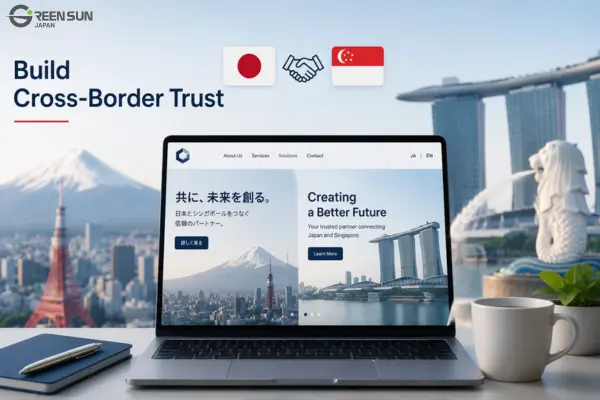
Japanese companies expanding into Singapore often already have websites built for the domestic market, but those structures may not work as well for international partners. Visitors need to quickly understand who the parent company is, which local entity operates in Singapore, what services are offered, who handles inquiries, and how to get in touch. Simply translating the website sentence by sentence may produce accurate English, but the site can still lack transparency or be difficult to navigate. A Japanese website translation service therefore needs to combine translation, content localization, information alignment, and interface testing to help build B2B trust between Japan and Singapore.
Quick Answer: A Japanese website translation service for Japanese companies operating between Japan and Singapore should turn headquarters-approved content into clear, verifiable information that meets the needs of readers in Singapore. The scope should include corporate pages, bilingual service pages, case studies, contact flows, compliance messaging, and technical checks.
Key Takeaways
・Align key information between Japan and Singapore.
・Prioritize pages that directly influence inquiries.
・Keep service scope and details consistent.
・Review both content and website functionality.
1. Clarify the Relationship Between the Japanese Headquarters and the Singapore Entity
The website should clearly explain who provides the services, who handles inquiries, and which markets are supported. Before starting Japanese website translation in Singapore, companies should confirm their legal entity names, the role of the parent company, the entity responsible for local operations, and the relevant contact information. Business information can be cross-checked through ACRA’s Bizfile, Singapore’s official business information portal.
Examples:
・The About page clearly distinguishes the Japanese group from the Singapore entity.
・The Contact page identifies the department responsible for sales or technical inquiries.
Managing content from the Japan side helps minimize inconsistencies between information approved by headquarters and the content published for the Singapore market.
2. Prioritize Content That Builds Cross-Border Trust
Companies should prioritize pages that help potential customers and partners decide whether to make contact. For Japanese corporate site translation, the order of implementation should reflect the level of risk created by missing or inconsistent information.
| Item | Risk | Localization approach |
|---|---|---|
| Company page | Legal entity is unclear | Clearly explain the role of each entity |
| Service page | Too focused on the Japanese market | Clarify the target audience and limitations |
| Contact flow | Visitors do not know what to submit | Explain inquiry requirements and necessary documents |
| Case study | B2B value is unclear | Explain the business context and project scope |
| Compliance | Does not reflect actual practices | Provide appropriate notices when collecting data |
This table helps identify which sections should be translated or rewritten.
3. Localize Bilingual Service Pages and B2B Contact Flows
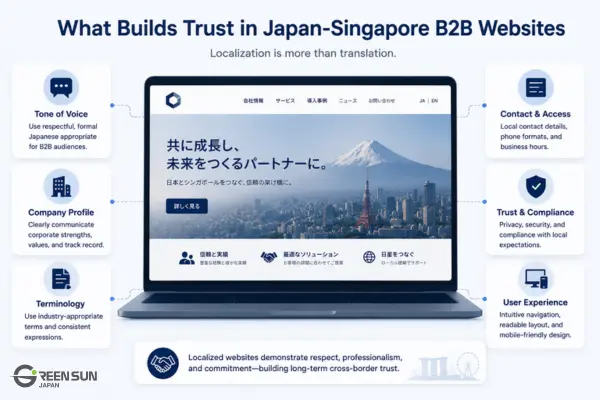
Bilingual service pages should consistently communicate the service name, service provider, scope, conditions, and limitations. The introduction and calls to action can be adapted so that Singapore-based partners can quickly understand the key information. This is a central part of B2B Japanese web translation.
Examples:
・The Japanese version may begin with technical details, while the English version starts with the customer’s business needs.
・The contact form may ask users to select a project type and indicate which documents they already have.
Forms also need to be localized. PDPC Singapore requires organizations to notify individuals of the purposes for collecting, using, or disclosing personal data. Website content should accurately reflect the company’s actual data-handling processes.
4. Maintain Quality From Translation Through the Live Website
Even an accurate translation can undermine trust if buttons overflow, links lead to the wrong pages, or forms are sent to the wrong department. A Japanese website translation service should therefore include QA testing on the actual website before publication.
Pre-publication checklist:
・Finalize terminology for legal entities, services, and job titles.
・Cross-check website content against proposals and brochures.
・Review menus, forms, metadata, and confirmation emails.
・Test contact flows on both desktop and mobile devices.
・Confirm that each language version links to the correct corresponding page.
Google Search Central provides guidance on using hreflang to identify localized page versions and recommends that corresponding pages reference each other.
5. Conclusion
A Japan-Singapore website builds trust when visitors can clearly understand the legal entity, service scope, responsible organization, and contact process. Companies should align key information across their Japanese and English websites while adapting how that information is presented for Singapore-based partners. Keeping website content consistent with proposals and brochures also helps prevent conflicting messages.
6. FAQ
1. Do we need to translate the entire website from the beginning?
Not necessarily. It is generally better to prioritize the homepage, About page, service pages, Contact page, case studies, and data policies because these are key touchpoints customers use to evaluate and verify a company. Other pages can be translated later.
2. Do the Japanese and English versions need to be exactly the same?
No. Both versions should be consistent in terms of legal entity names, service scope, limitations, and contact points. The order and presentation of information can be adapted to the target audience as long as the approved facts remain unchanged.
3. What should be checked on bilingual service pages?
Companies should review the service name, target audience, scope, required inputs, limitations, and responsible entity. They should also check buttons, forms, confirmation emails, downloadable files, and links between the two language versions.
4. Can machine translation be used for a corporate website?
Machine translation can be used to create an initial draft. However, corporate pages, service pages, case studies, forms, and compliance messaging should be manually reviewed for meaning, terminology, and the level of commitment communicated to customers.
5. Who should approve a Japan-Singapore website?
Approval should involve the person responsible for content at the Japanese headquarters, a representative in Singapore, the person responsible for compliance, and the website administrator. Clearly defined responsibilities help prevent situations where the language is correct but the content does not reflect actual business operations.

Green Sun Japan helps businesses create content that fits the target language, market, and intended use.
・Multi-format translation and localization – covering corporate pages, service pages, case studies, and forms.
・Three-step quality assurance process – reviewing content, terminology, formatting, and consistency.
・Email response within 30 minutes – to discuss requirements and define the project scope.
Send your documents or website link to Green Sun Japan for review and a recommended approach.