

Bahasa Melayu vs. Bahasa Indonesia: Why One Machine Translation Model Won’t Work for Both
When expanding content into Southeast Asian markets, many businesses use malaysian machine translation services as a fast way to localize content into Bahasa Melayu and Bahasa Indonesia. With high processing speed, automation capabilities, and lower costs, machine translation has become an almost default tool for e-commerce, digital advertising, and multilingual SEO content.
However, one common mistake is assuming that Bahasa Melayu and Bahasa Indonesia can use the same machine translation model. This assumption exists because the two languages share many similarities in structure and vocabulary. Yet this similarity is exactly what hides deeper differences in meaning, culture, and language use in commercial contexts.
Without clearly separating the two markets, businesses may end up with content that is “grammatically correct but wrong for the market,” leading to weaker SEO performance, lower conversion rates, and a direct impact on user experience.
📌 Key Takeaways / Direct Answer:
While Bahasa Melayu and Bahasa Indonesia share grammatical roots, using a single Machine Translation (MT) model for both markets causes “semantic dilution,” resulting in content that is grammatically correct but culturally and commercially wrong. Differences in localized vocabulary (e.g., universiti vs. universitas), spelling rules, search behavior, and commercial tone (formal in Malaysia vs. direct in Indonesia) directly impact local SEO rankings and conversion rates. To ensure market relevance and avoid brand risk, businesses expanding into Southeast Asia should adopt a hybrid workflow combining domain-specific MT with Malay MTPE (Machine Translation Post-Editing) and native human review.
Contents
- 1. Overview of Bahasa Melayu and Bahasa Indonesia in Machine Translation
- 2. Core Differences Between Bahasa Melayu and Bahasa Indonesia in Machine Translation
- 3. Why a Single Machine Translation Model Cannot Be Used for Both Languages
- 4. MTPE for Malay and Its Role in Localization
- 5. Machine Translation vs. Human Translation: Which Solution Should You Choose?
- 6. Conclusion
- 7. FAQ
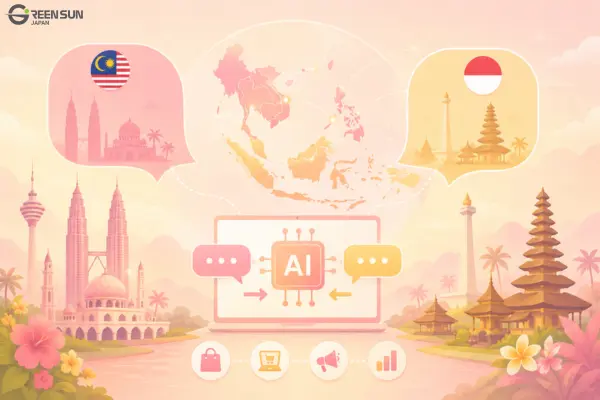
1. Overview of Bahasa Melayu and Bahasa Indonesia in Machine Translation
Bahasa Melayu and Bahasa Indonesia both belong to the Malayic language family and share a common historical foundation. At the grammatical level, the two languages have very similar sentence structures, which makes it easy for early machine translation systems to group them under the same processing model.
In many AI-powered translation systems, these languages are often treated as different variants of the same language. As a result, training data is not always clearly separated by market and may instead be combined into a single dataset. This is one of the key limitations of many malaysian ai translation systems when they are not optimized for market-specific localization.
In practice, however, the two languages have evolved independently due to differences in national development and cultural environments. Malaysia has been heavily influenced by English, particularly in business and administrative communication. Meanwhile, Indonesia has developed a more localized language system, especially in media, communications, and marketing.
These differences mean that the same machine-translated sentence may be grammatically correct but still sound unnatural or inappropriate in the real-world context of each country.
· Professional Translation Services: How to Select the Best Partner for Your Business
· 7 Essential Standards for Evaluating Translation Quality
· Understanding the Professional Translation Process from Start to Finish
· A Complete Guide to Translating Malaysian Business Contracts
2. Core Differences Between Bahasa Melayu and Bahasa Indonesia in Machine Translation
2.1. Differences in Vocabulary and Spelling
One of the most noticeable differences lies in vocabulary and spelling. This is also where malay machine translation systems are most likely to make mistakes when they are not adapted to the target market.
For example, people in Malaysia use “teksi,” “universiti,” and “pejabat,” while in Indonesia, the corresponding terms are “taksi,” “universitas,” and “kantor.” These are not merely spelling variations; they reflect each country’s standardized language conventions.
For local SEO, these differences are highly significant. Using the wrong language variant can reduce the likelihood of content being prioritized by Google in the target country. This is particularly important for businesses that rely on bahasa melayu machine translation to scale multilingual content quickly.
In addition, some words appear identical but carry different meanings depending on the national context. As a result, machine translation systems can produce inaccurate content that is difficult to detect without human review.
2.2. Differences in Cultural and Commercial Context
Language is more than a system of vocabulary; it also reflects cultural behavior, an area where many machine translation systems still struggle. Bahasa Melayu is generally more formal, particularly in corporate communications, government documents, and official correspondence. In contrast, Bahasa Indonesia is more flexible and is commonly used in digital marketing, social media, and direct advertising.
For example, the same advertising message should be expressed politely with a more informative and suggestive tone in Malaysia, while in Indonesia, a more direct style is often preferred to encourage immediate action. This illustrates an important distinction in bahasa indonesia vs bahasa melayu translation. When the same machine translation model is applied to both markets, content intended for Malaysia often becomes too casual and less credible, while content for Indonesia may sound overly formal, reducing the effectiveness of marketing campaigns.
2.3. Limitations of Machine Translation Models and Natural Language Processing
Modern machine translation systems rely on deep learning and natural language processing to generate translations. However, the main challenge lies in the quality and organization of the training data.
When Malay and Indonesian data are combined into the same dataset, the model tends to learn an averaged representation of the two languages. This leads to a phenomenon known as “semantic dilution,” where linguistic nuances are weakened in favor of producing more neutral output.
As a result, the translated content loses its country-specific characteristics. Vocabulary is selected based on statistical probability rather than contextual appropriateness, producing sentences that are grammatically correct but lack natural fluency. This is a common limitation of malay machine translation and many general-purpose malaysian ai translation systems that are not trained separately for each market.
For commercial content, this can be particularly problematic. Native users can often recognize that the content does not truly reflect their language, reducing trust and ultimately affecting business performance.
3. Why a Single Machine Translation Model Cannot Be Used for Both Languages
The core issue is not that the two languages are similar, but how machine translation models learn from and process training data.
First, training data is often not clearly labeled by country. As a result, the model cannot reliably distinguish between Bahasa Melayu and Bahasa Indonesia within the same linguistic space.
Second, multilingual models are generally optimized for overall translation accuracy rather than accuracy for a specific market. This produces translations that are “safe” and broadly understandable but not fully optimized for either Malaysia or Indonesia. This is one of the key limitations of general-purpose malaysian machine translation services.
Third, because the two languages are highly similar, the model can easily confuse semantic nuances, selecting words that are grammatically correct but inappropriate for the intended context.
As a result, businesses may experience:
· Content that lacks proper localization
· An inappropriate commercial tone of voice
· Reduced SEO performance in the target country
Common Errors When Using the Same Machine Translation Model for Malaysia
| Error Category | Typical Issue | Real-World Impact |
|---|---|---|
| Incorrect local vocabulary | Uses words that belong to the wrong country | Content sounds less natural and reduces user trust |
| SEO spelling errors | Uses the wrong keyword variant | Lower Google rankings in the target market |
| Inappropriate tone | Too formal or too casual | Lower CTR and conversion rates |
| Incorrect commercial context | CTAs do not match local market expectations | Reduced advertising effectiveness |
| Mixed-language content | Blends Malay and Indonesian | Loss of user confidence and credibility |
The greatest risk is not obvious translation mistakes, but content that appears correct while being inappropriate for the target market. Without review by a native speaker, these market-specific errors can be difficult for businesses to identify.
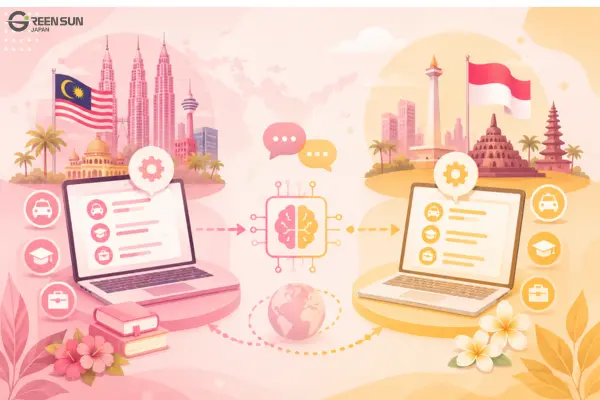
4. MTPE for Malay and Its Role in Localization
MTPE for Malay, or Machine Translation Post-Editing, combines machine translation with human review to improve the overall quality of translated content.
Within malaysian machine translation services, MTPE for Malay plays an important role by balancing speed and quality. Machine translation generates the initial draft, while native linguists refine the text to ensure it is culturally appropriate and aligned with the expectations of the target market.
MTPE is particularly suitable for:
· Large-scale marketing content
· E-commerce websites
· Multinational SEO content
· Customer support content
However, for legal documents or premium brand content, MTPE alone may not be sufficient, as these materials require a higher level of accuracy, consistency, and linguistic nuance.
5. Machine Translation vs. Human Translation: Which Solution Should You Choose?
Choosing between machine translation, MTPE for Malay, and human translation should not be based solely on cost or speed. Instead, the decision should reflect the importance of the content to your brand and business objectives. For both Bahasa Melayu and Bahasa Indonesia, differences in cultural context and commercial language mean that selecting the wrong translation approach can result in content that feels unnatural or fails to communicate the intended message.
Rather than treating machine translation as a one-size-fits-all solution, businesses should view malaysian machine translation services as part of a broader translation workflow with multiple levels of quality control, selecting the most appropriate approach based on content type and target market.
Recommended Translation Method by Content Type
| Content Type | Recommended Solution |
|---|---|
| Internal documents | Pure machine translation |
| Informational SEO blogs | Machine translation + light MTPE |
| E-commerce websites | MTPE required |
| Advertising content (Ads) | MTPE + native review |
| Customer support content | MTPE or semi-human translation |
| Legal documents | Human translation required |
| Premium branding content | Human translation + professional review |
In practice, many businesses using malaysian machine translation services apply machine translation directly to marketing content without MTPE for Malay. This often results in issues with tone, local vocabulary, and overall language naturalness. The risk becomes even greater when publishing content for both Malaysia and Indonesia at the same time, as even subtle differences in tone can negatively affect conversion rates.
The most important principle is simple: the closer the content is to revenue generation or brand reputation, the greater the level of human review and quality control it requires.
6. Conclusion
The similarities between Bahasa Melayu and Bahasa Indonesia lead many businesses to assume that a single machine translation model can effectively serve both languages. However, in practice, they differ significantly in vocabulary, spelling, usage context, and commercial tone.
Using the same translation model for both markets can result not only in linguistic inaccuracies but also in weaker SEO performance, a poorer user experience, and reduced business effectiveness.
The right strategy is therefore not simply to maximize translation speed, but to optimize market relevance. By combining malaysian machine translation services with MTPE for Malay and human editing at the appropriate level for each content type, businesses can achieve both efficiency and high-quality localization.
7. FAQ
1. Can Bahasa Melayu and Bahasa Indonesia share the same machine translation model?
Although the two languages have many similarities, they differ in vocabulary, spelling, and usage context. Using the same model often produces translations that are grammatically correct but inappropriate for the target market.
2. Why do machine translation systems often confuse Bahasa Melayu and Bahasa Indonesia?
Many machine translation systems do not separate their training data by country. Instead, the model learns an averaged representation of both languages, resulting in translations that sound grammatically correct but fail to reflect local linguistic and cultural nuances.
3. Are malaysian machine translation services suitable for marketing content?
Yes, but only when combined with MTPE for Malay. Relying solely on machine translation can lead to an inappropriate tone, incorrect local vocabulary, and lower conversion performance.
4. What is MTPE for Malay?
MTPE for Malay is the process of using machine translation to generate an initial draft, followed by post-editing by native linguists to ensure the content is accurate, natural, and appropriate for the Malaysian or Indonesian market.
5. When should businesses use machine translation instead of human translation?
Machine translation is suitable for internal documents or content that needs to be processed quickly and does not have strict branding requirements. For marketing, SEO, legal, or other high-impact content, MTPE or professional human translation is the recommended approach.

· Malaysian Translation Service · Indonesian Translation Service
If your business is expanding into the Malaysian or Indonesian market, using machine translation incorrectly can result in content that is grammatically correct but inappropriate for the target audience, reducing SEO performance and costing you valuable conversions without you even realizing it.
Green Sun Japanprovides malaysian machine translation services combined with MTPE for Malay and professional localization, ensuring your content is not only translated quickly but also matched to the language, culture, and search behavior of each target market.
What you can expect:
· Translation optimized for each target country
· Post-editing by native linguists to ensure natural, market-appropriate language
· Marketing intent preserved while improving local SEO performance
· Minimized contextual errors in commercial content
👉If your translation does not meet the required localization standard for your target market, we will revise it free of charge until it is ready for real-world use.
Contact us today for a free evaluation of your existing translations and personalized recommendations for the most effective localization strategy for your target market.