

English to Nepali Translation: Preserving Meaning, Respect, and Readability
A translation may be accurate in meaning, but it can still make readers feel distant, unnatural, or not properly respected. This is especially common when handling documents from English to Nepali, where nuances of respect, communication relationships, and levels of politeness directly affect how readers receive the information.
For business emails, contracts, official notices, internal documents, or public-facing content, the goal is not only to convert one language into another. Translators need to preserve the intended meaning, choose an appropriate writing style, maintain consistent terminology, and ensure the text is easy to read. Therefore, English to Nepali translation requires a combination of language ability, cultural understanding, and skill in handling formal documents.
📌 Key Takeaways / Direct Answer:
- Beyond Word-for-Word Conversion: High-quality English to Nepali translation (translate English to Nepali) requires adapting direct English phrasing into polite, socially appropriate Nepali honorific structures based on the reader’s relationship to the organization.
- Devanagari Font & DTP Integrity: Nepali uses the Devanagari script. A professional workflow must include post-typesetting QA to prevent broken ligatures, irregular line breaks, and rendering errors on mobile devices and PDFs.
- Terminology Consistency: Technical manuals, legal contracts, and corporate policies must use centralized glossaries and Translation Memory (TM) to avoid translating identical terms (e.g., “Service Agreement”) into conflicting Nepali words.
- 4-Stage Risk-Reduction Workflow: Effective Nepali document translation (Nepali document translation) follows Document Analysis ➔ Glossary Setup ➔ Specialist Translation & Bilingual Review ➔ Devanagari Layout QA. Green Sun Japan delivers certified English-Nepali localization tailored to corporate and official communications.
Contents
- 1. Why Translating English to Nepali Is Not Just About Converting Words
- 2. Key Factors That Determine the Quality of a Nepali Translation
- 3. Common Mistakes When Translating Formal Documents into Nepali
- 4. A Translation Process That Helps Businesses Reduce Risks
- 5. Checklist Before Publishing a Nepali Translation
- 6. Conclusion
- 7. Frequently Asked Questions (FAQ)
1. Why Translating English to Nepali Is Not Just About Converting Words
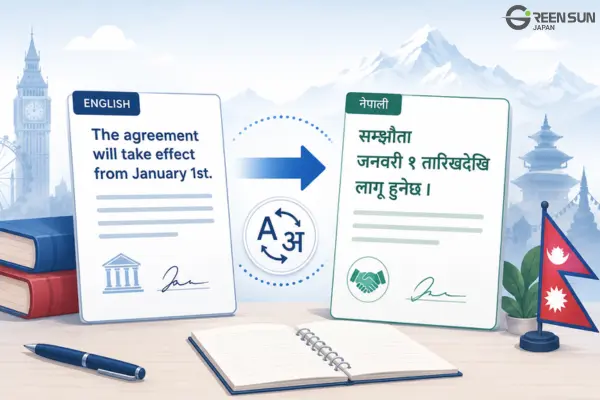
When looking at an English sentence, many assume that finding equivalent words in Nepali is sufficient. However, this approach frequently produces stiff, unnatural translations, especially in business communications and official documents. English can be direct, while Nepali communication culture relies on softer, hierarchical, and more respectful phrasing.
For example, translating the sentence “Please submit the signed agreement by Friday” too literally produces a grammatically correct sentence that sounds overly abrupt to a Nepali business partner or government official. Translators must adjust the sentence structure to maintain clarity while embedding appropriate social respect.
Source: “Please submit the signed agreement by Friday.”
❌ Literal Translation: Abrupt, command-like phrasing lacking corporate courtesy.
✅ Culturally Localized: Polite request incorporating standard business honorifics.
Furthermore, Nepali is written in the Devanagari script. Translators and typesetters must verify font rendering, character ligatures, line breaks, and date formats across PDFs, mobile screens, and web interfaces. An accurate translation still fails if complex Devanagari script elements break during layout rendering.
2. Key Factors That Determine the Quality of a Nepali Translation
A successful translation ensures readers grasp the core message accurately, perceive institutional respect, and take intended actions without hesitation.
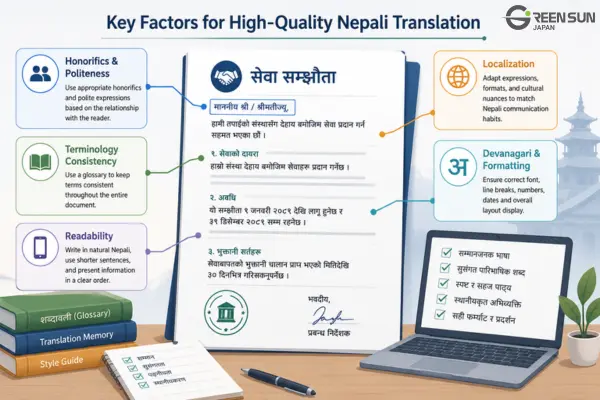
| Factor | Common Translation Mistake | Recommended Professional Approach |
|---|---|---|
| Honorifics (आदरार्थी) | Translating too directly; using overly casual or cold phrasing. | Select the appropriate level of formality based on whether the reader is a client, executive, or public citizen. |
| Terminology | Inconsistent phrasing (e.g., translating “Service Agreement” under multiple terms). | Build an approved bilingual Glossary and enforce Translation Memory across all files. |
| Readability | Retaining lengthy, multi-clause English sentence structures. | Break complex English sentences into concise, logical Nepali clauses prioritizing key information first. |
| Devanagari & Localization | Preserving English idioms; ignoring Devanagari font rendering. | Adapt phrasing to Nepali conversational customs and verify script rendering on digital displays. |
3. Common Mistakes When Translating Formal Documents into Nepali
| Document Context | Typical Literal Error | Risk & Operational Impact | Correct Localization Strategy |
|---|---|---|---|
| Direct Instructions | Literal translation of “Please submit the signed agreement by Friday.” | Sounds blunt and command-like; damages business rapport with partners. | Recast into a respectful, polite business request. |
| Complex Legal Clauses | Keeping long English sentence structures unchanged. | Obscures key obligations; creates reader fatigue and confusion. | Divide into shorter, coherent clauses placing critical stipulations first. |
| Corporate Terminology | Translating identical terms differently across sections. | Causes contractual ambiguity and weakens brand authority. | Enforce a unified client Glossary and Translation Memory system. |
| DTP & Graphic Formatting | Neglecting post-typesetting Devanagari font verification. | Causes broken character ligatures and unreadable text on PDFs/web. | Conduct multilingual desktop publishing (DTP) QA before delivery. |
4. A Translation Process That Helps Businesses Reduce Risks
To ensure consistent output across business, technical, and legal documents, professional English-Nepali localization follows a structured 4-step workflow:
| Process Stage | Key Operational Activities | Risk-Reduction Benefit |
|---|---|---|
| 1. Document & Audience Analysis | Identify document purpose, target reader hierarchy, formality level, and technical domains. | Establishes the correct linguistic tone and selects the right subject-matter linguist. |
| 2. Terminology Standardization | Create client-specific Glossaries for job titles, product names, legal clauses, and acronyms. | Guarantees consistent terminology across long-term corporate projects. |
| 3. Translation & Bilingual Proofreading | Translate content and conduct an independent sentence-by-sentence bilingual comparison. | Eliminates omissions, mistranslations, and quantitative discrepancies. |
| 4. Devanagari Layout & Formatting QA | Verify Devanagari typography, line wrapping, PDF formatting, and mobile responsiveness. | Ensures clean visual presentation and error-free script rendering. |
5. Checklist Before Publishing a Nepali Translation
Before deploying a Nepali translation across print or digital channels, verify each item against this quality checklist:
| Verification Item | Quality Check Criteria | Status |
|---|---|---|
| Core Meaning & Intent | The translation fully preserves source meaning, obligations, and conditions without omissions. | [ ] Passed |
| Honorific Appropriateness | Formality levels and honorific pronouns align precisely with the target audience and business context. | [ ] Passed |
| Glossary Compliance | Specialized terms, job titles, and product names match the approved glossary 100%. | [ ] Passed |
| Sentence Naturalness | Sentence structure flows naturally according to standard Nepali syntax (SOV order). | [ ] Passed |
| Devanagari Typography | All Devanagari ligatures, vowel signs (matras), and conjunct characters render properly. | [ ] Passed |
| Data & Units Verification | Numbers, currency values, dates (Bikram Sambat vs. Gregorian), and units of measurement are exact. | [ ] Passed |
| Layout & DTP Quality | Text boxes, table cells, and bullet lists display without clipped lines or awkward text wrapping. | [ ] Passed |
6. Conclusion
Effective translation goes beyond transferring dictionary definitions. It preserves core intent, conveys institutional respect, standardizes specialized terminology, and delivers effortless readability across real-world operational contexts.
Executing English to Nepali translation through a professional workflow—incorporating audience analysis, glossary governance, independent proofreading, and Devanagari layout verification—ensures your organization communicates with precision, authority, and cultural authenticity.
🚀 Professional English to Nepali Translation with Green Sun Japan
Need accurate, culturally respectful Nepali business translation for your corporate policies, legal agreements, technical manuals, or digital platforms?
Green Sun Japan provides certified English to Nepali translation services backed by experienced native linguists and strict multi-tier quality assurance workflows.
Why Global Enterprises Choose Green Sun Japan:
- 🇳🇵 Native Linguistic & Cultural Mastery: Subject-matter linguists who ensure natural phrasing, correct honorific levels, and authentic tone.
- 🛠️ Devanagari DTP & Layout Control: Complete formatting and typesetting checks ensuring error-free script rendering on PDFs, web, and mobile.
- 🛡️ Centralized Asset Management: Comprehensive Glossary and Translation Memory administration to maintain consistency and lower costs over time.
7. Frequently Asked Questions (FAQ)
Q1. When should businesses hire a professional English to Nepali translation provider?
Professional services are essential whenever documents carry legal weight, operational risks, or public visibility—such as commercial contracts, employee handbooks, technical SOPs, medical documentation, corporate websites, and official correspondence with partners or regulatory bodies.
Q2. Can Google Translate be used for formal Nepali business documents?
Machine translation tools may provide a basic gist for informal internal reading, but they frequently fail to select appropriate honorific levels, misinterpret specialized terminology, and produce broken Devanagari script formatting. Formal business and legal documents require human translation and QA.
Q3. Why is a bilingual glossary critical for Nepali translation projects?
A glossary establishes fixed, approved translations for corporate terms, product names, and legal expressions, preventing different translators from using conflicting Nepali equivalents across interrelated files.
Q4. What is the difference between translating and localizing content for Nepal?
Translation focuses on accurately converting text from English into Nepali, while localization adapts cultural nuances, honorific registers, date conventions, numerical formatting, and Devanagari typesetting to align with local reading habits and digital platforms.