

Nepali Machine Translation Services: When Is MTPE Enough for Support Content?
FAQs, emails, support response templates, and knowledge bases often involve large volumes of repetitive content that needs frequent updates. These types of content can benefit from machine translation, but publishing unchecked translations can still lead to incorrect instructions, inconsistent terminology, or user errors. That is why Nepali machine translation services should not be applied across the board.
Businesses need to choose between raw machine translation, MTPE, and human translation based on how the content will be used, how easily an error can be corrected, and what could happen if users misunderstand the information. This article provides a practical use-case table, a decision flow, and an implementation checklist.
Quick Answer: Nepali machine translation services are a good fit for FAQs, emails, support response templates, and knowledge bases when the source content is clear, repetitive, and low to moderate risk. Public-facing content should go through MTPE. Legal, financial, medical, safety, security, or user-rights content should be translated and reviewed by humans.
Key Takeaways
・Classify content based on the consequences of a translation error.
・Use raw machine translation for internal drafts.
・Use MTPE for public-facing support content.
・Use human translation for high-risk content.
1. When Is MTPE Enough for FAQs, Emails, and Support Content?
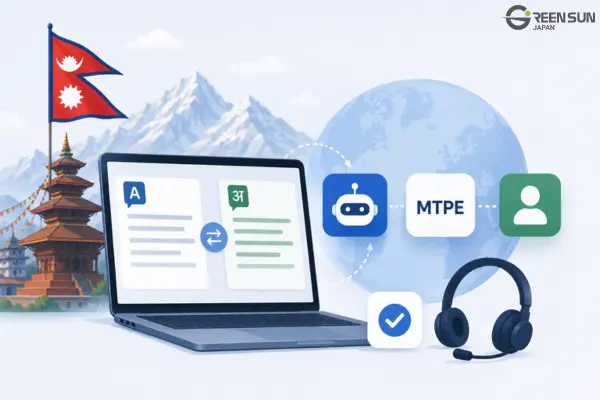
MTPE is generally sufficient when the source content is clear, terminology is consistent, and minor errors would not lead to consequences that are difficult to reverse. According to the European Commission, light post-editing focuses on basic comprehensibility, while full post-editing produces clearer and more polished output.
For public-facing content, Nepali MTPE should typically involve full post-editing. Light post-editing is better suited to internal drafts or materials used only to understand the general meaning.
MTPE may be appropriate when the editor has enough context, terminology has already been standardized, and users can easily correct or repeat an action if something is misunderstood.
Suitable examples include:
・FAQs explaining how to change a password.
・Emails confirming that a request has been received.
・Support response templates providing status updates.
MTPE is not sufficient when the content establishes rights, obligations, or decisions that are difficult to reverse.
For example, refund terms, legal commitments, compensation notices, or complaint-handling instructions that directly affect customer rights should be fully translated and reviewed by humans.
2. Choose the Right Approach by Use Case and Risk Level
The translation approach should be selected based on the use case and the consequences of a misunderstanding. The table below provides a quick way to assess the appropriate level of translation and review.
| Use case | Risk level | Recommended approach |
|---|---|---|
| Routine FAQ instructions | Low to moderate | Full MTPE |
| Confirmation or status update emails | Low | Light or full MTPE |
| Support response templates | Moderate | Full MTPE |
| Feature-related knowledge base content | Moderate | Full MTPE |
| Refunds, payments, security, or legal content | High | Human translation |
This table should be used as an initial screening tool rather than a fixed rule.
For example, a basic confirmation email may be suitable for MTPE, while an email rejecting a refund request should be handled through human translation. If a document contains content with different risk levels, assess each section separately instead of applying a single translation approach to the entire file.
3. Decision Flow: Raw Machine Translation, MTPE, or Human Translation
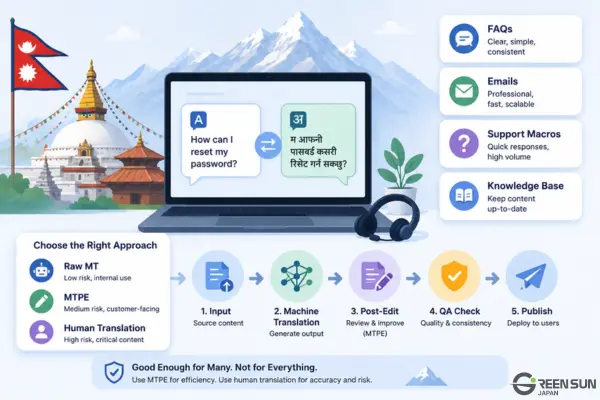
For Nepali machine translation services, the decision process should start with three questions: Who will read the content? What action are they expected to take? And how easily can an error be corrected?
Nepali machine translation can produce drafts quickly, but the final level of review should always match the purpose and risk of the content.
| Decision question | Recommended approach |
|---|---|
| Is the content only for internal use to understand the general meaning? | Raw machine translation |
| Will the content be sent to or displayed for customers? | Full MTPE |
| Can the user repeat or correct the action if necessary? | MTPE and testing |
| Does the content affect money, rights, safety, or compliance? | Human translation and independent review |
Examples:
・Status confirmation email – MTPE.
・Password reset article – MTPE and testing.
・Notice of changes to terms and conditions – human translation.
This decision flow helps businesses avoid publishing unchecked machine translation while also preventing unnecessary use of human translation for every type of content.
4. Build a Nepali Localization Workflow
A Nepali localization workflow should begin with an assessment of the content, its intended use, and its risk level. This allows the business to determine the most appropriate translation method.
Not every type of content should go through machine translation. MTPE may be a practical option for FAQs, internal emails, or repetitive support content. In contrast, legal and financial content, as well as information that directly affects user rights, should generally be handled by professional human translators.
A basic workflow may include:
・Analyze the content and determine its risk level.
・Choose the appropriate translation method: machine translation, MTPE, or fully human translation.
・Standardize source sentences, terminology, and forms of address before translation.
・Translate the content using the selected approach.
・Check negation, conditions, numbers, proper names, variables, error codes, and links.
・Test the translated content in the actual interface to identify display issues or text overflow.
・Track recurring errors and update the glossary, translation memory, or post-editing rules.
When machine translation is used, ISO 18587 defines requirements for the full post-editing of machine translation output.
Google Cloud Translation and Microsoft Azure Translator both support Nepali. However, the fact that a platform supports the language does not mean its output is automatically suitable for publication without human review.
When working with Devanagari script, W3C Devanagari Layout Requirements can be used as a reference for text display and layout requirements. Unicode CLDR for Nepali can also be referenced for Nepali locale data.
5. Conclusion
MTPE works well for FAQs, emails, support response templates, and knowledge bases when the source content is clear, terminology is consistent, and the risk is manageable.
Raw machine translation should generally be limited to internal-use content. Content involving payments, user rights, safety, security, or regulatory compliance should be handled through human translation and appropriate review.
Green Sun Japan can help businesses determine the right approach for each type of content while supporting the localization of documents, websites, software, and applications through a three-step quality assurance process.
6. FAQ
1. Can Nepali FAQs rely entirely on machine translation?
Raw machine translation can be used to create a draft or provide an internal reference. Public-facing FAQs should go through MTPE to verify meaning, terminology, and user instructions.
Content involving payments, security, or safety should be manually reviewed by a professional translator or qualified reviewer before publication.
2. When Is Nepali MTPE Sufficient?
Nepali MTPE is generally sufficient when the source content is clear, terminology is consistent, the editor has enough context, and minor errors would not cause consequences that are difficult to reverse.
The final content should still be reviewed for meaning, tone, variables, and consistency.
3. Which Support Emails Should Not Use Raw Machine Translation?
Raw machine translation should not be used for refund denials, requests involving personal data, contractual obligations, or serious complaints.
Because these types of messages can directly affect the recipient’s rights or obligations, they should be handled through human translation.
4. What Should Be Checked in Support Templates and Knowledge Bases?
Review terminology, user instructions, variables, error codes, links, images, and tone.
For knowledge base content, the translated workflow should also be tested in the actual interface to make sure the instructions match the product and display correctly.
5. Can One Translation Approach Be Used for an Entire Document?
Not necessarily.
If a document contains content with different risk levels, each section should be assessed separately. Routine instructions may be suitable for MTPE, while warnings, terms and conditions, payment-related content, or security information should be separated for human translation and independent review.

Green Sun Japan helps businesses deliver content that fits the target language, market, and intended use.
・Multi-format translation and localization – support for FAQs, emails, support response templates, knowledge bases, documents, websites, software, and applications.
・Three-step quality assurance process – review of content, terminology, context, formatting, and consistency.
・Email responses within 30 minutes – fast support for discussing requirements and defining project scope.
Send Green Sun Japan your documents, files, links, or project requirements, and we will review the scope and recommend the most appropriate approach.