

Vietnamese Medical Translation Services: Clinical Trial, IFU, and Patient Content That Demands Zero Ambiguity
In the medical field, an inaccurate translation can affect far more than content quality. Errors in warnings, contraindications, operating instructions, or information provided to clinical trial participants may cause readers to misunderstand critical information and take incorrect actions.
For this reason, selecting Vietnamese medical translation services should not be based solely on price, turnaround time, or translation capabilities. Companies also need to assess whether the provider has an appropriate quality control process tailored to each document type, target audience, and intended use.
📌 Key Takeaways / Direct Answer
- Medical translation requires specialized QA: Vietnamese medical translation services require a multi-layered quality assurance (QA) process because clinical trial documents, Instructions for Use (IFUs), medical device documentation, and patient-facing content serve different legal and safety purposes.
- Requirements vary by audience: Documents intended for physicians and researchers, such as clinical trial protocols and IFUs, require precise medical terminology. In contrast, patient-facing materials, including Informed Consent Forms (ICFs) and leaflets, must use clear, accessible language without weakening or omitting critical risk warnings.
- AI and machine translation have limitations: Raw machine translation (MT) should never be used directly for official medical documentation. Every translation must undergo professional human review by a qualified medical expert before it is finalized.
- Current regulations must be considered: Medical device translation in Vietnam must comply with the applicable regulatory framework, including Decree No. 98/2021/ND-CP, Decree No. 07/2023/ND-CP, and Decree No. 04/2025/ND-CP, together with international guidance such as ICH E6(R3) and FDA requirements.
Contents
- 1. What Are Vietnamese Medical Translation Services?
- 2. What Types of Medical Documents Commonly Need to Be Translated Into Vietnamese?
- 3. Why Can Medical Translation Errors Affect Reader Safety?
- 4. What Does a Multi-Layered QA Process in Medical Translation Include?
- 5. Can AI or Machine Translation Be Used for Medical Documents?
- 6. Checklist for Choosing Vietnamese Medical Translation Services
- Conclusion
- Frequently Asked Questions (FAQ)
1. What Are Vietnamese Medical Translation Services?
Vietnamese medical translation services involve translating content related to medicine, pharmaceuticals, clinical trials, medical devices, and healthcare into or from Vietnamese.
Medical translation differs from general translation in three key ways:
- The content contains a high volume of specialized terminology.
- The target audience may include physicians, nurses, research staff, patients, or caregivers.
- The consequences of misunderstanding the content can be far more serious than a wording error in a general document.
For clinical trial documentation, ICH E6(R3) emphasizes protecting participants’ rights, safety, and well-being while also ensuring the reliability of study results. Information provided during the informed consent process must be presented clearly and in a way participants can understand.
This means Vietnamese clinical translation requires more than accurate terminology. It must also preserve the reader’s ability to understand the information and make informed decisions.
2. What Types of Medical Documents Commonly Need to Be Translated Into Vietnamese?
Medical translation projects cover a wide range of document types. Each category has its own target audience and specific risks to control:
| Document Type | Primary Audience | Content & Risks to Control |
|---|---|---|
| Protocols & Clinical Trial Documents | Research teams, physicians, clinical trial sites | Specialized terminology, patient eligibility criteria, study schedules, and research logic |
| Patient Information Sheets & Informed Consent Forms (ICFs) | Study participants, patients | Participant rights, risks, trial procedures, and readability in plain language |
| IFUs & Medical Device Instructions | Physicians, medical technicians, users | Warnings, contraindications, operating sequences, maintenance procedures, and emergency troubleshooting |
| Leaflets & Patient-Facing Materials | Patients, family caregivers | Easy-to-understand language, medication instructions, and steps for monitoring health at home |
| Hospital Operational Information | Patients, healthcare staff | Appointment schedules, admission procedures, preoperative preparation, and contact information |
| Medical Device Registration Documents | Regulatory authorities, including the Ministry of Health, and specialists | Intended use, risks, warnings, technical standards, and conditions for market authorization |
According to the FDA, patient labeling should help patients or nonprofessional caregivers clearly understand the medical device, how to operate it, and how to care for and maintain it. The guidance also addresses contraindications, risks, warnings, troubleshooting, and usability testing.
Therefore, the quality of Vietnamese medical translation should be evaluated based on a document’s real-world function and intended use, not solely on whether the translated sentences are grammatically correct.
3. Why Can Medical Translation Errors Affect Reader Safety?
Medical translation errors can change how readers understand a warning, condition, or required action.
Common risks include:
- Omitting a negative word in a contraindication.
- Confusing numbers, units, or frequency.
- Reversing the sequence of medical device operating steps.
- Using different translations for the same component.
- Translating technical terminology accurately but making it too difficult for patients to understand.
- Omitting warnings, notes, or text embedded in images.
- Failing to update the translation when the source document changes.
For example, a sentence may be linguistically accurate but still fail to meet quality requirements if the patient cannot understand what action to take. Conversely, oversimplifying the content may remove important conditions, limitations, or warnings.
For this reason, healthcare translation in Vietnam must balance three key requirements: technical accuracy, clarity for the intended audience, and completeness compared with the source document.
4. What Does a Multi-Layered QA Process in Medical Translation Include?
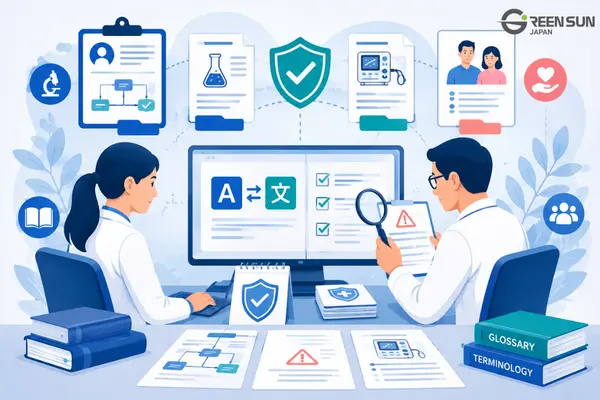
To minimize errors as thoroughly as possible, healthcare translation in Vietnam should follow a closed-loop quality assurance (QA) process consisting of seven steps:
| QA Step | QA Objective | Control Actions |
|---|---|---|
| 1. Define Purpose & Target Audience | Establish the appropriate translation style | Clearly determine whether the document is intended for physicians, healthcare professionals, or patients to select the appropriate tone and level of technical language. |
| 2. Establish a Glossary | Ensure terminology consistency | Create a terminology list covering drug names, medical devices, symptoms, and abbreviations before translation begins. |
| 3. Assign Qualified Specialists | Ensure translator competence | Assign translators with relevant medical qualifications or experience in the required medical specialty. |
| 4. Medical Expert Review | Verify meaning and safety information | Conduct a bilingual review to check accuracy, clinical logic, warnings, and contraindications against the source text. |
| 5. Verify Numbers & Data | Eliminate data-related errors | Independently review all numbers, units of measurement, dosages, version codes, and tables. |
| 6. Formatting & DTP Review | Verify page layout and display | Review the final PDF layout to prevent font corruption, overlapping text, or missing warnings embedded in images. |
| 7. Version Control | Maintain document history and traceability | Accurately track source updates, reviewers, revisions, and the final approved version. |
5. Can AI or Machine Translation Be Used for Medical Documents?
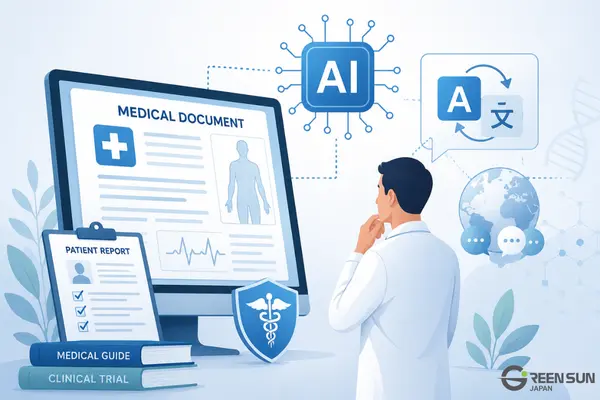
AI and machine translation can support certain stages of the translation process, but raw machine translation should not be used directly as the final version of documents that may affect patients, clinical trial participants, or medical device users.
Common risks associated with raw MT include:
- Omitting negative terms.
- Misinterpreting abbreviations.
- Selecting terminology that is incorrect for the context.
- Producing inconsistent translations across files.
- Failing to recognize regulatory requirements or the document’s intended use.
- Omitting critical warnings or conditions.
- Uploading sensitive data to uncontrolled systems.
The key issue is not simply whether AI should be “prohibited,” but where AI is used in the workflow, how data is handled, and who is responsible for reviewing and validating the output.
For low-risk materials intended for internal reference, AI may be used to support draft creation. However, clinical trial protocols, informed consent forms, IFUs, medical device labeling, and patient-facing content should undergo a full review by appropriately qualified human professionals before use.
6. Checklist for Choosing Vietnamese Medical Translation Services
Companies should evaluate medical translation providers based on practical capabilities and clearly defined quality criteria:
| Evaluation Criteria | What to Check With the Provider | Value Provided |
|---|---|---|
| Medical Specialization Experience | Has the provider previously handled similar projects involving clinical trial protocols, IFUs, and ICFs? | Helps ensure accurate interpretation of context and compliance with industry standards. |
| Independent QA Team | Are the translation and review stages handled by two different professionals? | Reduces individual blind spots and improves overall accuracy. |
| Terminology Standardization | Does the provider develop a glossary and use Translation Memory (TM)? | Ensures consistent terminology across the entire document set. |
| Independent Data Review | Is there a separate review process for numerical data, units of measurement, and text embedded in images? | Minimizes the risk of dosage errors or incorrect medical device specifications. |
| Knowledge of Local Regulations | Does the provider stay up to date with regulations such as Decree No. 98/2021/ND-CP, Decree No. 07/2023/ND-CP, and Decree No. 04/2025/ND-CP? | Helps ensure that documentation supports lawful customs clearance and medical device market authorization. |
| Data Confidentiality (NDA) | Does the provider offer written confidentiality commitments and secure data management systems? | Protects patient information and confidential research data. |
· Follow a practical process for accurate English-to-Vietnamese business translation
· Compare useful Vietnamese translator apps for everyday communication
· See how AI processes Vietnamese tones, diacritics, and regional language
· Learn key practices for adapting subtitles for Vietnamese viewers
· Explore medical transcription requirements for healthcare documentation in Vietnam
Conclusion
Vietnamese medical translation services do more than simply convert content into Vietnamese. For clinical trial documents, IFUs, patient-facing materials, and medical device documentation, translations must also preserve technical meaning, warnings, readability, and consistency throughout the entire project.
Companies should select a translation provider based on relevant document-specific experience, team expertise, and a multi-layered QA process rather than comparing providers solely on price or turnaround time.
Frequently Asked Questions (FAQ)
1. Are medical translation and healthcare translation the same?
The two concepts overlap. “Medical translation” generally focuses more heavily on specialized medical content, while “healthcare translation” may also include healthcare materials, hospital operations, and communication with patients.
2. Do clinical trial documents require specialized translators?
Yes. Translators need to understand both medical terminology and the research context, especially when working with clinical trial protocols, patient information sheets, and informed consent forms.
3. Can an IFU be translated with AI and used immediately?
It is not recommended. AI can support draft creation, but an IFU must be reviewed for warnings, contraindications, operating sequences, terminology, numerical data, and formatting before it is used.
4. How Can Terminology Consistency Be Ensured?
A glossary should be developed, Translation Memory (TM) should be used where appropriate, a dedicated reviewer should be assigned, and terminology should be managed consistently across every document version.
5. Should Patient-Facing Documents Retain All Technical Medical Terminology?
Not necessarily. The technical meaning must be preserved, but the wording should be adapted to match the comprehension level of patients and caregivers.
Accurate Vietnamese Medical Translation Solutions From Green Sun Japan
Do you need to translate clinical trial protocols, Informed Consent Forms (ICFs), medical device IFUs, or patient guidance materials into Vietnamese?
Green Sun Japan supports pharmaceutical companies, Contract Research Organizations (CROs), and medical device manufacturers with:
- 🩺 Medical expertise: Translators and reviewers with practical experience in the medical and pharmaceutical industries.
- 🛡️ A rigorous 7-step QA process: Independent quality checks covering terminology, numerical data, writing style, and DTP formatting.
- 📜 Strong regulatory awareness: In-depth knowledge of ICH E6(R3), FDA guidance, and medical device market authorization requirements in Vietnam.
👉 Contact Green Sun Japan today to submit a sample document and receive expert consultation on a robust medical translation QA process.