

Myanmar Machine Translation Services: Why Burmese Is Difficult for AI Translation
Myanmar Machine Translation Services: Why Is It the Most Difficult Language in ASEAN, and Where Is the Breakthrough?
Some translation errors are difficult to detect because the wording sounds natural, even though the meaning has already shifted.
This often happens when businesses use AI to translate Myanmar content. It is not because AI is completely helpless or because Myanmar is impossible to translate. The issue runs deeper: with Myanmar, machines may struggle from the very first step, which is identifying how the source text is divided into meaningful units.
That is why Myanmar machine translation services should not be judged only by speed or cost. They are about how AI reads, understands, analyzes, and transfers meaning from a language whose structure is very different from Vietnamese, English, and many other widely used ASEAN languages.
This naturally raises a question: if Myanmar is so difficult, why is Burmese translation AI still attracting so much attention from businesses? The answer lies in recent advances in multilingual AI translation. AI cannot completely replace humans in every situation yet, but when placed within the right workflow, Myanmar machine translation can become a powerful support tool for businesses that need to process multilingual documents, website content, technical materials, contracts, product manuals, or marketing content.
This article explains why Burmese language difficulty makes machine translation more error-prone than many people realize, where the real errors usually begin, and how businesses should choose Myanmar machine translation services so they can use AI while still controlling translation quality.
Contents
- 1. The Most Dangerous Error in Myanmar Machine Translation Is the Error That “Looks Correct”
- 2. Why Does Burmese Language Difficulty Make AI More Error-Prone?
- 3. The breakthrough is not perfect AI translation, but broader multilingual learning
- 4. How to Choose Myanmar Machine Translation Services and Avoid Translations That Are “Correct but Unusable”
- 5. Conclusion
1. The Most Dangerous Error in Myanmar Machine Translation Is the Error That “Looks Correct”
Many people only realize a machine translation is wrong when the translated sentence sounds obviously strange. For example, the sentence may have no subject, the verb may be in the wrong position, or the wording may sound completely unnatural. But with Myanmar, the more worrying errors are harder to see: the translation is still readable, but the main meaning has already shifted.
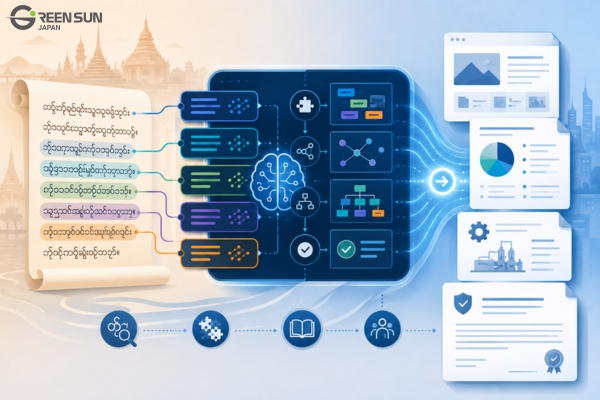
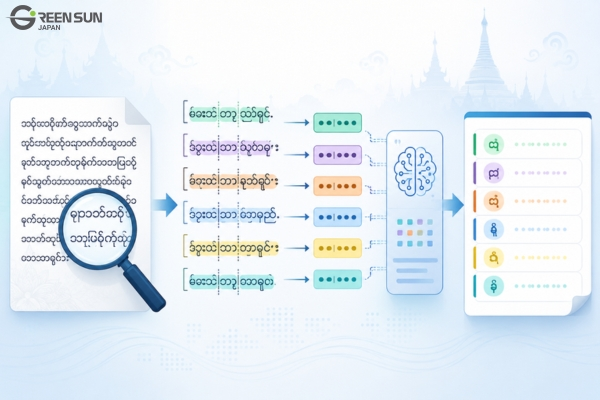
The reason lies in how AI processes text before translation. For languages such as Vietnamese or English, spaces help systems recognize individual words fairly clearly. But in Myanmar, text often does not clearly mark word boundaries with spaces. In natural language processing, word segmentation is an important step for tasks such as text classification, information retrieval, and machine translation, especially for writing systems that do not clearly show word boundaries, such as Burmese, Thai, and Khmer. (MDPI)
This means that before translating, AI has to guess what counts as a word, what forms a meaningful phrase, what modifies a noun, and what relates to a verb. If this step is wrong, the translation that follows may go wrong in a chain reaction. This is one of the core reasons why Myanmar machine translation is difficult to stabilize, especially with long texts or specialized documents.
The important point is this: Myanmar is not only difficult at the stage of “translating into Vietnamese” or another target language. It is difficult from the stage of “reading the source text correctly.” When AI has not properly analyzed the input, the output translation may still be fluent but not necessarily reliable.
This is especially important for businesses. In an ordinary email, a small error may only make the sentence sound slightly unnatural. But in contracts, technical documents, safety instructions, medical materials, or product descriptions, an analytical error can change a condition, subject, responsibility, or required operation.
For example, if a conditional phrase in a technical document is misidentified, the translation may turn “perform only when condition A is met” into “always perform operation A.” If a sentence in a contract mistranslates the cause-and-effect relationship, the reader may misunderstand the obligations of the parties involved. If a marketing sentence is translated too literally, it may lose its persuasive nuance.
That is why Myanmar machine translation services should be viewed as a language-processing workflow, not merely as a tool for converting one language into another. With Myanmar, translation quality depends on text normalization, format handling, word segmentation, sentence recognition, model selection, and post-editing.
2. Why Does Burmese Language Difficulty Make AI More Error-Prone?
Simply saying “Myanmar is difficult” does not help readers understand where that difficulty actually comes from. In reality, Burmese language difficulty comes from multiple layers of overlapping challenges. Each layer alone is enough to make AI struggle. When they combine, Burmese translation AI becomes even more likely to produce unstable results.
The first layer is the writing system. Myanmar uses its own script, with many marks and combined characters. If the source file has font errors, encoding issues, formatting problems, or text extracted from a low-quality scanned image, the system may misrecognize the text from the beginning. With languages that use many combined characters, even a small input error can lead to a much larger translation error.
The second layer is sentence structure. Burmese is often described as a subject-object-verb language. It is head-final and uses many particles to express grammatical functions. There are also significant differences between written and spoken forms. (Wikipedia) This is very different from Vietnamese, where the common sentence order is usually subject-verb-object.
Therefore, when translating into Vietnamese, English, or another target language, AI cannot simply replace words one by one. It has to restructure the sentence. If it fails to identify the relationship between sentence components correctly, the translation may shift the focus, distort the logic, or become rigid. This is one reason why Myanmar machine translation requires more careful post-editing than language pairs with more data and more similar structures.
The third layer is data. Modern machine translation learns from large volumes of bilingual data. Languages with abundant resources tend to produce more stable translation quality. In contrast, low-resource languages are at a disadvantage because the model has not been exposed to enough contexts, styles, and specialized domains. The No Language Left Behind research highlights the gap between high-resource and low-resource languages while developing a model designed to narrow that gap. (arXiv)
For Myanmar machine translation services, this means a tool may translate simple news content fairly well but struggle with legal, financial, manufacturing, logistics, medical, or technical documents. The same term may be translated inconsistently. A formal sentence may become too casual. A marketing message may be literally correct but lose its persuasive power.
The table below summarizes the main factors that create Burmese language difficulty for AI.
| Difficulty factor | Why it makes AI more likely to make mistakes | Business risk |
|---|---|---|
| Word boundaries are not as clear as in Vietnamese | AI has to guess what counts as a word or meaningful phrase | Incorrect phrase translation, wrong grouping of ideas, or omitted information |
| A distinct writing system with many combined marks | Font errors, encoding errors, or OCR issues can distort the input | Incorrect names, place names, terms, or numbers |
| Sentence order differs from Vietnamese | Sentences must be restructured during translation | Rigid, illogical, or unclear translations |
| Limited bilingual data | AI has not learned enough contexts and specialized terminology | Unstable quality across different document types |
| Differences between written and spoken language | AI may struggle to choose the right level of formality | Unnatural translations or wording unsuitable for the intended purpose |
The key point is that these factors do not operate separately. A source file with formatting errors may cause AI to misrecognize words. Incorrect word boundaries may lead to incorrect sentence structure. Incorrect sentence structure may produce a Vietnamese or English translation that reads fluently but still deviates from the original meaning. This is the “trap” of Myanmar machine translation: the translation is not always wrong in an obvious way.
That is why, when businesses look for Myanmar machine translation services, the question should not only be “Is it fast?” or “How much does it cost?” The more important questions are: can the system handle the specific characteristics of Myanmar, does it normalize the input, does it manage terminology, and is there a human review process after AI translation?
3. The breakthrough is not perfect AI translation, but broader multilingual learning
After looking at these barriers, many people may think Burmese translation AI is not yet ready for real-world use. But this is where the story becomes more interesting: Myanmar is difficult, but it is no longer the blank area in machine translation that it once was.
The major breakthrough comes from multilingual machine translation models. Instead of learning only one individual language pair, modern models can learn from hundreds of languages and use cross-lingual knowledge to improve quality for lower-resource languages. The No Language Left Behind project introduced a multilingual machine translation model covering 200 languages and used transfer learning across languages to better support low-resource languages. (Nature)
In the project’s publication, the research team reported that the system was evaluated across more than 40,000 translation directions using the FLORES-200 benchmark and achieved a 44% BLEU improvement over the previous state of the art. (arXiv) This is an important signal for languages such as Myanmar because it shows that AI is gradually becoming better at handling language pairs that previously lacked sufficient data.
However, it is important to understand this correctly: the breakthrough does not mean AI has completely replaced humans. It means AI can now create better draft translations, faster, more efficiently, and in a way that is easier to edit. It can also support large-scale translation workflows more effectively.
In other words, the real value of Myanmar machine translation is not in pressing a button once and using the translation immediately. Its value lies in a combined workflow: AI handles speed and volume, while humans control meaning, nuance, terminology, and suitability for the intended use.
This is the difference between using a free translation tool and using professional Myanmar machine translation services. A free tool may help you understand content quickly. But a professional service needs to do more: normalize documents, select the right model, build terminology resources, carry out post-editing, check numbers, verify proper nouns, and ensure that the translation can actually be used in a business context.
For businesses with many repetitive documents, such as product descriptions, training materials, website content, email templates, or user manuals, Burmese translation AI can significantly shorten processing time. But for high-risk content such as contracts, legal documents, medical records, safety-related technical materials, or official announcements, raw machine translation should not be treated as the final version.
This is the curiosity gap at the heart of the article: Myanmar is difficult for AI, but precisely because it is difficult, businesses that know how to use AI properly gain an advantage. They do not merely translate faster. They also build a better quality-control workflow than businesses that rely on scattered machine translation without standards or post-editing.
4. How to Choose Myanmar Machine Translation Services and Avoid Translations That Are “Correct but Unusable”
A “correct but unusable” translation may not be wrong word by word, but it fails to serve its intended purpose. It may be too stiff for marketing content, too vague for technical documents, too informal for contracts, or too unnatural for a website. With Myanmar, this type of error can easily occur when businesses focus only on speed and overlook the workflow.
When choosing Myanmar machine translation services, the first step is to classify documents by risk level. Not every type of content requires the same level of checking. Internal emails, market research drafts, or documents used only for quick understanding may make greater use of AI. In contrast, contracts, websites, sales materials, product manuals, technical documents, or customer-facing content require careful post-editing.
The second step is to assess input-processing capability. With Myanmar machine translation, the quality of the source file is extremely important. If a document contains scanned images, complex tables, OCR errors, font issues, or non-standard encoding, AI may misunderstand the content before translation even begins. A good service provider should know how to check and normalize documents before putting them into the system.
The third step is terminology management. For business documents, terminology cannot change randomly. Product names, functions, processes, clauses, specifications, and department names need to be translated consistently. If Burmese translation AI is not supported by a glossary or termbase, long translations can easily suffer from the problem of one concept being translated in different ways across different sections.
The fourth step is post-editing by specialists. Post-editing is not just correcting spelling mistakes. With Myanmar, editors need to compare the translation with the source text, check sentence relationships, adjust writing style, handle proper nouns, verify numbers, and ensure that the translation is appropriate for the target readers. This is an important layer of protection that helps businesses avoid translations that “sound fine” but fail in their intended purpose.
The fifth step is security. Many business documents contain customer information, prices, contract terms, product data, business strategies, or unpublished content. When using Myanmar machine translation services, businesses should clarify whether the data is stored, whether it is used to train models, who has access to it, and how the data is handled after the project is completed.
In practical terms, businesses can divide documents into three groups. The low-risk group includes reference materials, internal notes, or non-critical emails, where AI can be used for quick understanding. The medium-risk group includes product descriptions, website articles, training materials, or communication content, where AI should be combined with post-editing. The high-risk group includes contracts, legal documents, medical materials, safety-related technical documents, or official announcements, where stricter checking is required and businesses should not rely solely on raw machine translation.
From this perspective, Burmese language difficulty is not a reason to avoid AI translation. It is a reason to use technology more strategically. Myanmar machine translation can help businesses save time, expand their content-processing capacity, and respond to the market faster. But its real value only appears when AI is placed within a controlled workflow.
5. Conclusion
Myanmar is considered one of the most difficult ASEAN languages for machine translation not because AI has failed to develop, but because the language can cause machines to make mistakes from the earliest stages. When AI has not correctly identified word boundaries, has not properly understood sentence structure, or does not have enough specialized data, the output translation may appear reasonable while still deviating from the intended meaning.
That is the most important insight: Burmese language difficulty does not lie only in transferring meaning from one language to another. It lies across the entire processing chain, from reading and understanding the input, analyzing structure, transferring meaning, choosing the right style, and checking quality. Therefore, businesses need to view Myanmar machine translation services as a specialized professional workflow, not as a simple automatic operation.
The good news is that Burmese translation AI is improving thanks to multilingual models, better data, and more effective post-editing methods. When used properly, Myanmar machine translation can help businesses speed up document processing, reduce costs for suitable content, and communicate with the Myanmar market more flexibly.
If your business needs Myanmar machine translation services for websites, business documents, marketing content, product manuals, technical materials, or multilingual projects, Green Sun Japan can support you with a workflow that combines AI technology with a team of professional translators and editors. Green Sun Japan supports quality checks, terminology standardization, style adjustment, and post-editing so that translations are not only accurate, but also practical for real business use.

Contact Green Sun Japan for advice on a Myanmar translation solution that fits your documents, budget, and market expansion goals.