

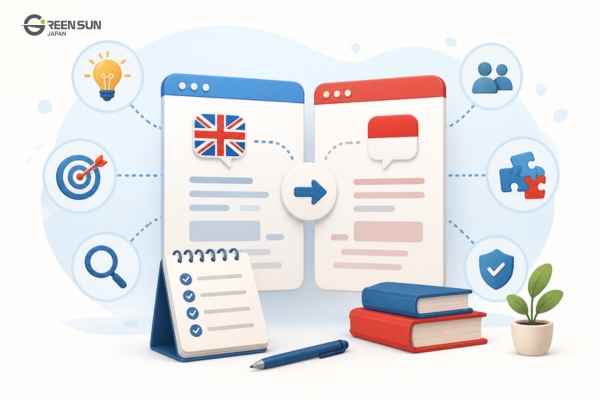
English to Indonesian Translation: Practical Tips for Accurate, Natural Results
The demand to translate English to Indonesian is continuing to grow among both individual and business clients. From emails, contracts, and websites to technical documents and marketing materials, accurate translation goes far beyond word-for-word conversion. It requires natural phrasing, cultural awareness, and alignment with the intended audience and purpose.
At first glance, Indonesian may appear easier to work with due to its less complex grammatical structure compared to English. In reality, however, translations can still go wrong very easily if the translator does not fully understand the differences between English and Indonesian, especially in expression, level of formality, and context of use.
This article will help you understand the most important points to consider when you translate English to Indonesian, along with practical Indonesian translation tips to improve both accuracy and naturalness.
📌 Key Takeaways / Direct Answer:
Translating English to Indonesian accurately requires understanding key linguistic nuances, such as replacing English tense markers with Indonesian adverbs (sudah, sedang, akan) and selecting context-appropriate pronouns (Anda vs. Kamu). Unlike English, Indonesian business and marketing translations demand strict control over formality levels, positive word nuances (e.g., using “terjangkau” instead of “murah” for affordable), and domain-specific terms in medical or technical fields. To avoid literal translation pitfalls, businesses should translate by meaning rather than word-for-word, apply strict Quality Assurance (QA), and ensure native proofreading before publication.

1. Key Differences Between English and Indonesian
Producing high-quality translations starts with understanding how these two languages differ. This foundation helps you avoid overly literal phrasing and create more natural results.
1.1. Grammar and Time Expression
One major difference is that English has a clear tense system, while Indonesian verbs do not change form based on tense in the same way. In Indonesian, time is often expressed through adverbs, markers such as sudah (already), sedang (currently / in progress), and akan (will), or simply through context.
Examples:
・EN: I have eaten.
・ID: Saya sudah makan.
・EN: We will send the document tomorrow.
・ID: Kami akan mengirim dokumen itu besok.
This means that when translating into Indonesian, you cannot rely on verb structure alone. You need to understand when the action takes place, whether it is ongoing, and which time-related details actually need to appear in the target sentence.
In addition, English often uses passive structures and long sentences in business writing. When translating into Indonesian, it may be necessary to adjust the wording so the sentence becomes clearer, shorter, and easier to understand.
Examples:
・EN: Please be informed that the meeting has been postponed until next Monday.
・Natural ID: Kami ingin menginformasikan bahwa rapat ditunda hingga Senin depan.
If the original English structure is carried over too closely, the Indonesian sentence can sound heavy, unnatural, and overly translated.
1.2. Pronouns, Politeness, and Nuance
English uses a relatively simple pronoun system, such as I, you, we, and they. In Indonesian, however, forms of address change depending on the relationship between the speakers and the context.
For example, the English pronoun “you” may need to be translated as Anda, kamu, or even expressed indirectly without directly addressing the reader. As a result, pronoun choice can directly affect how professional the translation sounds.
Example:
・EN: Have you received the document?
・Formal ID: Apakah Anda sudah menerima dokumen tersebut?
・Informal ID: Kamu sudah terima dokumennya?
1.3. Sentence Structure and Directness
English, especially in business writing, tends to be clear, direct, and logically structured. Indonesian can also be clear, but its phrasing is often more flexible and, depending on the context, sometimes softer in tone. If the English sentence structure is transferred too directly into Indonesian, the result can sound stiff and more like a translation than a naturally written sentence.
Example:
・EN: We would appreciate your prompt response.
・Natural ID: Kami akan menghargai tanggapan Anda sesegera mungkin. / Kami menantikan tanggapan Anda secepatnya.
Translators should prioritize phrasing that feels natural to Indonesian readers rather than following the exact form of the source sentence too closely.
2. Formal vs. Informal Indonesian: Why Tone Matters
One of the most important aspects of Indonesian translation is choosing the appropriate tone—formal or informal. English, especially in international contexts, tends to be relatively neutral. However, when converting content into Indonesian, the level of formality becomes much more explicit through pronouns, word choice, and sentence structure.
2.1. Formal vs. Informal Language
Formal Indonesian is typically used in business emails, contracts, proposals, internal documents, corporate websites, official announcements, and professional customer communication. It is characterized by more complete sentence structures, polite wording, and the use of pronouns such as Anda.
Example:
・EN: Could you please send the updated file?
・Formal ID: Bisakah Anda mengirim file yang telah diperbarui?
In contrast, informal Indonesian is more suitable for chats, social media, casual content, or everyday communication. Sentences are often shorter and more flexible, and may use kamu or omit certain parts of the sentence.
Example:
・Informal ID: Bisa kirim file yang sudah di-update?
Both versions can be correct, but using the wrong tone can misalign the message. For example, using an informal tone in a client email may come across as less professional, while overly formal language in social media content can feel distant and less engaging.
2.2. Tone Across Different Contexts
📌In business settings, formal language should be the default choice. This applies to emails, proposals, contracts, company profiles, and communication with clients or partners.
Example:
・EN: We appreciate your cooperation.
・Formal ID: Kami menghargai kerja sama Anda.
📌In customer service, tone can be more flexible depending on the brand. Industries such as banking, insurance, and healthcare usually require a formal or semi-formal tone. Meanwhile, consumer apps or e-commerce platforms may adopt a more friendly and conversational style while maintaining politeness.
Example:
・EN: Please wait while we process your request.
・Formal ID: Mohon tunggu sementara kami memproses permintaan Anda.
・More natural ID: Mohon tunggu, permintaan Anda sedang kami proses.
📌In marketing, tone selection depends heavily on the target audience. Brands targeting businesses should maintain a professional tone, while those targeting younger consumers may benefit from a more casual and engaging style.
Example:
・EN: Discover our latest collection.
・Neutral/formal: Temukan koleksi terbaru kami.
・More engaging: Yuk, cek koleksi terbaru kami.
2.3. Choosing the Right Tone
Before starting an English-to-Indonesian translation, it is important to clarify three key factors:
・Who is the target audience?
・What is the purpose of the content?
・What kind of brand image should the tone convey?
Answering these questions helps guide decisions on pronouns, sentence structure, and level of formality.
This is a critical step, as many translation issues are not caused by incorrect vocabulary, but by tone that does not match the context. Applying these Indonesian translation tips can significantly improve both the effectiveness and professionalism of your translation.
· A Step-by-Step Guide to English–Vietnamese Business Translation
· Practical Tips for Accurate English–Japanese Translation
· Common English–Burmese Translation Issues and Solutions
· How to Improve Accuracy in English–Lao Translation
· Best Practices for English–Thai Business Translation
· English–Malay Translation Errors Businesses Should Avoid
· Business and Localization Tips for English–Filipino Translation
3. Common Translation Mistakes and How to Fix Them
Many translations from English to Indonesian may sound “not entirely wrong” but still fall short of being truly effective. This often happens because translators make several common mistakes when they translate English to Indonesian.
3.1. Translating Word-for-Word
This is the most common issue. When translators follow the English wording too closely, the Indonesian sentence can become rigid, overly long, and unnatural.
Business example:
・EN: Please take into consideration our previous discussion.
・Literal translation: Silakan ambil ke dalam pertimbangan diskusi kami sebelumnya.
・More natural translation: Mohon pertimbangkan kembali hasil diskusi kita sebelumnya.
💡 How to fix it:
Before translating, identify the core meaning of the sentence. Then rewrite that meaning using natural Indonesian phrasing. Avoid preserving every element of the original sentence if it reduces clarity or readability.
3.2. Correct Meaning, Wrong Tone
In many contexts – especially in marketing and business – choosing the correct meaning is not enough. The word must also carry the right nuance.
Example:
・EN: cheap but reliable solution
・Less effective: solusi murah tetapi andal
・Better option: solusi terjangkau dan andal
The word murah is not incorrect, but it can sometimes imply “low quality.” In contrast, terjangkau conveys affordability in a more positive and professional way.
💡 How to fix it:
When translating words related to value, quality, or perception, consider whether the tone aligns with the brand image. This is one of the most important Indonesian translation tips, especially for website and marketing content.
3.3. Ignoring Industry Context
In fields such as healthcare, engineering, or business, many terms must be interpreted based on their technical meaning rather than their general meaning.
Medical example:
・EN: positive result
・Literal translation: hasil positif
・Context-specific ID: hasil tes positif (terdeteksi penyakit)
In medical contexts, positive result does not necessarily mean a “good” outcome. It typically indicates that a condition or disease has been detected. Simply translating it as hasil positif can be misleading without clarification. Adding context—such as terdeteksi penyakit—helps ensure the meaning is accurate and avoids misunderstanding.
Technical example:
・EN: shutdown procedure
・Less accurate: prosedur mematikan
・More appropriate: prosedur penghentian sistem
In technical documentation, shutdown does not simply mean “to turn off.” It often refers to a standardized process for safely stopping a system. Translating it too literally as mematikan (“turn off”) can result in a loss of accuracy and may not align with the intended technical context.
💡 How to fix it:
Always identify the subject field before translating. For specialized content, refer to trusted bilingual materials, industry glossaries, or consult relevant experts to ensure accuracy.
3.4. Skipping the Final Review
Some translation issues do not come from the initial draft but from skipping the final review stage. Common problems include inconsistent terminology, shifting pronouns, or sentences that still sound machine-translated.
💡 How to fix it:
After completing the translation, review it based on three key criteria:
・Does the sentence sound natural?
・Is the terminology consistent throughout?
・Is the tone appropriate and consistent?
This final step is essential to improving the overall quality of your Indonesian translation.
4. Practical Indonesian Translation Tips
To improve the quality of your English-to-Indonesian translation, you do not need overly complex techniques. Instead, focus on the essential principles below.
📌 Understand the audience and context before translating
Before you begin, clearly identify the purpose of the content and its context. The same English sentence can be translated differently depending on whether it is used in a business email, marketing content, or casual communication. Without a clear understanding of context, it is easy to choose the wrong phrasing.
📌 Translate by meaning, then refine the sentence
This approach is especially effective for long English sentences. Instead of following the original structure word by word, break the sentence into meaning units and rewrite it in a more natural Indonesian structure. This method improves clarity and helps avoid literal translation errors—one of the most common issues addressed in Indonesian translation tips.
📌 Use common, easy-to-understand vocabulary
For websites, user guides, customer support content, and marketing materials, simple language is often more effective than overly technical or academic wording. After translating, review your text to identify any terms that feel too complex for your target audience. If necessary, replace them with clearer and more natural alternatives while maintaining accuracy.
📌 Always review your translation from a native perspective
Once the translation is complete, read it as if you were a native speaker. Check whether the sentences sound natural, whether they feel machine-translated, and whether terminology is consistent throughout. If possible, have a native speaker or experienced editor review the content. This step is especially important for business, technical, and marketing materials.
5. Conclusion
Translating English to Indonesian effectively requires more than just transferring meaning. It involves adapting content to fit context, audience, and purpose. By understanding key language differences, choosing the right tone, avoiding common mistakes, and applying practical strategies, you can significantly improve translation quality.
Need professional support for your English to Indonesian translation projects?
Green Sun Japan provides accurate, natural, and context-aware Indonesian translation services backed by native linguists and strict quality assurance protocols. Whether you require business contracts, technical documentation, websites, or marketing localization, our team ensures your message resonates with Indonesian audiences while protecting your brand reputation.
- ⏱️ Fast Response: Free consultations and quotations within 30 minutes.
- 🛡️ Confidentiality Assured: Strict NDA execution for all corporate files.
- 🎯 Native Expertise: Specialized translators for legal, technical, and marketing content.
👉 Contact Green Sun Japan today to receive your free quotation and sample translation.

Professional Translation Solutions for Businesses
For important materials such as contracts, websites, marketing content, and technical documents, accuracy is essential.
Green Sun Japan provides English-to-Indonesian translation services as well as support for many other languages, with:
✅ Native-speaking translators
✅ Strong understanding of cultural and contextual nuances
✅ High standards of accuracy and natural phrasing
✅ Support across multiple fields, including business, engineering, healthcare, and marketing
👉 Choose Green Sun Japan to ensure your message is delivered accurately and professionally.