

Japanese Website Translation Services for B2B Manufacturers
Japanese website translation services for B2B manufacturers should do more than convert English content into Japanese. The goal is to help Japanese engineers, procurement teams, distributors, and business partners quickly understand what you sell, whether the specifications fit their requirements, and how to contact you.
For technical and industrial websites, the highest-priority content is usually the product or service page, technical specifications, downloadable catalogs or datasheets, and the inquiry flow. These areas directly affect product evaluation and lead generation, so terminology, numbers, units, model codes, and interface text need controlled review.
Quick answer: Start with the pages that influence technical evaluation and inquiries. Build an approved glossary, protect product codes and numerical data, localize UI and forms, and perform linguistic QA on the staging site before launch.
- Translate first: product pages, technical specifications, catalogs/datasheets, company information, and contact forms.
- Control technical risk: verify model codes, units, tolerances, decimal points, test conditions, and JIS/ISO/IEC references against the source.
- Keep terminology consistent: use the same approved terms across the website, PDF documents, sales materials, and automated emails.
- Localize the full user journey: navigation, buttons, filters, validation messages, inquiry forms, thank-you pages, and confirmation emails.
- Check the live context: review Japanese line breaks, table layout, mobile display, links, forms, and downloadable files on staging.
1. What should be translated first for the Japanese market?
If budget or time does not allow a full-site rollout, prioritize the content that Japanese prospects use to evaluate a supplier. This creates a usable Japanese sales funnel without translating every blog post or low-priority page at once.
1.1 Product and service pages
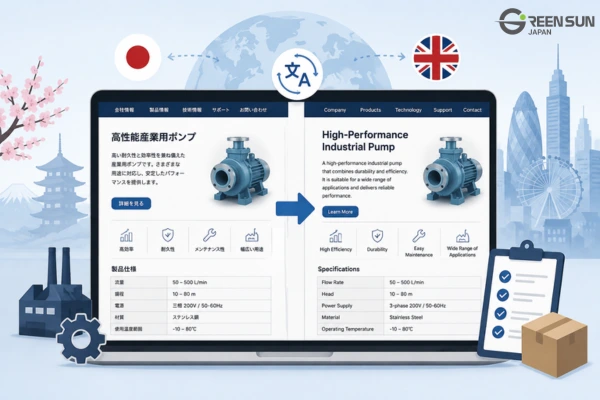
A strong Japanese product page should make the product category, application, differentiators, model options, materials, operating conditions, and quotation requirements easy to scan. Generic category names can be localized into commonly used Japanese industry terms, while model names, part numbers, trademarks, and product codes should normally remain fixed unless the manufacturer has an approved Japanese form.
1.2 Technical specifications
Specification tables are high-risk because a small numerical or formatting error can change the meaning of product data. Figures, decimal points, tolerances, units such as mm, μm and MPa, test conditions, footnotes, and standard references should be checked against the source independently from the language review.
For references such as JIS, ISO, or IEC, translators should preserve the official code and verify the referenced standard instead of freely translating or reformatting the identifier.
1.3 Catalogs, datasheets, drawings, and downloadable PDFs
The website and its downloadable documents should use the same terminology. If a product name appears one way on the website and another way in the catalog or datasheet, buyers may be unsure whether the documents describe the same model. A shared glossary and translation memory help keep website content, PDF files, presentations, and sales materials aligned.
1.4 Inquiry forms and conversion elements
Do not stop at body text. Localize field labels, dropdown options, validation errors, CTA buttons, thank-you pages, automated confirmation emails, and any instructions about drawings, specifications, quantities, or required attachments. A clear inquiry flow makes it easier for prospects to submit useful information for a quotation.
· Explore the Best Japanese Translation Apps for 2026
· Key Questions to Ask Before Hiring a Japanese Translator
· Essential Insights for Localizing Your Website for Japan
· How to Localize Brand Names and Taglines for Japanese Audiences
2. Japanese website translation vs. localization: what is the difference?
Website translation focuses on transferring meaning accurately from the source language into Japanese. Website localization goes further by adapting terminology, information order, UI strings, forms, visual layout, SEO elements, and downloadable assets to the Japanese user journey.
| Area | Translation only | Japanese localization |
|---|---|---|
| Body content | Translate sentences | Adapt wording to audience, page purpose, and B2B context |
| Product terminology | Translate term by term | Use approved industry terminology and lock model codes |
| Technical data | Carry over values | Perform separate numeric and unit checks |
| UI and forms | May be outside scope | Localize menus, filters, errors, buttons, and emails |
| SEO | Translate keywords directly | Research Japanese search intent and rewrite metadata/headings |
| QA | Proofread text | Review the staging site on desktop and mobile |
3. Common risks in technical Japanese website translation
| Risk | Typical problem | Recommended control |
|---|---|---|
| Terminology mismatch | Website, catalog, and datasheet use different product terms | Create and approve a project glossary before full translation |
| Model-code errors | Part numbers or model names are translated or reformatted | Set do-not-translate rules for codes and trademarks |
| Numeric errors | 0.05 becomes 0.5 or a tolerance symbol is lost | Run independent numeric QA against the source |
| Unit errors | mm, μm, MPa, °C, or test conditions are omitted | Compare specification cells and footnotes bilingually |
| Untranslated interface | Buttons, filters, errors, or emails remain in English | Extract and localize UI strings as part of the scope |
| Layout problems | Japanese text wraps badly or breaks tables on mobile | Perform linguistic QA on staging before launch |
| Literal SEO translation | English keywords are translated without checking Japanese search behavior | Research Japanese queries and optimize titles, headings, URLs, and internal links separately |
4. Recommended workflow for Japanese B2B website localization
- Scope and page prioritization: identify pages that drive product evaluation, trust, and inquiries.
- Content extraction and asset inventory: collect CMS text, UI strings, PDFs, images, diagrams, and automated emails.
- Glossary and do-not-translate rules: confirm product names, terminology, units, standards, and model codes before translation.
- Translation and specialist review: translate according to page context and have technical or industry-sensitive content reviewed by a suitable linguist.
- DTP and CMS implementation: localize diagrams or PDFs where required and place approved content into the website.
- Staging QA and final verification: test terminology, numbers, layout, links, forms, metadata, and responsive display before publication.

5. Japanese SEO and staging QA checklist
A translated website can still underperform if search intent and technical implementation are ignored. SEO for the Japanese version should be reviewed separately rather than copied directly from the source-language website.
| Check | What to verify |
|---|---|
| Search intent | Target terms reflect how Japanese users actually search for the product, service, or problem |
| Title and meta description | Written naturally in Japanese and aligned with the page purpose |
| Headings | H1-H3 structure is clear and not simply copied from the source language |
| URLs and internal links | Japanese pages are linked logically from related services, products, and resources |
| Localized versions | Corresponding language versions are implemented correctly, including hreflang where applicable |
| Images and PDFs | Important text inside diagrams or downloadable documents is localized when needed |
| Desktop/mobile QA | No broken tables, clipped buttons, unnatural line breaks, or form errors |
| Inquiry flow | Submission, confirmation page, notification email, and attachments work correctly |
For the core language service behind the website project, see Green Sun’s Japanese translation services. For broader multilingual projects, see our translation services.
6. What should be included in a Japanese website translation quote?
A useful quotation should define more than the word count. For B2B websites, ask the provider to clarify which assets and QA steps are included so that there are no gaps between translated text and the live website.
- Number of pages, words, or CMS strings
- Languages and source formats
- Technical subject area and reviewer requirements
- Glossary and translation memory setup
- PDF, image, diagram, or multilingual DTP work
- CMS upload or developer handoff format
- Japanese SEO metadata localization
- Staging-site linguistic QA and correction rounds
- Delivery schedule and priority pages
Green Sun Japan can support website translation, terminology management, multilingual DTP, and localization QA for B2B projects. Send your website URL or source files and we can review the scope before quotation.
Request a free consultation and quotation for Japanese website translation.
7. Frequently Asked Questions
Do we need to translate the entire website at once?
No. For many B2B sites, it is practical to launch the Japanese version in phases. Start with the homepage or key landing page, product or service pages, technical specifications, company information, and inquiry flow. Lower-priority news or archive content can follow later.
Can machine translation be used for a Japanese B2B website?
Machine translation can support drafting or high-volume workflows, but technical pages, product claims, specifications, forms, and sales-critical content should be reviewed by qualified linguists. The required review level depends on the content risk and intended use.
Should the website and PDF catalog use the same terminology?
Yes. Consistent product names and technical terminology make it easier for buyers to compare web pages, catalogs, datasheets, and quotations. A shared glossary and translation memory are useful for maintaining consistency.
Is Japanese SEO part of website translation?
It should be included when organic search is a business goal. Japanese keyword research, title and meta-description writing, heading optimization, internal linking, and localized page relationships require separate attention from literal translation.
What should be checked before the Japanese website goes live?
At minimum, check language accuracy, terminology consistency, model codes, numerical data, units, links, forms, metadata, downloadable files, and desktop/mobile display. The final review should happen on the staging site whenever possible.