

How Japanese Teams Use GlobalLink to Centralize Multilingual Content Workflows
As Japanese companies continue expanding their international operations, managing multilingual content has become an essential part of business. However, manual translation workflows that rely on email or spreadsheets can easily lead to document version errors, inconsistent terminology, and longer turnaround times.
As a result, many Japanese companies use GlobalLink or similar translation management platforms to standardize translation workflows, improve cross-department collaboration, and streamline multilingual content management.
This article explains what GlobalLink is, how Japanese companies use it to manage multilingual translation workflows, the benefits it offers for version control, terminology consistency, and workflow automation, and when organizations should consider implementing it.
📌 Key Takeaways / Direct Answer:
Japanese companies use GlobalLink—a Translation Management System (TMS) by TransPerfect—to replace fragmented email and spreadsheet workflows with a centralized, automated multilingual content process. GlobalLink integrates directly with CMS, DAM, and PIM platforms, enabling seamless content synchronization, real-time status tracking, and strict document version control. By establishing centralized Translation Memory (TM) and terminology glossaries, organizations reduce translation costs, eliminate document version errors, and shorten time-to-market. For Japanese enterprises expanding globally, integrating GlobalLink into their localization strategy streamlines collaboration between Japan headquarters and overseas subsidiaries.
Contents
- 1. Why Do Japanese Companies Need a Centralized Translation Management Platform?
- 2. How Japanese Companies Use GlobalLink to Centralize Multilingual Content Workflows
- 3. How Does GlobalLink Support Translation Workflows for Japanese Companies?
- 4. How Does GlobalLink Help Reduce Errors and Improve Operational Efficiency?
- 5. When Should Japanese Companies Implement GlobalLink?
- 6. Conclusion
- 7. FAQ

1. Why Do Japanese Companies Need a Centralized Translation Management Platform?
As content volumes grow and businesses expand into more languages, manual translation workflows are no longer sufficient to support operational needs. Exchanging documents by email, managing multiple file versions, and coordinating with multiple translation providers make it difficult to maintain visibility into project progress, quality, and content consistency.
In addition, using different terms or expressions for the same concept can negatively affect the customer experience and weaken brand consistency. For this reason, many Japanese companies choose to manage documents, terminology, and translation workflows through a centralized platform, enabling better collaboration and greater control over multilingual content.
· The Strengths and Limitations of AI in Japanese Translation
· Costly Legal Risks in Japanese Contract Translation
· Japanese Document Translation for Manufacturing and Technology
· When Japanese Machine Translation and MTPE Are Effective
2. How Japanese Companies Use GlobalLink to Centralize Multilingual Content Workflows
As they expand into international markets, Japanese companies must manage large volumes of multilingual content, including websites, technical documentation, marketing materials, and e-commerce content. This requires translation workflows that ensure accuracy, consistency, and timely updates across every market.
GlobalLink is a Translation Management System (TMS) developed by TransPerfect that enables companies to centrally manage the entire translation and content localization process. The platform supports integration with a wide range of content management systems, terminology management, Translation Memory, and workflow automation for multilingual content.
Instead of managing translation projects manually through email or spreadsheets, many Japanese companies use GlobalLink or similar translation management platforms to centralize the entire workflow. By managing every stage within a single system, GlobalLink helps reduce errors, strengthen collaboration across departments, and shorten time to market.
3. How Does GlobalLink Support Translation Workflows for Japanese Companies?
Rather than managing each translation project independently, GlobalLink enables companies to build an end-to-end translation and localization workflow—from content creation through publication. Every translation request is tracked within a centralized system, making it easier for teams to collaborate without relying on multiple communication tools.
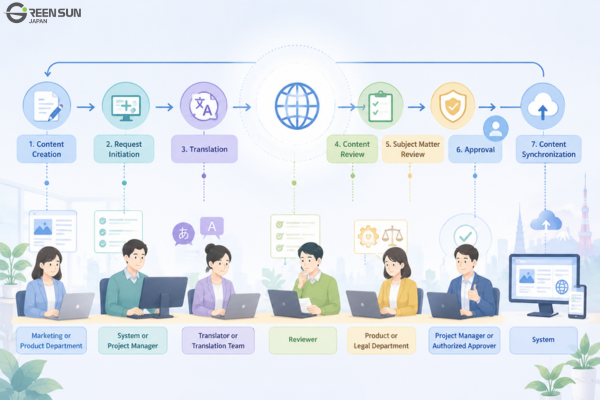
A typical workflow includes the following stages:
| Stage | Person Responsible | Objective |
|---|---|---|
| Content Creation | Marketing or Product Department | Prepare source content for translation |
| Request Initiation | System or Project Manager | Create the project and assign tasks |
| Translation | Translator or Translation Team | Translate according to approved terminology and translation guidelines |
| Content Review | Reviewer | Verify accuracy, naturalness, and suitability for the target market |
| Subject Matter Review | Product or Legal Department | Verify technical accuracy and compliance requirements |
| Approval | Project Manager or Authorized Approver | Approve content before publication |
| Content Synchronization | System | Update translated content in the website, application, or content management system |
Within this workflow, every stage has a clearly defined owner. The content team prepares the source material, the system automatically creates and assigns translation requests, translators complete the work, reviewers evaluate quality for each target market, and the project manager approves the content before publication.
Another key advantage of GlobalLink is its ability to integrate with content management systems such as CMS, DAM, and PIM platforms. When website content is updated, the system can automatically generate a translation request without requiring manual intervention. Once the translation is approved, the content is synchronized back to the website or application through the same unified workflow.
By automating multiple stages of the translation process, companies can significantly reduce time spent on repetitive tasks while minimizing the risk of overlooked content or incorrect document versions.
In Japanese companies, this workflow typically involves collaboration among multiple departments, including marketing, product development, legal, and localization. Each team is responsible for a specific part of the process—from creating content and validating technical information to reviewing legal requirements, managing translations, and approving content before publication.
Centralizing the entire workflow on a single platform enables these teams to collaborate more efficiently while significantly reducing communication overhead and processing time.
4. How Does GlobalLink Help Reduce Errors and Improve Operational Efficiency?
For Japanese companies, implementing an enterprise translation management platform is not only about increasing translation speed. It also helps standardize the entire multilingual content management process. When all work is completed within the same system, companies gain greater control over content quality, project progress, and cross-departmental collaboration.
One of the most noticeable improvements is document version control. Instead of storing multiple versions in email inboxes or on individual computers, companies can manage all documents in a centralized location. Every revision is recorded in the version history, allowing users to track changes, identify the latest version, and restore previous versions when necessary.
Japanese translation management can also be improved through the use of a glossary and Translation Memory. Once a term or sentence has been approved, the system can reuse it in future projects. This not only helps reduce translation costs but also ensures consistent wording across websites, technical documents, and marketing materials.
The table below compares a traditional workflow with a standardized workflow using GlobalLink:
| Traditional Workflow | Workflow Using GlobalLink |
|---|---|
| Documents exchanged by email | Centralized management on a single platform |
| Difficult document version control | Clear version history and revision tracking |
| Inconsistent terminology | Synchronized glossary and Translation Memory |
| Manual progress tracking | Real-time status updates |
| Manual publishing | Direct synchronization with CMS and content management systems |
With a standardized and automated workflow, companies can shorten the time between submitting a translation request and publishing the final content. They can also significantly reduce the amount of manual coordination required between departments.
This approach also helps Japanese companies standardize content operations between their headquarters and overseas branches. Instead of managing each translation project separately, all teams can monitor progress, complete tasks, and collaborate through the same unified workflow. This helps streamline Japanese content operations across headquarters in Japan and international offices.
5. When Should Japanese Companies Implement GlobalLink?
Not every company needs a translation management platform from the beginning. However, as content volume, the number of languages, and the number of stakeholders increase, maintaining a manual workflow can reduce operational efficiency and create additional risks.
Companies should consider implementing GlobalLink or a similar translation management platform if they are experiencing one or more of the following situations:
・Managing multilingual websites or applications.
・Having multiple departments create and update content.
・Coordinating with several translation providers or freelance translators.
・Frequently encountering errors caused by using the wrong document version.
・Experiencing inconsistent terminology across documents or markets.
・Dealing with lengthy review and approval processes.
・Seeking to standardize content reviews before publication.
・Needing to monitor operations between headquarters and branch offices.
To support a successful implementation, companies should prepare several key elements in advance. First, they should establish a shared glossary to ensure that all projects use consistent product names, technical terms, and brand messaging.
Next, they should clearly define the responsibilities of each department within the workflow, including content creators, project managers, translation providers, reviewers, and approvers.
Finally, companies should monitor operational metrics such as translation turnaround time, on-time completion rates, Translation Memory reuse rates, review time, and the number of document version errors. These metrics provide a basis for evaluating performance and continuously improving the workflow throughout the implementation process.
6. Conclusion
As companies expand into multiple markets, multilingual content management is no longer solely the responsibility of the translation department. It has become an essential part of business operations. An inconsistent workflow can delay project delivery, increase costs, and weaken brand consistency.
Implementing GlobalLink helps Japanese companies standardize translation workflows, centrally manage content, and improve collaboration across departments. More importantly, the platform supports the development of a clear, transparent, and scalable multilingual content management process as companies expand into new markets.
Rather than simply addressing immediate translation needs, a standardized workflow helps companies optimize resources, maintain content quality, and improve the efficiency of multilingual content operations.
7. FAQ
1. What Is GlobalLink?
GlobalLink is a Translation Management System (TMS) that enables companies to manage the entire translation and content localization process through a centralized platform.
2. Which Companies Should Use GlobalLink?
GlobalLink is suitable for companies that manage multiple websites, support multiple languages, or regularly collaborate with several departments and translation providers.
3. How Does GlobalLink Help Reduce Document Version Errors?
The system stores all documents in a centralized location, tracks revision history, and manages document versions on a single platform. This helps reduce the risk of using an incorrect version or losing important files.
4. What Should Companies Prepare Before Implementing GlobalLink?
Companies should standardize their content workflows, establish a consistent glossary, clearly define each department’s responsibilities, and set performance metrics to help ensure a successful implementation.

If your company is struggling to manage multiple document versions, coordinate with several translation providers, or maintain consistency across languages, the experts atGreenSun Japancan help assess your current workflow and recommend improvements based on your business needs.
If your company is struggling to manage multiple document versions, coordinate with several translation providers, or maintain consistency across languages, the experts at GreenSun Japan can help assess your current workflow and recommend improvements based on your business needs.
GreenSun Japan helps companies:
・Build a clear translation management workflow aligned with their business operations.
・Standardize terminology and review processes to maintain consistency across multilingual content.
・Reduce the risk of document version errors and improve control throughout the entire workflow.
・Shorten processing times by automating translation and content localization workflows.
・Access implementation consulting and workflow optimization at every stage of business growth.
👉 Contact Green Sun Japan today for expert guidance on selecting the right solution and building an efficient multilingual content management workflow that supports your company’s international expansion goals.