

Japanese Medical Translation Services: Accuracy, Safety, and Risk Control
In the healthcare, pharmaceutical, and medical device industries, an inaccurate translation can do more than create misunderstandings—it may compromise patient safety and delay regulatory compliance. That’s why Japanese medical translation services require more than linguistic accuracy. They demand subject-matter expertise, contextual understanding, and consistent terminology across every document.
This article explores the common risks involved in Japanese medical translation, explains why machine translation alone is not suitable for high-risk medical content, and outlines best practices for ensuring quality in clinical, pharmaceutical, and medical device documentation.
Contents
1. Why Medical Translation Requires More Than Language Skills
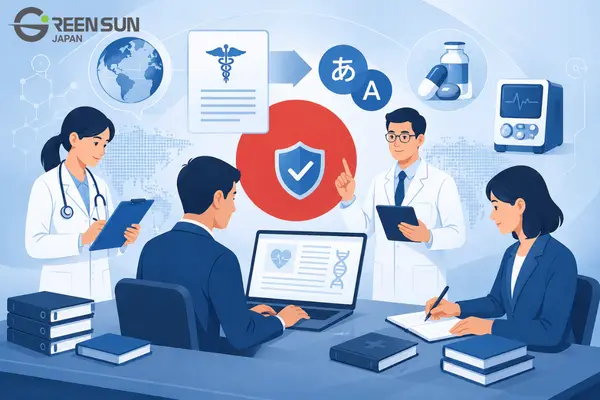
Medical translation is far more than converting text from Japanese into another language. Translators must understand medical terminology, the context in which the document will be used, and its intended purpose to ensure the information is communicated accurately. Even familiar terms can carry different meanings depending on the medical specialty, stage of treatment, or document type.
In addition to language proficiency, Japanese medical translation requires knowledge of clinical research, pharmaceuticals, medical devices, and relevant regulatory requirements. For example, an Instructions for Use (IFU) document must be clear and easy for end users to follow, while a Clinical Protocol or regulatory submission requires precise terminology and consistency throughout the document.
This is why organizations often rely on professional Japanese medical translation services for high-risk medical documentation. Combining linguistic expertise with medical knowledge and a structured quality assurance process helps minimize errors, maintain consistency, and ensure translations are fit for their intended purpose.
· Recommended Translation Apps for Japanese in 2026
· The Strengths and Limitations of AI-Powered Translation
· Professional Translation Solutions for Technical Documents
2. High-Risk Documents That Require Expert Japanese Medical Translation
Not all medical documents carry the same level of risk. Documents used in clinical research, regulatory submissions, or product instructions require an exceptionally high level of accuracy because they directly support healthcare decisions, regulatory review, or the safe use of medical products.
2.1. Clinical Documents
Clinical documents such as Clinical Protocols, Investigator’s Brochures (IBs), Informed Consent Forms (ICFs), Case Report Forms (CRFs), and patient-facing materials contain highly specialized terminology and require precise, consistent language. In Japanese clinical translation, translators must understand clinical trial processes, study endpoints, and medical terminology to preserve the original meaning without introducing ambiguity.
2.2. Pharmaceutical Documents
Pharmaceutical documentation often includes information about active ingredients, indications, dosage instructions, safety warnings, and regulatory submissions. Documents such as the Common Technical Document (CTD), Package Inserts, Pharmacovigilance reports, and safety updates require consistent terminology and an understanding of pharmaceutical regulations. As a result, Japanese pharmaceutical translation should be handled by linguists with both language expertise and pharmaceutical knowledge.
2.3. Medical Device Documents
Medical device documentation—including Instructions for Use (IFUs), User Manuals, Product Labeling, Technical Files, and Risk Management Files—plays a critical role in product safety and regulatory compliance. During Japanese medical device translation, every operating instruction, warning, and technical specification must be translated clearly and consistently to ensure users understand how to use the device safely and as intended.
3. Why Machine Translation Alone Is Too Risky for High-Risk Medical Content
Machine Translation (MT) can help speed up translation workflows and improve efficiency for certain types of content. For example, it can be useful for translating internal emails, reference materials, or generating an initial draft for human editing. However, it should not be used as the only solution for high-risk medical, pharmaceutical, or medical device documents. These materials often contain information related to treatment, patient safety, and regulatory compliance, where even minor translation errors can have significant consequences.
3.1. Machine Translation May Miss Context-Specific Meaning
Machine Translation can produce fluent translations, but it may still select the wrong meaning when terminology depends on professional context. For example, the same term may need to be phrased differently in a Clinical Protocol, an Instructions for Use (IFU) document, or patient-facing materials. Without expert review, the translation may sound correct linguistically but may not be accurate enough for medical or regulatory use.
3.2. Medical Documents Must Remain Consistent
Medical products are typically supported by multiple documents, including Package Inserts, IFUs, training materials, and regulatory submissions. If terminology or safety warnings are translated inconsistently across these documents, organizations may face additional review cycles before publication or regulatory submission. Maintaining consistent terminology also helps reduce the risk of misinterpretation when documents are used by different teams or across multiple markets.
3.3. Human Review Is Essential for High-Risk Content
Machine Translation can provide a useful first draft, but it cannot independently verify medical accuracy or determine whether a translation is appropriate for its intended purpose. Documents such as Clinical Protocols, Informed Consent Forms (ICFs), Risk Management Files, and regulatory submissions should always be reviewed by a qualified Japanese medical translator to validate terminology, context, and consistency before use.
Rather than replacing human expertise, Machine Translation delivers the best results when used within a human-in-the-loop workflow, where technology improves efficiency while experienced specialists remain responsible for the final quality of the translation.
4. How to Build a Safer Quality Process for Japanese Medical Translation
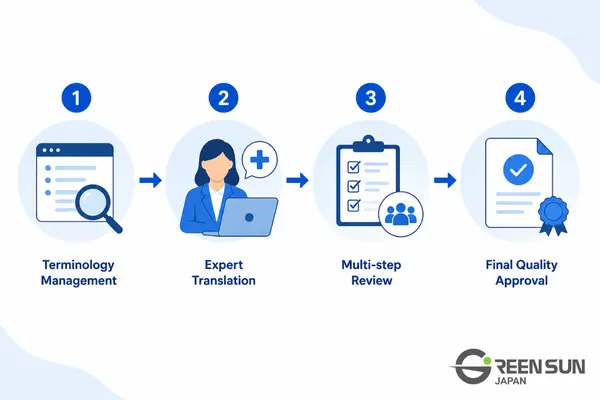
Reducing risk in Japanese medical translation requires more than fast turnaround times. Organizations should establish a structured quality assurance process to ensure accuracy, consistency, and compliance throughout every stage of translation.
📝 Standardize Medical Terminology: Maintaining a dedicated glossary and terminology guide helps ensure that disease names, active ingredients, medical devices, and other technical terms are translated consistently across all documents.
📝 Use Qualified Medical Translators: High-risk medical documents should be translated or reviewed by an experienced Japanese medical translator with expertise in the relevant field. This helps ensure both linguistic accuracy and subject-matter correctness.
📝 Implement a Multi-Step Review Process: Translations should undergo multiple quality checks, including editing, terminology verification, and quality assurance (QA) before they are finalized. A multi-step review process is more effective at identifying errors than relying on a single review.
📝 Balance Technology with Human Expertise: Translation technologies such as Translation Memory (TM) and Machine Translation can improve efficiency and consistency. However, for high-risk medical documents, they should support—not replace—expert human review.
By combining technology, medical expertise, and a structured quality assurance process, Japanese medical translation services can deliver more accurate, consistent, and reliable translations for clinical, pharmaceutical, and medical device documentation.
5. Conclusion
For clinical, pharmaceutical, and medical device documentation, accurate translation is essential not only for clear communication but also for effective risk management, regulatory compliance, and patient safety. Professional Japanese medical translation services combine linguistic expertise, medical knowledge, terminology management, and rigorous quality assurance to meet these demanding requirements.
While Machine Translation can improve efficiency in certain workflows, it should not be relied on as the sole solution for high-risk medical content. For documents such as Clinical Protocols, IFUs, Package Inserts, and regulatory submissions, review by a qualified Japanese medical translator remains essential to ensure accuracy, consistency, and fitness for purpose.
Need Professional Medical Translation Services?
Green Sun Japan helps businesses translate medical documents with confidence through:
・Experienced industry translators across healthcare, pharmaceutical, and medical device sectors
・Rigorous quality assurance to ensure accuracy, consistency, and compliance
・Multilingual translation solutions to support global communication and international markets
Contact Green Sun Japan to discuss your medical translation needs.