

Indonesian Legal Translation Services: Contracts, Compliance, and Quality Checks
An Indonesian contract translation can read smoothly while changing who must pay, which losses are covered, or when an obligation takes effect. These discrepancies can delay negotiations and create misunderstandings between business partners. Indonesian legal translation services help preserve the meaning of contracts, compliance documents, and corporate filings through specialist translation and bilingual review.
This article highlights the primary types of documents that frequently require Indonesian legal translation services, explains why translation accuracy is paramount, outlines common translation errors that can trigger legal liabilities, and provides key selection criteria for choosing the right service provider.
📌 Key Takeaways / Direct Answer:
- Essential for B2B Legal Documentation: Indonesian legal translation services are critical for commercial contracts, compliance policies, corporate registration documents, and regulatory filings.
- Preserves Obligations and Legal Meaning: Preserves duties, permissions, conditions, and defined terms. In an obligation clause, shall may be expressed with wajib, while indemnification wording depends on the full clause. Accurate translation alone does not establish a contract’s validity or enforceability.
- Provider Selection Criteria: Organizations should prioritize translation providers that employ legal subject-matter experts, maintain multi-step quality assurance (QA) workflows, utilize CAT tools and translation memory, and are willing to sign non-disclosure agreements (NDAs).
- Solutions from Green Sun Japan: Green Sun Japan provides Indonesian translation services for legal and business documents, with terminology checks, linguistic review, and confidentiality arrangements agreed for the project.
1. What Types of Documents Require Indonesian Legal Translation Services?
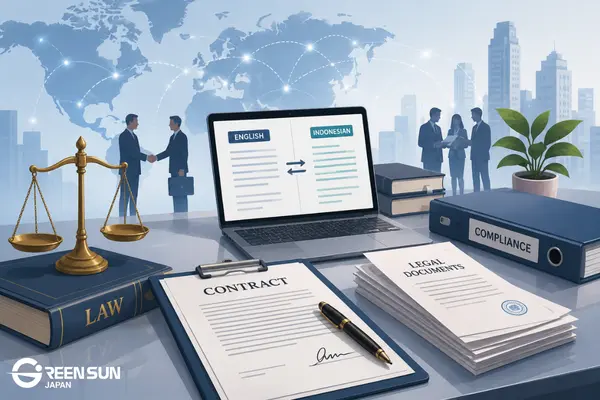
Businesses typically require Indonesian legal translation services when handling documents that hold legal value, must meet compliance requirements, or serve as official filings in cross-border transactions. Unlike standard business documents, these materials must be translated with strict fidelity to their original meaning, legal terminology, and applicable legal requirements to mitigate the risk of disputes or compliance failures.
For a broader market-entry checklist, see our guide to business documents for expansion into Indonesia. This article focuses on legal meaning, clause consistency, and review requirements.
Below are some common document categories that frequently require professional legal translation:
| Document Category | Intended Use / Purpose | Why Precision Matters |
|---|---|---|
| Commercial Contracts | Sales agreements, service contracts, distribution agreements, supply agreements | Ensures that rights, obligations, and contractual clauses are articulated with precision. |
| Compliance Documentation | Internal policies, codes of conduct, regulatory compliance updates | Helps organizations meet statutory requirements and industry-specific regulatory standards. |
| Corporate Records | Articles of Incorporation, Board Resolutions, shareholder documentation | Maintains consistency across corporate governance records and official documentation. |
| Regulatory Submissions | Business registration filings, license applications, government agency submissions | Reduces the risk of processing delays or rejections caused by translation errors. |
| Partnership & Investment Files | Memorandums of Understanding (MOUs), joint venture contracts, investment agreements | Ensures all parties share a common understanding, minimizing transaction risks in international deals. |
While each document type serves a distinct corporate objective, all require high-quality translation to ensure clarity, consistency, and legal risk mitigation. Ultimately, this enables businesses to communicate effectively with international partners, regulatory authorities, and key stakeholders across global operations.
2. Why Is Accuracy Critical in Legal Translation?
Accuracy matters because an omitted negation, changed deadline, or inconsistent defined term can alter the meaning of a clause. Review the source and target together, including annexes and schedules; flag unclear source wording for the client instead of silently rewriting it.
Language requirements also matter. Article 31 of Indonesia’s Law No. 24 of 2009 requires Indonesian for memoranda of understanding or agreements involving specified Indonesian institutions, private entities, or citizens. Agreements involving foreign parties are also written in the foreign party’s national language and/or English. Ask Indonesian legal counsel to confirm the requirements for the transaction.
- Preserving Legal Meaning: The translated text must precisely reflect the rights, obligations, and specific legal provisions of each clause, without adding, removing, or resolving ambiguity that should be referred to the client or legal counsel.
- Supporting Regulatory Compliance: Legal documents are frequently submitted for administrative procedures or regulatory audits. Using correct terminology in the appropriate context helps reduce translation-related errors that may lead to delays or requests for clarification.
- Mitigating Cross-Border Transaction Risks: In multilingual business environments, precise translation helps contracting parties develop a clear, consistent understanding, thereby reducing the risk of misinterpretation during contract negotiations and execution.
- Enhancing Professionalism and Credibility: A carefully prepared translation reflects a company’s commitment to professionalism and fosters trust when documents are presented to business partners, legal counsel, or regulatory bodies.
3. What Are Common Legal Translation Errors and Their Associated Risks?
Legal translation demands a high level of precision in terminology and context. Even a slight phrasing mismatch can alter the meaning of a clause, compromising contract enforceability or compliance processes. Below are examples of common legal terms found in English documents and the risks that may arise if they are translated inaccurately into Indonesian.
| Term / Clause | Translation Example | Risk of Inaccurate Translation |
|---|---|---|
| Shall | The Buyer shall pay within 30 days. → Pembeli wajib melakukan pembayaran dalam waktu 30 hari. | If translated as dapat (may) or expressed without mandatory force, the clause could be interpreted as optional, changing the apparent obligation into a permission. The legal effect depends on the complete agreement and applicable law. |
| Indemnify | The Supplier agrees to indemnify the Buyer against third-party claims. → Pemasok setuju untuk memberikan ganti rugi kepada Pembeli atas tuntutan dari pihak ketiga. | Incomplete or incorrect translation can alter the scope of indemnification obligations between the parties. |
| Governing Law | This Agreement shall be governed by the laws of Indonesia. → Perjanjian ini diatur oleh hukum Indonesia. | If phrased incompletely, the governing law clause could be interpreted inconsistently in the event of a dispute. |
| Force Majeure | Neither party shall be liable for delays caused by force majeure. → Tidak ada pihak yang bertanggung jawab atas keterlambatan yang disebabkan oleh keadaan kahar (force majeure). | An error may change the stated allocation of risk. Check the defined events, notice requirements, exclusions, and remedies rather than relying on the label alone. |
| Confidential Information | The receiving party shall keep all Confidential Information strictly confidential. → Pihak penerima wajib menjaga kerahasiaan seluruh Informasi Rahasia. | Inconsistent terminology may trigger disputes regarding the scope of information subject to confidentiality obligations. |
These examples illustrate translation choices; they are not ready-to-use contract clauses. “Shall” can serve different drafting functions, and an indemnity clause may cover specified claims, losses, costs, or duties to defend. Translate the complete provision, defined terms, exclusions, and limitations rather than substituting isolated words. For general language considerations, see our guide to professional Indonesian translation.
4. How to Choose the Right Indonesian Legal Translation Service Provider
Before requesting a quote, supply the final source files, language pair, intended use, receiving authority, deadline, annexes, and approved terminology. Specify whether you need a bilingual layout, tracked changes, a certification statement, or another authority-required format. For documents with legal significance, assess these provider criteria:
| Evaluation Criteria | Key Checkpoints | Business Assurance / Value |
|---|---|---|
| Legal Subject-Matter Expertise | Linguists with in-depth knowledge of Indonesian legal terminology, contractual structures, and the local legal framework. | Prevents literal or awkward translations and helps ensure professional legal translation standards. |
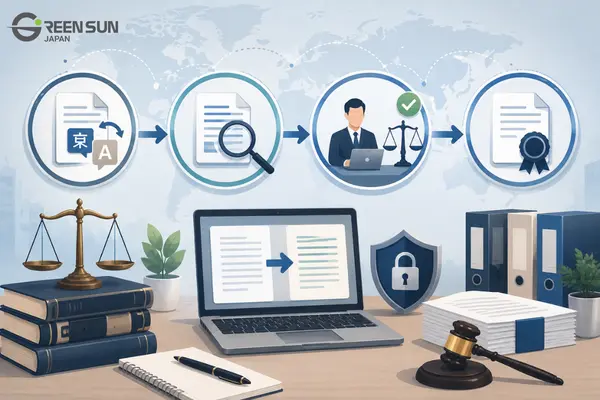
| Multi-Step QA Process | Documented workflow: specialist translation ➔ independent bilingual revision ➔ final QA. Confirm separately whether review by qualified legal counsel is included. | Helps detect errors in terminology, figures, defined terms, cross-references, and formatting. |
| Data Confidentiality (NDA) | Enforceable written confidentiality commitments and willingness to sign non-disclosure agreements (NDAs) before project commencement. | Protects proprietary business data, trade secrets, and partner information. |
| Specialized Legal Requirements | Confirm the receiving authority’s required format, accepted translator credentials, and any certification, notarization, or legalization requirements before ordering. | Reduces the risk of rejection or repeated requests for supplementary filings by government authorities. |
| Project Management & Client Support | Capacity to manage rush projects and offer post-delivery revision support. | Helps businesses meet tight negotiation timelines, filing deadlines, and partner milestones. |
Choosing a suitable translation partner can reduce rework and translation-related misunderstandings. Legal drafting, advice on enforceability, and acceptance by a receiving authority are separate matters that should be checked with the appropriate professional or institution.
5. Conclusion
For Indonesian legal documents, the goal is to preserve meaning, maintain consistent terminology, and deliver the format required for the intended use. Agree on the language pair, review scope, final source version, and submission requirements before work begins. Specialist translation and independent revision support clear communication; qualified legal counsel should address legal interpretation and enforceability.
· Understanding Honorifics and Formality in English-Korean Translation
· Essential Documents to Translate When Doing Business in Indonesia
· Key Differences Between Bahasa Melayu and Bahasa Indonesia
6. FAQs
Q1: How long does it typically take to translate an Indonesian legal document?
A: Turnaround time depends on document length, legal complexity, and specific formatting requirements. For time-sensitive matters, Green Sun Japan offers expedited translation options while maintaining its multi-tier quality control process prior to final delivery.
Q2: Can AI fully replace human legal translation?
A: AI may assist with a preliminary draft, but unreviewed output should not be relied on for signing or official submission. Use an approved tool with suitable data-handling terms, and require specialist bilingual review. If the draft needs extensive rewriting, human translation may be more efficient. Discuss the review scope before choosing machine translation post-editing (MTPE).
Q3: When is a certified translation required?
A: Requirements depend on the receiving authority and purpose. A translator’s accuracy declaration, a sworn translation by an authorized translator, notarization, and legalization are different requirements and are not automatically interchangeable. Obtain the authority’s current instructions and confirm that the provider can meet them before work starts.
Q4: How can a business evaluate the quality of a legal translation agency?
A: Key factors to evaluate include legal subject-matter expertise, a transparent quality assurance (QA) workflow, robust non-disclosure agreements (NDAs), experience with international transactions, and reliable post-delivery client support.
Need Indonesian Legal Translation Services?
Green Sun Japan delivers specialized Indonesian legal translation services for commercial contracts, compliance documentation, corporate filings, and international business transactions.
Why Choose Green Sun Japan?
- Legal Subject-Matter Expertise: Reviews terms, conditions, and context against the source document.
- Multi-Tier Quality Control: Helps ensure consistency, accuracy, and appropriate legal terminology across all deliverables.
- Confidentiality Arrangements: Agree on file handling, access, retention, and any non-disclosure agreement before sharing sensitive documents.
Contact Green Sun Japan today to consult with our experts and receive a legal translation solution tailored to your corporate needs.