

Malay Machine Translation Services: When Should You Use MTPE?
Machine translation can help businesses process large volumes of content more quickly, but not every type of document is suitable for automated output. For customer support content, product catalogs, knowledge bases, internal documents, or highly repetitive text, combining machine translation with human post-editing often provides a better balance of speed, cost, and quality.
Therefore, Malay machine translation services should be selected based on the intended use, level of risk, degree of repetition, and required quality of the final output. Depending on the type of content, businesses can choose raw machine translation, Malay MTPE, or fully human translation.
Key Points to Know
- Machine translation is most suitable for high-volume content with a clear structure and a high degree of repetition.
- Support content, product catalogs, knowledge bases, and internal documents are often suitable for Malay MTPE.
- Post-editing helps check meaning, terminology, numerical data, grammar, and consistency before publication.
- Creative, sensitive, or high-risk content usually requires greater human involvement.
- The same level of translation and review should not be applied to an entire project.
Contents
- 1. When Are Malaysian Machine Translation Services a Suitable Choice?
- 2. What Types of Content Are Suitable for MTPE?
- 3. Should You Choose Raw Machine Translation, MTPE, or Human Translation?
- 4. How Should the MTPE Process Be Controlled?
- 5. How Can You Tell Whether a Project Is Suitable for MTPE?
- 6. Conclusion
- 7. Frequently Asked Questions

1. When Are Malaysian Machine Translation Services a Suitable Choice?
Machine translation is most effective when businesses need to process large volumes of content within a short period and most of the text follows a stable, consistent structure.
For example, a support center may have thousands of help articles, frequently asked questions, and troubleshooting materials. In this case, Malay machine translation can be used to generate an initial draft, after which a human post-editor reviews the necessary sections before the content is published.
Suitable content typically consists of clear sentences, limited creative elements, highly repetitive structures, and terminology that can be standardized. Its main purpose is usually to communicate information rather than create emotion or express a strong brand voice.
By contrast, content that relies heavily on implied meaning, creativity, or subtle wording usually requires deeper human involvement.
Therefore, the important question is not simply, “Can machine translation be used?” but rather, “Where will this content be used, and what level of quality does it need to achieve?”
If a document is intended only for internal reference, the required level of refinement may be much lower than that of a public-facing support page.
· A Practical Guide to Translating Business Contracts in Malaysia
2. What Types of Content Are Suitable for MTPE?
Not every document requires the same level of processing. Classifying content before translation helps businesses determine which parts can be automated and which parts require greater human involvement.
Customer support content, such as help articles, FAQs, troubleshooting content, or product usage instructions, is often suitable for Malay MTPE. During review, particular attention should be paid to button names, interface terminology, error messages, and the sequence of steps so that the content remains consistent with the actual product.
Product catalogs are also a suitable use case because they often contain many repetitive fields, such as names, sizes, colors, materials, and technical specifications. Machine translation can quickly process structured content, while the post-editor focuses on numerical data, units, product attributes, and descriptions that could easily cause misunderstandings.
Knowledge bases often include help articles, feature explanations, and frequently asked questions. This type of content is suitable for MTPE because the materials generally follow similar structures and are updated frequently. If a business maintains a terminology glossary and translation memory, consistency across multiple articles can also be maintained more easily.
Internal content, such as operating instructions, system usage documentation, training materials, or internal announcements, may be suitable for Malaysian machine translation when the main objective is to communicate information. However, content related to safety, policies, or employee rights and benefits still requires more careful review.
In addition, highly repetitive text, such as product specifications, transactional email templates, system notifications, feature descriptions, or template-based content, can make effective use of Bahasa Melayu machine translation. The clearer and more consistent the source content is, the easier it becomes to control the quality of the output.
3. Should You Choose Raw Machine Translation, MTPE, or Human Translation?
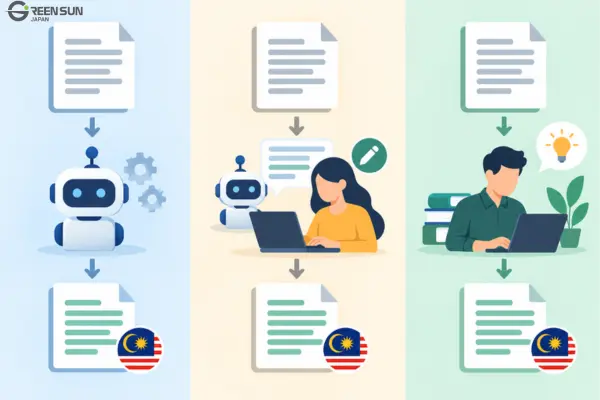
Businesses do not necessarily need to apply a single translation method to all content. Each level of processing is suited to a different need.
| Method | How It Works | Suitable Content | Required Level of Review |
|---|---|---|---|
| Raw machine translation | Uses automated output directly | Quick-reference content, internal content, low-risk materials | Low |
| Machine translation + post-editing | Machine translation generates a draft, which is then reviewed and edited by a human | Support content, product catalogs, knowledge bases, internal content | Medium to high |
| Human translation | A human translator handles the entire translation, which may be followed by an additional proofreading or review step | Creative, sensitive, or high-quality content | High |
Raw machine translation is suitable when the goal is simply to understand the content quickly and the translation will not be used directly for customers. However, the output may still contain terminology errors, grammatical issues, or unnatural wording.
Machine translation combined with post-editing is often more suitable for high-volume projects. The system generates an initial draft, after which the post-editor corrects errors in meaning, terminology, numerical data, consistency, and wording according to the intended use. This approach is commonly used in Malay MTPE workflows.
Human translation is more suitable for creative, sensitive, or high-impact content where translation errors could have serious consequences, such as brand content, marketing campaigns, important legal documents, high-risk medical materials, or content that requires extensive cultural adaptation.
In many projects, the most effective approach is to combine different methods. Highly repetitive sections can use MTPE, while content that requires creativity or tighter quality control can be assigned to human translators.
4. How Should the MTPE Process Be Controlled?
Effective MTPE is not simply a matter of putting content into a machine translation tool and then editing the wording. The quality of the final output depends on how the content is prepared, how terminology is managed, and how thoroughly the translation is reviewed after machine translation.
4.1. Content and Terminology Preparation
Before translation begins, the target audience, intended use, and required quality level should be clearly identified. The source content should also be written clearly, with ambiguous sentences minimized and product names, feature names, and specialized terminology used consistently.
For projects involving multiple files, terminology glossaries and translation memories help maintain consistent usage across different pieces of content and reduce the amount of editing required later.
4.2. Machine Translation and Post-Editing
After the content has been classified, the machine translation system generates an initial draft for the sections considered suitable. The post-editor then compares the machine-translated output with the source content and corrects errors related to meaning, terminology, numerical data, units, product names, user interface elements, and wording.
The required level of editing depends on the intended use. Public-facing customer content generally requires a higher level of refinement than materials intended only for internal reference. This distinction is particularly important when planning a Malay MTPE workflow.
4.3. Quality Control and Final Output
After post-editing, terminology, numerical data, untranslated content, and consistency across files should be reviewed again.
For catalogs, knowledge bases, or content published on websites, applications, or customer support systems, the final displayed version should also be checked for formatting errors, truncated text, or content placed in the wrong position.
5. How Can You Tell Whether a Project Is Suitable for MTPE?
Checklist for Assessing MTPE Suitability
- Is the content volume large?
MTPE is generally more suitable when there are many pages, products, or content segments to process. For very short documents, the time-saving benefit may be limited. - Is the content highly repetitive?
Catalogs, FAQs, knowledge bases, system notifications, and template-based content are often more suitable because their structures and terminology tend to remain relatively stable. - Is the source content clear and consistent?
The clearer the source sentences are, the fewer ambiguities they contain, and the more consistently terminology is used, the easier the machine-translated output is to post-edit. - Would a translation error have serious consequences?
Low- or medium-risk content is generally more suitable for MTPE. Content that could have significant consequences if translated incorrectly requires a higher level of review or should be moved to a workflow with deeper human involvement. - Does the content require creativity or a strong brand voice?
If the objective is to persuade, create emotion, or require extensive cultural adaptation, machine translation is usually not the optimal choice for the entire content set. - Is there a terminology glossary or translation memory available?
For long-term projects, these resources help reduce terminology inconsistencies and improve consistency across multiple files or update cycles.
If most of the answers point toward large content volumes, repetitive structures, manageable risk, and clear source content, Malay MTPE is generally a suitable choice. If the content is creative, sensitive, or could have serious consequences if translated incorrectly, businesses should increase the required level of review or move to a workflow with deeper human involvement.
6. Conclusion
Machine translation does not completely replace human translators, but it can become an effective part of the localization workflow when applied to the right types of content.
Customer support content, product catalogs, knowledge bases, internal documents, and repetitive text are often suitable for a Malay MTPE workflow. By contrast, creative, sensitive, or high-risk content generally requires greater human involvement.
The value of Malaysian machine translation services lies in correctly identifying which content can be automated, determining the appropriate level of post-editing, and recognizing which parts should still be handled entirely by human translators.
7. Frequently Asked Questions
Q1. What is MTPE?
MTPE is the process of post-editing a translation generated by a machine translation system. The post-editor reviews and corrects errors in meaning, terminology, grammar, consistency, and wording according to the requirements of the project.
Q2. Can raw machine translation be used directly?
Yes, for low-risk content or when the goal is simply to understand information quickly. Public-facing content or content that may influence customer actions should generally be reviewed before use.
Q3. What types of content are most suitable for Malay MTPE?
Support content, FAQs, product catalogs, knowledge bases, internal instructions, and text with repetitive structures are generally among the most suitable content types.
Q4. Is MTPE always cheaper than human translation?
No. MTPE provides the clearest benefits when the content volume is large enough and the machine translation output is of suitable quality. If the post-editor has to revise almost the entire translation, the time and cost advantages will be reduced.
Q5. Does post-editing need to be performed by a native speaker?
For content intended for end users, it is advisable to prioritize someone with strong language proficiency and an understanding of the target market. Specialized content also requires a post-editor who understands the relevant terminology.
Q6. When should MTPE not be used?
MTPE is generally not the optimal choice for content that requires a high level of creativity, a strong brand voice, extensive cultural adaptation, or content where translation errors could have serious consequences. In such cases, the required level of review should be increased, or a human translation and editing workflow should be used.

For large-scale projects with highly repetitive content, choosing the right approach among machine translation, MTPE, and human translation can help businesses optimize turnaround time while maintaining control over output quality. Green Sun Japansupports businesses in evaluating content types, determining the appropriate level of post-editing, and selecting a workflow suited to each project.
3 Advantages of Choosing Green Sun Japan
Content classification based on MTPE suitability:
Support in identifying which content can use machine translation, which content requires post-editing, and which content should be handled entirely by human translators.
Terminology and consistency management:
Support for terminology glossaries, translation memories, and approved language usage for projects involving multiple files or frequent updates.
Support for large-scale content projects:
Suitable for content categories such as customer support materials, product catalogs, knowledge bases, and highly repetitive text.
Contact Green Sun Japanfor a consultation on Malaysian machine translation services and an MTPE workflow suited to your content type, project scale, and quality requirements.